
Best Ecommerce Platforms for Canadian Businesses: How to Choose the Right One
Selling online in Canada isn’t just growing; it’s become a core part of how businesses succeed. Ecommerce now makes up 14.5% of total retail sales, and Canadians are spending over $3 billion CAD online every month. That kind of demand creates huge opportunity, but it also means more competition and higher expectations from customers.
Choosing the right ecommerce platform is one of the first, and most important, decisions you’ll make when building an online business. It’s not just about launching a website. It’s about choosing the system that will shape how you sell, manage orders, market your products, and grow over time.
With so many options available, it’s easy to get stuck comparing feature lists without thinking about what actually fits your business. Many platforms look similar at a glance, but once you start using them, the differences become much more obvious. Some are easier to manage day to day, some are better for scaling, and some become more expensive than expected once you add the tools you really need.
The truth is, there isn’t one universal “best” ecommerce platform. The right choice depends on what you sell, how you like to work, how much flexibility you need, and where you want your business to be a year from now. In this guide, we’ll break down the best ecommerce platforms by category so you can choose with more confidence and less guesswork.
What Makes a Great Ecommerce Platform?
At its core, an ecommerce platform is the engine behind your online store. It affects everything from your website design and checkout experience to inventory tracking, payment processing, shipping, and customer communication. While most platforms cover the basics, the way they deliver those basics can be very different.
A strong platform should make it easy to build and manage your storefront, accept payments securely, keep inventory organized, and connect with the tools you already use for shipping, accounting, marketing, and customer support. Those are the essentials that keep an online business running smoothly.

Best Ecommerce Platforms for Small Businesses
For small businesses, the priority is usually simplicity, speed, and efficiency. You want a platform that helps you launch quickly, manage your store without a steep learning curve, and grow without needing to rebuild everything later. Below are some of our favourite picks to get your small business online.
| Platform | Monthly Starting Price (CAD) | Best For | Key Strength |
|---|---|---|---|
| Shopify | ~$37 | Scaling SMBs | All-in-one + apps |
| Wix | ~$33 | Beginners | Ease of use |
| Square Space | ~$21 | Creatives | Design |
| Square Online | Free | Retail + POS | Omni channel |
| Woo Commerce | Free | Custom builds | Flexibility |
Shopify
Shopify is one of the most popular ecommerce platforms for small businesses because it brings almost everything into one place. Hosting, security, payment processing, themes, and store management are all wrapped into a streamlined system that is easy to get started with. For many business owners, that simplicity is the biggest advantage. You can spend less time managing the technical side of your site and more time focusing on products, customers, and growth.
It’s also a strong option for businesses that want room to expand. Shopify works well for brands that start small but expect to add more products, more sales channels, or more operational complexity over time. Its app ecosystem gives you access to tools for reviews, subscriptions, email marketing, shipping, and more. The main thing to watch is cost. While Shopify starts at around $37/month CAD, many stores end up paying more once they add apps, premium themes, or advanced functionality.
What makes Shopify especially appealing is how balanced it is. It is user-friendly without feeling too limited, and scalable without being overly technical. That said, some customizations require apps or developer support, so it’s best for businesses that want an all-in-one platform more than complete backend freedom.
Pros:
- Easy to launch and scale
- Strong app ecosystem
- Reliable performance
Cons:
- App costs add up
- Limited customization without apps
Wix
Wix is built for beginners who want to launch quickly and keep the setup process simple. Its drag-and-drop builder is easy to understand, which makes it appealing for business owners creating their first online store. If design flexibility matters to you, Wix gives you a lot of visual control without requiring technical knowledge.
For smaller catalogues and straightforward businesses, Wix can be a very practical choice. It works well for local brands, service-based businesses, side hustles, and smaller product lines that do not need deep operational complexity. The platform also makes it easy to build out content pages, galleries, and basic store functionality in one place. Starting at around $33/month CAD for the functionality to accept payments, it can feel more accessible than some larger ecommerce-focused platforms.
Where Wix tends to be less ideal is long-term scalability. As your store grows, you may find the ecosystem, integrations, and advanced ecommerce tools more limited than what platforms like Shopify or BigCommerce offer. Still, for businesses that want ease of use first, Wix is often one of the smoothest ways to get online.
Pros:
- Very beginner-friendly
- Strong design control
- Quick setup
Cons:
- Limited scalability
- Smaller integration ecosystem
Squarespace
Squarespace is a strong fit for businesses that care deeply about branding, visual presentation, and storytelling. It is especially popular with creative entrepreneurs, boutique brands, photographers, designers, and product-based businesses that rely on polished presentation. If your website needs to feel like an extension of your brand, Squarespace does a very good job of combining content and commerce.
One of its biggest strengths is that it feels cohesive. Instead of patching together multiple tools, you can manage your site, blog, product pages, and checkout experience in one clean environment. That makes it easier to create a consistent customer experience from homepage to purchase. Pricing typically starts around $21/month CAD, which makes it affordable for businesses that want a design-forward platform.
The trade-off is that Squarespace is not usually the best choice for large or operationally complex stores. If you have extensive inventory, complicated product options, or advanced ecommerce workflows, you may eventually outgrow it. But for businesses where strong design and simple selling matter most, it can be an excellent option.
Pros:
- Beautiful templates
- All-in-one simplicity
- Strong content integration
Cons:
- Limited advanced features
- Not ideal for large stores
Square Online
Square Online is a natural choice for businesses already using Square for in-person payments. It connects your online store with your point-of-sale system, helping keep product listings, sales, and inventory in sync. For retailers, restaurants, and service-based businesses selling both online and offline, that connection can make daily operations much easier.
One of the biggest reasons businesses choose Square Online is accessibility. There is a free plan available, and paid plans typically range up to around $99/month CAD, depending on the features you need. That makes it attractive for newer businesses that want a lower-cost way to start selling online without investing heavily up front. It is especially useful if your online store is an extension of an existing brick-and-mortar setup.
The limitation is depth. Square Online works well for straightforward ecommerce, but it does not offer the same flexibility or advanced ecosystem as larger platforms built primarily for online-first growth. Still, for businesses that want omnichannel convenience and a simple learning curve, it is a very practical solution.
Pros:
- Free plan available
- Seamless POS integration
- Easy setup
Cons:
- Limited advanced ecommerce features
- Fewer integrations
WooCommerce
WooCommerce is a very different kind of platform from the all-in-one options above. Because it runs on WordPress, it gives you much more control over how your store looks and functions. For businesses that want custom features, unique design flexibility, or direct control over their website infrastructure, that can be a major advantage.
It is also appealing from a cost perspective because the plugin itself is free, though real-world costs still add up. Hosting, premium plugins, security tools, development support, and maintenance can easily bring the monthly cost into the $20 to $100+ CAD range, depending on how simple or customized your setup is. In other words, WooCommerce can be cost-effective, but it is rarely “free” once your store is fully running.
WooCommerce tends to work best for businesses that are comfortable with WordPress or have access to technical help. It offers impressive flexibility, but that flexibility comes with more responsibility. You are in charge of updates, performance, security, and the overall setup. If you want full control and do not mind a more hands-on approach, WooCommerce can be a powerful option.
Pros:
- Highly customizable
- No platform fees
- Flexible integrations
Cons:
- Requires technical setup
- Ongoing maintenance
Best Ecommerce Platforms for Clothing & Retail Brands
Retail businesses usually need more than a basic storefront. Product variants, inventory tracking, merchandising, and multichannel selling all matter more when you’re dealing with multiple SKUs, seasonal collections, or in-store and online sales at the same time.
| Platform | Starting Price (Monthly CAD) | Best For | Strength |
|---|---|---|---|
| Shopify | $37/Month CAD | Retail brands | Omni channel selling |
| Centra | Price by Quote | Fashion brands | Global scaling |
| Presta Shop | Free | Custom retail | Flexibility |
| AbanteCart | Free | Small retailers | Light weight |
| Big Commerce | Price by Quote | Scaling retail | Built-in features |
Shopify
For clothing and retail brands, Shopify stands out because it handles product variants, inventory, and multichannel selling very well. If you sell items in different sizes, colours, or styles, Shopify makes it relatively easy to organize those options and create a shopping experience that feels smooth for customers.
It is also a strong choice for brands selling across multiple channels. You can connect online sales with marketplaces, social commerce, and in some cases, physical retail operations. That makes Shopify attractive for growing retail businesses that want one central system for products and orders. Pricing still starts around $37/month CAD, but retail brands often budget for additional apps to support reviews, upselling, returns, or advanced merchandising.
The reason Shopify remains so popular in retail is that it balances usability with growth potential. It is approachable enough for smaller brands but capable enough for more established ones. The main drawback is that some advanced functionality depends on paid add-ons, so your monthly cost can rise as your store becomes more sophisticated.
Pros:
- Handles sizes and variants well
- Strong retail integrations
- Easy to scale
Cons:
- App dependency
- Checkout limitations on lower plans
Centra
Centra is built specifically for fashion and apparel brands, which gives it a more focused feel than general-purpose ecommerce platforms. Instead of trying to serve every kind of business, it is designed around the needs of brands managing collections, merchandising, international pricing, and wholesale or multi-market sales.
That specialization is what makes it attractive for established fashion businesses. If you are selling across regions, currencies, or customer segments, Centra offers tools that can help manage that complexity more effectively than many standard small business platforms. It is especially relevant for brands with ambitious growth plans or more advanced operational needs.
The trade-off is accessibility. Centra is not usually positioned for beginners or very small stores, and pricing is generally considered enterprise-level, which means it will be significantly higher than entry-level platforms like Shopify or Wix. For fashion brands that need those built-in capabilities, it can be a strong fit. For everyone else, it may feel too specialized and too expensive.
Pros:
- Apparel-focused features
- Global pricing control
- Strong merchandising
Cons:
- Enterprise pricing
- Not beginner-friendly
PrestaShop
PrestaShop is an open-source platform that appeals to retailers who want flexibility and customization without being tied to a hosted system. It gives merchants more control over the structure and functionality of their store, which can be valuable if your retail setup has unique requirements.
Because the software itself does not come with a traditional licensing fee, it can look cost-effective at first. But in practice, your costs will vary depending on hosting, modules, development work, and maintenance. For many businesses, that means a realistic cost range can shift significantly over time rather than staying fixed like a standard monthly subscription.
PrestaShop makes the most sense for retail businesses that want customization and either have technical resources in-house or are prepared to work with developers. It offers freedom, but it is not the easiest route for teams that want fast, simple store management. If you want control more than convenience, it is worth considering.
Pros:
- Fully customizable
- No licensing cost
Cons:
- Requires technical skills
- Variable costs
AbanteCart
AbanteCart is a lighter-weight option for smaller retail businesses that want a simple, customizable ecommerce setup without the size or complexity of larger platforms. It is often appealing to businesses looking for an alternative to more mainstream solutions.
One of its advantages is cost. The platform itself is free to use, which makes it attractive for budget-conscious retailers. That said, as with other open-source tools, the actual cost depends on hosting, development, and any extensions you choose to add. So while the entry price is low, the total investment depends on how far you want to take it.
AbanteCart can work well for smaller operations with straightforward needs, but its ecosystem and support network are more limited than what you will find with larger platforms. That does not make it a bad option; it just means it is better suited to businesses that value simplicity and cost control over a large marketplace of integrations and services.
Pros:
- Free and customizable
- Simple structure
Cons:
- Limited ecosystem
- Smaller support network
BigCommerce
BigCommerce is a strong platform for retail brands that are scaling and want more built-in functionality from the start. Compared with platforms that rely heavily on add-ons, BigCommerce includes a broader set of native ecommerce features, which can reduce the number of third-party apps you need to manage.
That can be especially appealing for retail businesses with larger catalogues or more complex selling needs. BigCommerce supports growth well, and many merchants like that they can access advanced functionality without piecing together as many separate tools. Pricing generally starts in a similar range to other major ecommerce platforms and increases with plan level and business needs.
The platform can feel a little less intuitive at first than simpler entry-level options, so there may be more of a learning curve during setup. But for businesses that want stronger built-in capabilities and less reliance on extra apps, BigCommerce is often a smart middle ground between usability and depth.
Pros:
- Less reliance on apps
- Scales well
Cons:
- Slight learning curve
Best Ecommerce Platforms for Digital Products
Digital product businesses have different priorities from physical retailers. Instead of inventory and shipping, they care more about secure delivery, subscriptions, checkout simplicity, and creating a smooth customer experience for downloads or memberships.
| Platform | Starting Price (Monthly CAD) | Best For | Strength |
|---|---|---|---|
| Square space | ~$21 | Creators | Content + commerce |
| Payhip | Free | Downloads | Secure delivery |
| Ecwid | ~$7 | Flexibility | Add-on ecommerce |
| SureCart | Free | Subscription | Checkout + billing |
Squarespace
Squarespace is a strong option for creators who want to combine content, branding, and digital sales in one polished experience. If you sell eBooks, templates, courses, guides, or other downloadable products, it gives you a clean way to present your offer without making the site feel overly technical.
What makes it appealing is the balance between simplicity and design. You can create landing pages, blog content, brand-driven product pages, and a checkout flow within the same platform. For creators building an audience and selling directly from their site, that can feel much more natural than using a more operations-heavy ecommerce platform.
Squarespace is best when the business model is relatively straightforward. If you need more advanced digital delivery tools, complex automation, or a highly customized membership setup, you may need something more specialized. But for creators who want a professional storefront without a steep learning curve, it is a very solid choice.
Pros:
- Simple setup
- Strong design
Cons:
- Limited advanced tools
Payhip
Payhip is focused on secure digital delivery, which makes it attractive for businesses that primarily sell downloadable products. Rather than trying to be everything at once, it concentrates on making digital fulfillment simple, organized, and secure.
That specialization can be a real advantage if your biggest priority is making sure customers receive purchased files smoothly and reliably. For a business built around digital downloads, that focus can remove a lot of unnecessary complexity. Pricing will vary by plan and usage, but it is important to account for the total cost of secure delivery features rather than just the base offer.
The trade-off is flexibility. Because it is more specialized, it may not offer the same broad site-building or ecosystem benefits as a full ecommerce platform. That means it works best when digital delivery is the core need, not when you are trying to build a large, multi-layered commerce operation around it.
Pros:
- Built for downloads
- Simple workflow
Cons:
- Limited flexibility
Ecwid
Ecwid is a useful option for businesses that already have a website and want to add ecommerce functionality without rebuilding everything. Instead of starting from scratch, you can plug it into an existing site and begin selling products, including digital products, with relatively little friction.
That makes it especially appealing for smaller brands, creators, and businesses testing online sales. It is lightweight, flexible, and generally affordable compared with more full-scale platforms. Its pricing varies by plan, with entry-level options aimed at keeping costs accessible for businesses that do not need an extensive feature set right away.
Where Ecwid can become limiting is scale. It works well as an add-on commerce solution, but it may not be the best fit for businesses expecting a large or highly customized ecommerce operation over time. For simplicity and lower upfront commitment, though, it is often a practical choice.
Pros:
- Lightweight
- Affordable
Cons:
- Limited scalability
SureCart
SureCart is designed with checkout, subscriptions, and recurring billing in mind, which makes it especially relevant for digital sellers offering memberships, software, services, or subscription-based products. If recurring revenue is central to your business model, that focus can be a major benefit.
One of its biggest strengths is the checkout experience. A faster, cleaner checkout can have a direct impact on conversions, especially for digital products where buyers often expect a quick path from interest to purchase. Pricing depends on the version and setup you choose, so businesses should look beyond the starting cost and consider what they need for billing, integrations, and long-term usage.
Because it has a smaller ecosystem than some major platforms, it may not feel as expansive or established for every use case. Still, for businesses centered on digital sales and subscriptions, SureCart can be a very compelling option.
Pros:
- Strong recurring billing
- Fast checkout
Cons:
- Smaller ecosystem

Best Ecommerce Platforms for B2B Businesses
B2B ecommerce usually requires more than a standard online store. Custom pricing, account-based purchasing, bulk orders, approvals, and workflow automation all become more important when you are selling to other businesses.
| Platform | Price (Monthly CAD) | Best For | Strength |
|---|---|---|---|
| Shopify Plus | $3,400 | Enterprise | Scalability |
| Big Commerce | Price per quote | B2B features | Built-in tools |
| Adobe Commerce | Price per quote | Custom builds | Flexibility |
| Oro Commerce | Price per quote | Wholesale | Workflow automation |
Shopify Plus
Shopify Plus is the enterprise version of Shopify and is built for larger businesses that need more customization, more automation, and more support at scale. It takes the familiar Shopify experience and adds greater flexibility for brands managing higher order volume or more complex operations.
For B2B businesses, Shopify Plus can be useful when you want enterprise reliability without moving into a fully custom platform environment. It supports more advanced workflows and can help create tailored buying experiences for different customer segments. The big consideration, of course, is price. Shopify Plus is significantly more expensive than standard Shopify plans and is typically priced at an enterprise level.
That means it makes the most sense for businesses that have already outgrown entry-level tools and need more robust infrastructure. If your B2B operation is still fairly simple, it may be more platform than you need. But if you need scale and a strong ecosystem, Shopify Plus is a serious contender.
Pros:
- Scalable
- Custom experiences
Cons:
- High cost
BigCommerce
BigCommerce is often a strong B2B option because it includes more built-in functionality than many competing platforms. For businesses that want native support for more advanced selling requirements, this can reduce the need to bolt on multiple apps or custom solutions.
It is particularly appealing for businesses that want to grow without losing operational control. The platform supports more complex product catalogues and can work well for companies serving both B2C and B2B audiences from the same broader ecosystem. Pricing depends on the plan and business needs, but it is generally positioned above entry-level tools while still being more accessible than some enterprise-heavy systems.
The main challenge is usability. Compared with simpler small-business platforms, BigCommerce can feel a bit more involved on the backend. But for B2B merchants that value built-in tools and long-term scalability, that extra complexity may be worthwhile.
Pros:
- Native B2B tools
- Flexible
Cons:
- UI complexity
Adobe Commerce
Adobe Commerce is a powerful option for larger B2B businesses with complex requirements and the resources to support a more advanced platform. It is highly customizable and capable of handling deep integrations, tailored workflows, and sophisticated ecommerce environments.
That level of control is its biggest advantage. If your business needs a platform built around very specific processes, Adobe Commerce can offer the flexibility to create that. Pricing is typically enterprise-level, and the total cost often includes development, implementation, maintenance, and ongoing support, so it is not a low-cost solution.
Because of that, Adobe Commerce is best suited to organizations with larger budgets, technical teams, and long-term ecommerce strategies. It can do a lot, but it also asks a lot in return. For the right business, that trade-off makes sense. For smaller teams, it is often more than necessary.
Pros:
- Full control
- Deep integrations
Cons:
- Complex
- Resource-heavy
OroCommerce
OroCommerce is built specifically for wholesale, distribution, and other B2B-focused operations. That specialization makes it different from platforms that primarily started in the DTC world and later added B2B features.
Its strength is workflow depth. For businesses managing account-based ordering, approvals, customer-specific pricing, and more involved purchasing processes, OroCommerce offers functionality that aligns more directly with how B2B companies actually operate. Pricing is generally positioned for mid-market to enterprise businesses rather than smaller companies, so cost should be evaluated with that in mind.
Because it is so B2B-specific, it is usually not the right fit for small businesses or brands with simple ecommerce needs. But for wholesalers and distributors that need software shaped around their operational reality, it can be a much better fit than a general-purpose platform.
Pros:
- B2B-focused features
- Workflow automation
Cons:
- Not for small businesses
Where Tabit Fits In
Tabit is not an ecommerce platform, but it can play an important supporting role for B2B ecommerce businesses. Rather than replacing your storefront, it complements it by offering buy now, pay later solutions that can make larger purchases more manageable for customers.
That can be especially useful in B2B environments where cash flow, order size, and payment flexibility directly affect buying behaviour. If your platform helps customers place orders but your payment options create friction, a solution like Tabit can help bridge that gap and improve the purchasing experience.
Best Ecommerce Platforms for Dropshipping & Flexible Models
Dropshipping businesses typically care most about automation, supplier integrations, and ease of product management. Since you are often coordinating with third-party suppliers, the platform needs to support smooth order flow and operational flexibility.
| Platform | Price (Monthly CAD) | Best For | Strength |
|---|---|---|---|
| Shopify | ~$37 | Drop shipping | Integrations |
| Woo Commerce | Free | Custom drop shipping | Flexibility |
| Wix | ~$33 | Beginners | Simplicity |
| Ecwid | ~$7 | Add-on | Flexibility |
Shopify
Shopify remains one of the most common choices for dropshipping because of its integration ecosystem. Many dropshipping tools and supplier apps are designed with Shopify in mind, which makes it easier to connect products, import listings, and automate parts of the workflow.
That ecosystem matters because dropshipping businesses often rely on operational speed and simplicity. If you can connect suppliers, manage products, and keep your storefront running without much technical overhead, you can focus more on marketing and customer acquisition.
For dropshipping businesses that want a smoother launch experience, Shopify is often the easiest entry point. It may not be the cheapest once all costs are added in, but the convenience and integrations are often what make it worthwhile.
Pros:
- Strong dropshipping integrations
- Easy to launch
- Beginner-friendly backend
Cons:
- App costs can grow quickly
- Less flexible without third-party tools
WooCommerce
WooCommerce appeals to dropshipping businesses that want more customization and control over the store setup. Because it runs on WordPress, you can create a highly tailored site and connect different tools depending on how you want the business to operate.
That flexibility can be a major advantage for merchants who want more ownership over the storefront and backend. Costs are also more variable than with a fixed subscription platform.
The downside is that WooCommerce requires more hands-on work. If you are comfortable managing plugins, updates, and integrations, it can be a powerful solution. If you want plug-and-play simplicity, it may feel like more effort than necessary.
Pros:
- Flexible setup
- Strong customization potential
- No platform fee
Cons:
- More technical upkeep
- Can become complex over time
Wix
Wix can work for beginner dropshippers who want to get a simple store online without a technical learning curve. Its visual editor and guided setup make it accessible, especially for first-time ecommerce business owners.
For straightforward dropshipping operations, that simplicity can be helpful. You can create a polished storefront and start testing products without committing to a highly technical platform.
Still, dropshipping businesses that scale aggressively may eventually outgrow Wix. It is best suited to smaller operations or early-stage testing rather than highly complex systems with lots of supplier and automation requirements.
Pros:
- Easy to use
- Good for beginners
- Fast store setup
Cons:
- Limited scalability
- Smaller app ecosystem
Ecwid
Ecwid is useful for flexible ecommerce models because it can be added to an existing website instead of forcing you to build a new one from scratch. For entrepreneurs experimenting with dropshipping or hybrid models, that can be a convenient way to test online sales with lower friction.
Its pricing is generally affordable, and it works well for businesses that want something lightweight rather than a full standalone ecommerce system. If you already have an audience, website, or content hub, Ecwid can help you add commerce without a major rebuild.
The challenge is that it is not always the best long-term solution for large-scale dropshipping growth. It shines as a flexible add-on, but not necessarily as the central engine for a highly complex ecommerce operation.
Pros:
- Easy to add to an existing site
- Affordable entry point
- Flexible setup
Cons:
- Less ideal for advanced scaling
- Fewer deep operational tools
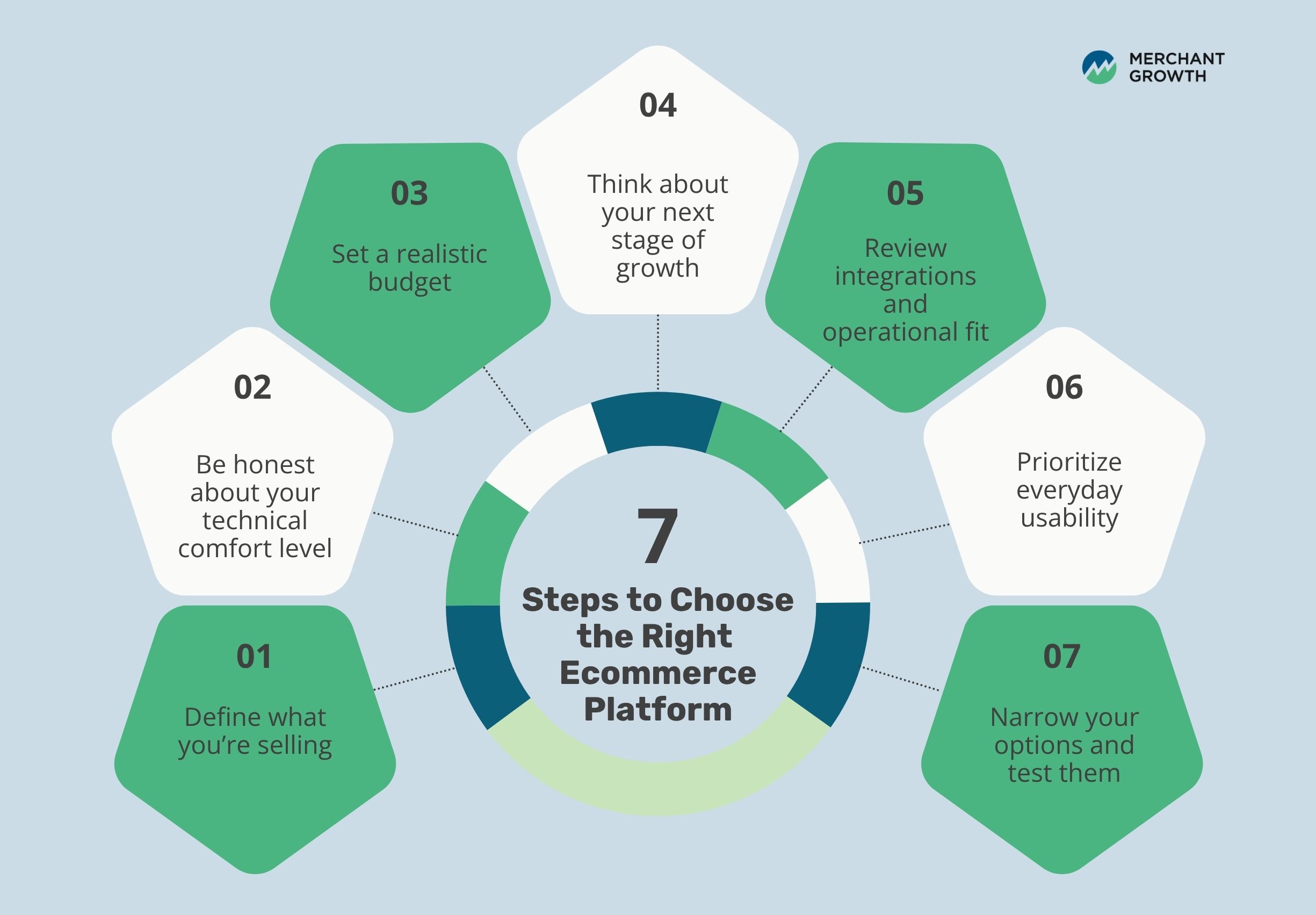
How to Choose the Right Ecommerce Platform
Choosing the right ecommerce platform gets easier when you break the decision into steps instead of trying to compare everything at once. The best platform is usually the one that matches your current needs, supports your next stage of growth, and does not create unnecessary complexity along the way.
Step 1: Define what you’re selling
Start with the basics: are you selling physical products, digital products, subscriptions, B2B services, or a mix of different models? A fashion brand with hundreds of SKUs needs something very different from a consultant selling digital downloads or a wholesaler managing custom account pricing.
When you’re clear on your business model first, it becomes much easier to filter out platforms that are not built for your kind of selling.
Step 2: Be honest about your technical comfort level
Some platforms are designed to be easy from day one, while others give you more control but require more setup and maintenance. If you do not want to deal with hosting, plugins, or troubleshooting, an all-in-one option will likely be a better fit.
On the other hand, if customization matters more than convenience and you have technical support available, a more flexible platform may be worth it.
Step 3: Set a realistic budget
Do not just compare headline pricing. Think about the total working cost of the platform, including apps, themes, payment processing, development help, and any tools you may need for marketing, subscriptions, or shipping.
A platform that looks cheaper upfront can become more expensive later, while a slightly higher monthly fee may actually save money if it includes more built-in functionality.
Step 4: Think about your next stage of growth
A platform should work for the business you have today, but it should also support where you want to go next. Consider whether you plan to expand your product line, sell internationally, add wholesale, connect to a retail store, or increase automation over time.
Choosing a platform that is too limited can create migration headaches later. Choosing one that is far too advanced can create unnecessary cost and complexity now.
Step 5: Review integrations and operational fit
Your ecommerce platform does not operate in isolation. It needs to work with payment processors, shipping providers, accounting tools, email marketing systems, POS software, and other key parts of your business.
Before deciding, make a list of the tools you already use, or know you will need soon, and check how well each platform connects with them.
Step 6: Prioritize everyday usability
It is easy to get distracted by advanced features, but the day-to-day experience matters just as much. Ask yourself how easy it is to add products, update inventory, process orders, and manage customer issues.
A platform that saves you time every day will often deliver more value than one with a long feature list that feels clunky to use.
Step 7: Narrow your options and test them
Once you’ve identified your priorities, narrow the list to two or three serious options. Explore demos, free trials, or backend previews where possible. Looking at the admin experience firsthand often tells you more than reading another feature comparison.
At that point, the decision usually becomes much clearer. You are not choosing the “perfect” platform. You are choosing the one that best fits your business right now, while still giving you room to grow.
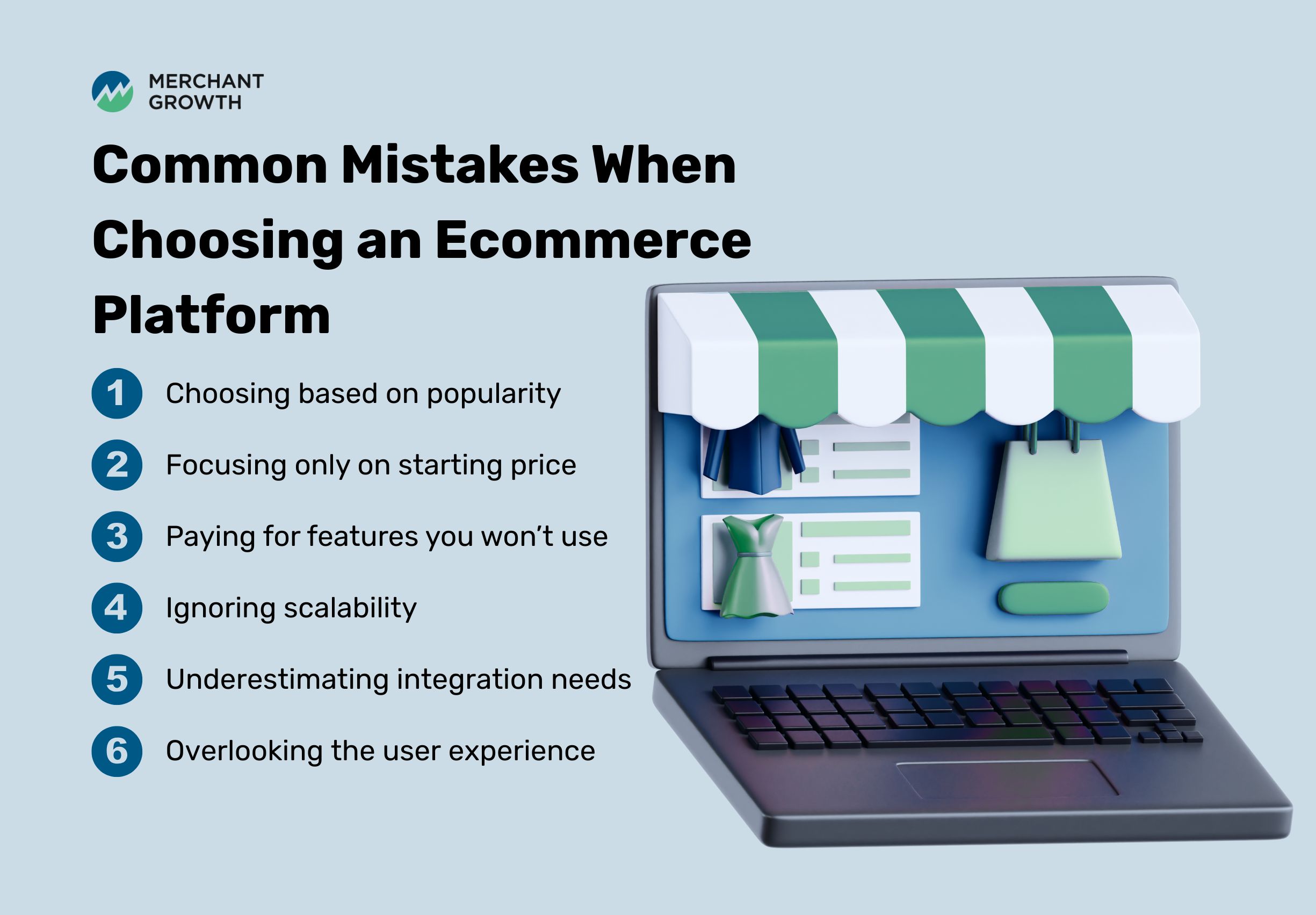
Common Mistakes When Choosing an Ecommerce Platform
Choosing an ecommerce platform can feel exciting at first, but it is also where many businesses make avoidable mistakes. It’s easy to get pulled toward the most popular option, the cheapest monthly plan, or the platform with the longest feature list. The problem is that those factors do not always reflect what your business needs.
Here are some of the most common mistakes to watch for:
- Choosing based on popularity instead of fit: A platform can be widely used and still be the wrong choice for your business model, team, or growth plans.
- Focusing only on starting price: Monthly subscription fees are only part of the picture. Apps, payment processing, themes, and development support can change the real cost significantly.
- Paying for features you won’t use: More features are not always better. If they add cost or complexity without solving a real problem, they can become a distraction.
- Ignoring scalability: A platform that works today may not work six or twelve months from now if your catalog, order volume, or sales channels expand.
- Underestimating integration needs: Your store needs to connect with the rest of your business. If key tools do not integrate properly, operations can become messy very quickly.
- Overlooking the day-to-day user experience: A platform might sound powerful on paper but still be frustrating to manage. Ease of use matters more than many businesses realize.
The good news is that these mistakes are avoidable. A little clarity upfront, about your business model, budget, workflows, and growth plans, can save you a lot of time, money, and frustration later. The goal is not to choose the platform with the most hype. It is to choose the one that will actually help your business run better.
How Merchant Growth Can Support Your Ecommerce Business
Choosing the right platform is an important first step, but it is only one part of building a successful ecommerce business. As your store grows, access to capital can become just as important as the technology behind it.
Merchant Growth provides flexible financing for Canadian businesses, which can help support inventory purchases, marketing campaigns, hiring, expansion, or other investments that help move the business forward.
The right ecommerce platform gives you the foundation to sell effectively. The right financial support gives you the ability to act on growth opportunities when they appear. Put those two pieces together, and you are in a much stronger position to build momentum, serve customers well, and grow with confidence.
The best ecommerce platform is the one that helps your business feel easier to run today, and more ready for tomorrow. If you choose with your real needs in mind, you will not just end up with a better website. You’ll build a stronger path for growth.