

Though we don't strive to be overly political or partisan here at the Merchant Advance blog, we would be remiss not to comment on the (seemingly interminable) run toward the next Canadian federal election, to be held in mid-October. In a landscape of changing economic conditions both domestically and internationally, Canadian small businesses and their owners are a major and highly vocal group reflecting the diverse needs of their communities. Small businesses represent close to 70 per cent of all private sector jobs and nearly eight million Canadians.

Major policy issues for small businesses include the direction of the Canadian Pension Plan (CPP), the rate of taxation for small and medium-sized firms, and the minimum wage standard - and, of course, general improvement to the well-being of the Canadian economy, which drives domestic and international interest in businesses and their products.
On a party-by-party basis, each of the major players in the coming election has taken a certain stand on the direction of many of these issues and others, including sustainability and technology development, that will be contributors to the small business landscape in Canada.
The Conservatives have pledged the following initiatives to support small business:
- A round of Canada-wide consultations on the topic of reducing bureaucratic red tape
- A 20 per cent reduction of the “red tape burden”
- A simplification of the tax calculation process for citizens who work from a home office.
While it appears that the Liberal Party has not created a comprehensive small business platform, Justin Trudeau made a point of critiquing the Conservative Party’s small business tax credit.
The Liberals do, however, plan to introduce several measures to support sustainable business and technology such as:
- Investing 200 million annually in sustainable technology and manufacturing in the natural resource sectors
- Investing 100 million in clean technology producers
- Working collaboratively with provinces, territories, universities and colleges to support new clean technology companies
The NDP’s Thomas Mulcair "Small businesses created the majority of private-sector jobs over the last decade in Canada, and it’s time to make them a priority.” The NDP plan to introduce the following measures:
- Implementing innovation tax to encourage investment in new equipment in the manufacturing sectors
- Lowering the tax rate from 11 to 9 per cent for small businesses
- Extending the capital cost allowance for machinery and manufacturing equipment.
The Greens, lead by Elizabeth May (who advocated for the technology sector in this month’s candidate debate), plan to:
- Establish a federally-funded Green Venture Capital Fund to support viable local businesses
- Reduce the paperwork burden on small businesses by eliminating red tape
- Ensure that small businesses are exempt from any increases to the corporate tax rate
At the blog, our main point of view on this is that the election presents an invaluable chance to make your voice heard as a small business owner, and advocate for the principles and rights that you believe will strengthen your business and your community. Abstaining from participation in voting effectively stalls the progress that so many of us desire, regardless of the party under whose direction it may be carried out. So, go out there and vote!
Your small business may focus of the day when it will be recognized as a local institution: a place where those in the know go to find what they need, with the history and the legacy of service that will attract customers both old and new. There's a perceived degree of commitment required in the pursuit of this goal: success achieved through finding your niche and narrowing it, and sticking to your guns.
While there is enormous value in that approach, small businesses must realize that, as in the current economic climate, versatility and adaptability are increasingly important in keeping ahead of changing consumer attitudes, economic conditions, and local/regional developments. As David Bowie put it: "Changes, turn and face the strange."

Established small businesses face competition both from large-scale alternatives and newer, buzz-worthy startups in the same market. Traditionally, the value added by personal and community-focused customer service has helped small business owners stand out among their peers. Diversity is the second, and often more overlooked, asset that many small businesses can leverage to succeed. It should be built from your existing strengths: if, for example, your business has longstanding expertise in sales of a a particular product, consider the value of adding repair services to your model once the market for new goods has been saturated. Maintain awareness of new ways to approach old problems - ones that might be more cost-effective, efficient or attractive. Don't fear the process of reworking, re-establishing, redesigning, or renovating: ensure that your most loyal customers and advocates come along for the ride during these transitions, and new audiences will be opened to you.
Much like the many faces and personalities of the aforementioned Bowie, a small business will find itself driving and reacting to new creative impulses that ought to be explored in order to stay competitive in a volatile marketplace. It may involve shifts in practice, personnel and personality: take care not to alienate your core customer base, but stay connected to the market as it changes around you in order to find continued success.

With so many options for small business loan funding - and even more blogs and commentators analyzing those options - out there, some information about the way small business lending works is bound to be muddled in the grand scheme of things. Some of this information will inevitably filter down to small business owners looking for solutions to their cash flow dilemmas, and it often convinces businesses that they might not be eligible even when, chances are, they could find funding through a merchant advance or small business loan product. Here are the top three pieces of misinformation about the small business loan marketplace that we've encountered - and how they should be corrected!
-
They Don't Work for New Businesses
This one is particularly tricky. Many business owners wonder whether their small business - be it a year old, three, or five - is simply not established enough to obtain funding or a business loan. Merchant Advance looks at businesses with as little as a year of experience in their market: we need to be able to see a credit history, but our assessment of the business goes beyond the calendrical proof of its financials. Which brings us to the second myth:
-
My Credit Score Is All That Matters to You
While your business' credit score does factor importantly into the assessment of eligibility for a small business loan or merchant advance, it's not all about algorithms. Financial technology has increased the efficiency and speed of approvals through automated processes, but the human element still has a deciding hand: even if your business has felt pressure on its credit score, you can still apply on the strength of your solid business planning, well-thought-out use of funds, and positive feedback from key associates like your suppliers and social media channels. And speaking of speed:
- Applying for a Small Business Loan Takes Too Long
Online applications processes have evolved to the point where getting approval for a merchant advance or small business loan can take as little as a week or even less. Our underwriters and admin staff are always getting better at identifying the key information that will allow us to get your application processed and start funding flowing to your accounts. As long as you help us out by sending a little bit of your business information in a timely manner, your funding can and will be on its way in time to cover shifts in your business cycle or unexpected emergencies.
With these myths busted, your small business can feel even more secure and confident that your funding needs can be addressed quickly and without disruption to your cash flow by either a merchant advance or small business loan.
It's that time again: coinciding with the first arrival of rain for many months here in Merchant Advance's home city of Vancouver, the end of August signals the transition between idyllic summer hours and the return, for young folks and higher education students alike, of the schoolday grind.

Small businesses generally concentrate on one or two peak periods that help define their fiscal year: for many, the winter holidays are a crucial moment that may determine the state of one's balance sheet throughout the year. The back-to-school period, often neglected in this regard, should be at the front of small business owners' minds in many sectors. A 2014 survey of American markets predicts that the average family will spend $669.28 this year outfitting young students for the return to classes. The average college student will spend $916.48.
Small businesses should also take note of the fact that back-to-school shopping is one of the few areas not to be dominated by e-commerce. Fewer than 20% of students and parents make half their back to school purchases online. This creates an opportunity for local, brick-and-mortar retailers. Local targeting will help your business reach the most interested audiences - and cut through the noise of big-box retail advertising designed to monopolize attention in the lead-up to September.
The transition to school days also inspires many consumers to begin tackling long-put-off lists of refurbishments, to-dos and tasks that may have gone by the wayside in the summer. This is the perfect moment to engage them with specifically tailored marketing efforts and promotions! In many parts of Canada, this means preparing for the winter months ahead: anticipate the needs of your market to best position yourself ahead of the game.
Going back to school is not just an opportunity for students: your small business can also set itself up to learn some valuable lessons in this important part of the calendar year!
Hold on to your hats: according to the Canadian Federation of Independent Business, small business confidence dropped in July to its lowest level in six years.
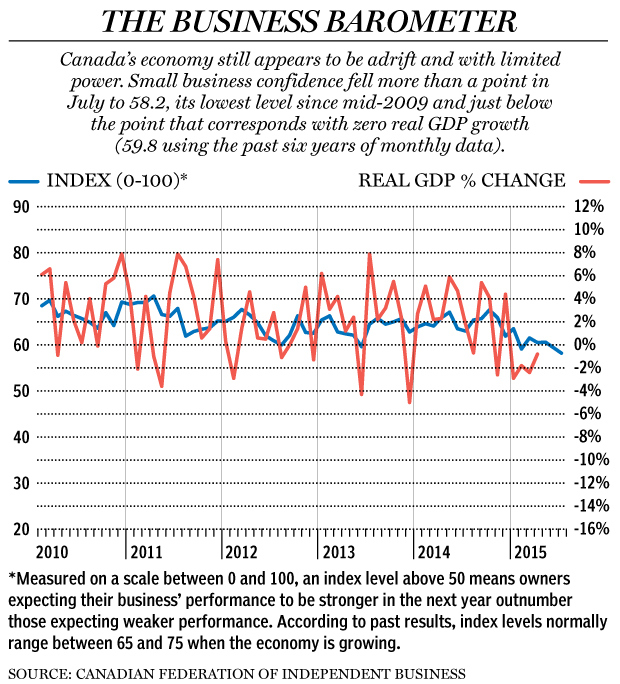
Small business confidence is now at a point just below the marker that indicates zero real GDP growth: July's score of 58.2 indicates that while a slim majority of business owners are showing optimism about their performance over the next year, broader economic indicators are more pessimistic in nature. Index levels normally range between 65 and 70 when the economy is growing at its potential.
Despite this sobering news, the words of the Hitchhiker's Guide to the Galaxy come to mind:
DON'T PANIC.
Small business confidence as calculated by the CFIB barometer is highly sector-dependent. Businesses in the resource sector for example, account for a major proportion of the score's decline in recent months. As economic effects trickle from sector to sector, they can be managed with specifically targeted plans made with situational foreknowledge that will help individual businesses weather any financial challenges.
Innovative small businesses in Canada can even find new opportunities during times of economic turbulence. For example, expensive equipment is often available at wholesale prices when the economy is slumping, and struggling corporations who are forced to exit the market leave more room for small businesses to fill the void.
Small businesses are uniquely positioned to take advantage of cost-saving measures that can have immediate and direct effects on day-to-day operations rather than requiring several business cycles to see meaningful improvement. Low-impact technological innovations and agile management practices allow small businesses, traditionally highly sensitive to variations in consumer demand and broader economic conditions, to balance more easily through the inevitably cyclical progression of macro boom and slowdown.
The financial technology sector and the availability of working capital and business loans during these periods must also be considered. As businesses feel the need to maintain operational stability, enabling access to capital in a fast and fair way will become increasingly important.
"The cloud" has been enshrined as one of the most important concepts of computing in the last decade - a model for enabling ubiquitous network access to a shared pool of configurable computing resources. This structure allows partners with limited ability to invest in the construction of full data centres and extensive network systems to access the benefits often previously afforded only to large corporations with tremendous technological capital.

According to cloud-computing provider Exact, users of online business software in the small business sector are seeing significant advantages in their cost-savings and productivity. Exact's research found that revenue growth increased by 25 percent and profits more than doubled compared to businesses that did not use the cloud.
Businesses identified security as the biggest reason for joining the Cloud, although participants also aimed to reduce technology and maintenance costs while easing mobile access to critical information. Other improvements that businesses cited included faster turnaround times for orders and RFPs, and more streamlined provision of customer service solutions.
Every small business has different needs, and cloud computing has evolved with scalability in mind. Small businesses could begin migrating to the cloud in ways as simple as signing up for Office 365 instead of purchasing a copy of the software for each of your work computers. Cloud-based collaboration tools also facilitate better project management and better workflow - at Merchant Advance, for example, we use the inexpensive cloud-based organizational tool Asana to manage tasks at a range of priority levels. Cloud solutions allow your business to get exceptional value for computing services as well as being able to avoid paying for what you don't need.
Finally, consider the increasing importance of data to the successful small business. Highly granular data collection will provide the hard evidence that your small business needs to change its policies or adopt new ones. It can help contextualize important decisions. Cloud computing is expertly designed to allow the collection and interpretation of such data, as well as to compare your metrics to a broader context.
The Canadian Intellectual Property Office (CIPO) defines intellectual property (IP) as creations of the mind: inventions, literary and artistic works, and symbols, names, images, and designs used in commerce.
 In other words, the identifying elements that clients and customers associate with your business and use to help drive sales and success. These elements - be they industrial or artistic or anything in between - are highly valuable, and may become the target of appropriation or theft for unscrupulous individuals looking to profit from the goodwill and recognition that your small business has built over time.
Select and consistently use your chosen brand together with its identifying symbol. This will give notice to others that the term is in use as a trademark, and over time common-law trademark rights will accrue.
The difference between registered and common-law trademark rights is that registered rights are deemed valid and enforceable across Canada, while common-law rights need to be proven and can only be enforced in an area where they are known. For example, if you do business only in Toronto, then you will not be able to enforce those rights in Vancouver.
Timing is also critical to a solid IP protection strategy: if you apply too soon, you may waste the cost of application fees for a patent if the idea cannot be proven sufficiently distinctive. Too late, and a competitor might beat your patent to the punch.
The ownership of all intellectual property should be clearly documented in writing with both employees and independent contractors. One item worth spending money on is clarifying the ownership of the intellectual property that your company creates.
Should your IP be violated the first course of action should be to consult a legal advisor or IP agent for advice. They will conduct a thorough investigation to determine whether infringement has taken place, that your IP paperwork is in order, and consider your probabilities of success should you take legal action.
Though small businesses are increasingly encouraged to take advantage of the highly cost-effective and reactive potential of social media and digital marketing, it is not to say that traditional means of advertising have gone the way of the dinosaur. One look at a range of local and specialty publications reveals that businesses across Canada are making the most of print media to reach niche market readers with a passion for products and services specific to their needs and interests.
What are some of the benefits of print advertising exposure for small businesses?

Specificity
Does your small business ply its trade in a niche market - handmade leather goods? Parts and repairs for British-made automobiles? You name it! Print outlets allow a high degree of specific targeting to interested audiences with an investment in these same niches. Magazines wishing to advertise to particular geographic, ethnic or demographic segments will likely be able to concentrate their efforts on readers with those identifying markers. This degree of specificity also allows small businesses to focus their advertising budget and avoid wasting money on non-regional targeting.
Legitimacy
Anyone can whip up a Facebook page and basic, good-looking website these days - including those individuals or groups with fraudulent or unscrupulous business principles. Advertising in print proves that your business has the stability needed to pass muster when it comes down to creating the appearance of professionalism and quality. This is especially the case for endorsements in industry-specific publications.
Creativity
In addition to creating a distinct visual identity for your business through a visual/graphic advertisement, magazine and other print media venues may offer the opportunity for written features or profiles of your small business, highlighting its products, services, qualities and place in the local community as well as any special initiatives (such as sustainability, charitable work or innovation) that you may be a part of.
Businesses may find it well worth the time and proportionally higher cost to advertise in print for these reasons if not many others. Though the digital frontier is expanding, it's not too late to consider the benefits of print advertising!
It may be something of a business faux-pas to be overly enthusiastic about a far-off event too early in the season (see: Christmas, Halloween, etc.) but there's one upcoming time of year that will definitely be beneficial to plan for in advance: Small Business Week 2015, taking place between October 18th and 24th this year.
Small Business Week was originally organized by BDC in recognition of the contributions and achievements of Canada’s entrepreneurs. Events held during the week bring entrepreneurs together at conferences, luncheons and trade fairs across the country where they have the opportunity to learn, network and enjoy themselves in the company of their peers
How will your community strive to celebrate and strengthen the business elements that compose it? In a week packed with information, it may be wise to plan ahead and find the thought leaders and experts whose contributions in a particular field will be most useful to your business. Can you use the week to roundtable about your financial strategy? Build organizational culture and team cohesion? Share ideas with fellow businesspeople in your region? Make a valuable networking connection? It's an inviting chance to put these resources together.
Of course, this week can also create opportunities for small businesses to stand out from the crowd in their markets by conducting their own events and promotions. Both online and in real-space, laying claim to your independent identity is more important than ever in our ever-more authenticity-focused commercial culture. We've blogged on what makes a stellar event before, in case you were wondering!