

Inventory financing can take many forms. Both using inventory as collateral to secure financing and leveraging financing to purchase inventory can be referred to as “inventory financing,” which can be a major point of confusion.
This article will explore various types of inventory financing options and explain their differences to help business owners figure out the best way to meet their company’s financing needs.
Inventory Financing: What is it?
If your business is in need of cash, inventory financing may be a good option. Inventory financing is when a company uses its inventory, instead of personal assets, as collateral for a loan. This can be in the form of a line of credit or a short-term business loan.
Inventory financing lenders allow businesses to free up cash that would otherwise be tied up in inventory. This can be helpful for businesses that are seasonal or have fluctuating inventory levels. Another advantage of this kind of asset-based financing, especially for companies with a limited business credit history, is that it can be easier to qualify for than other types of business loans, since the inventory serves as collateral.
Types of Inventory Financing
One common type of inventory financing is a merchant cash advance. With this type of financing, businesses commit a portion of their future sales in exchange for immediate funding, using those sales to pay off the amount borrowed. This can be a good option for businesses that need quick access to capital for purchasing inventory and supplementing their cash flow.
Another type of inventory financing is called accounts receivable financing. With this type of financing, businesses pledge part of their accounts receivable in exchange for a loan. This can be a good option for businesses that have difficulty qualifying for traditional business loans.
Inventory financing loans are a third type of inventory financing, one where businesses borrow money against the value of their inventory. This can be a good option for businesses with a lot of capital tied up in inventory on hand.
Inventory Financing from Merchant Growth
For many companies, inventory financing that leverages future cash flow is the best way to go about purchasing inventory. This type of financing is often used by businesses that have seasonal inventory needs or are experiencing rapid growth.
This form of inventory financing from Merchant Growth offers several advantages. Thanks to a lack of collateral requirements (meaning that the inventory does not serve as collateral), it is easy to apply for and quickly delivered, providing immediate working capital to make timely inventory purchases, take advantage of early payment discounts or other business opportunities, and the flexibility to repay the loan based on sales.
What’s the Best Way to Purchase Inventory?
The best way to finance inventory will be different for each business owner, as each type of business financing has its pros and cons. Here is how some of the more popular options compare:
Business Line of Credit
Instead of receiving a lump sum, you can purchase inventory and finance your company through a business credit line. This enables you to withdraw cash from a revolving credit line. The interest will only be charged on the amount used, and the principal amount does not need to be paid until the end of the draw period.
Pros
- Minimum Payments: In contrast to a lump sum loan, you can keep your line of credit in good standing by making the required minimum payments.
- Quick Access to Cash: The main advantage of a credit line is that you will have swift and consistent access to funds (dependent on your credit limit).
- Limited Interest: The interest charged will only be on the amount you use instead of the credit limit.
Cons
- Fees: Some banks and financial institutions will charge a yearly fee.
- Minimum Payments: Making only minimum payments can result in higher interest rates and accumulation of debt.
- Higher Interest Rates: Once the prime rate increases, the variable interest rate may be greater than the fixed rate.
Inventory Financing Loan
An inventory loan is essentially a secured business loan. A lump sum of money is deposited in your bank account after being approved for the loan. You then repay inventory loans through monthly installments, with a possibility of prepayments (larger or earlier installments). Defaulting on the loan can lead to your inventory getting seized depending on if it is a secured on unsecured loan.
Pros
- Fixed payments: An installment loan comes with a fixed rate of interest, so you know how much you are required to pay monthly and can budget for it.
- Better terms: The terms of an installment loan have shorter, more flexible repayment plans than a credit line.
- Lower risk: Because the collateral in this loan is the inventory, the total risk the lender takes is significantly lower. Due to this, you may be able to get a higher amount of money and a lower interest rate.
Cons
- Cost: It does not matter whether you do or don't use the entire amount borrowed; you'll be required to pay interest on the whole amount borrowed.
- Might affect credit: If you make incomplete payments or don't pay, it might negatively affect your credit rating.
- Collateral: The collateral used in inventory financing is your inventory (if applicable). Defaulting on the loan can lead to your stock being seized by the lender and sold to recoup losses.
Merchant Growth - Fast & Flexible Financing
If you're looking for financing for your business, our online application is the first step. We'll review your information and contact you to discuss financing options that are tailored to your specific business needs. We understand that every business has different financing needs, and we're committed to finding the right solution for you whether that’s our fixed solution, business line of credit, or e-commerce financing.
Merchant Growth can offer up to $500,000 in financing within 24 hours of approval so you can grow your business. What are you waiting for? Apply today!
At some point when you started your business, you decided to take the plunge on setting up a website for small business. You got the domain name you wanted, you set up hosting, and whether you used a template and built it yourself, or got professional help, and your site launch. Now what? There’s a gap between actually having the site built, and optimizing it both for functionality and brand building.
There’s a reason why it’s said that your website is your only 24/7 employee. No matter how many hours a day you dedicate to running your small business, at some point you have to take a break. Websites don’t. They’re always there, any time of the day, should someone be looking for your product, service, or specific business.
In this blog we’ll cover the benefits of a website for small business and in particular some of the ways small business owners should think about their website like another team member. Because ultimately if your website is not working for you, it’s working against you.
It Can Show Things That Can’t Be Said With Words
Visuals are definitely an essential for your small business' website that should not be overlooked. After the site load speed, visuals are what create the first impression on your website. You can go into countless details describing your product or service, but sometimes it can be best summed up with an image.
Think about how much time you usually spend on a website. Do you really go through all of its pages in great detail, reading every single point? Unlikely. That’s why it’s particularly important to make the most of visuals, people’s online behavior tends to favor image over text.
The goal with visuals on your website should be diversity but relevancy. Show your location, your product or service, perhaps some of the tools or vehicles that you use, and the people who work at your company. Focus on high quality images, but also be sure to not overdo it. This is a website not a photo album after all.
It’s Where You Can Craft Your Business’s Story
While visitors to your website are likely not reading every single word you’ve written, that does not mean you should write nothing. Make it a point to share your story, how you started your business, and what matters to your brand.
Even individual phrases such as headlines can be impactful. And it’s certainly one of the textual elements where the most effort should be invested. Even though all the information should be accurate and well-written, keep in mind that the further down or more buried the information is, the less likely someone is to read it.
When it comes to SEO practices, the textual part of your website is what matters most. Although it can be overwhelming, start by identifying relevant keywords (terms that people search) that could be relevant for your business and look to implement them across your site. That way when people are looking for those terms, the search engine will help connect the dots between that search and your site. The more you show up in relevant search results, the more people will end up on your site
It’s Where You Can Showcase the People Behind the Brand
Humanizing your brand is another small business website essential and it can be a powerful tool for your small business, and your website is a great way to do that. Give your company a human face, whether that’s you as the business owner, or even your team members. This not only builds trust in your company (because now there’s a face to it and not just a name) but it can also provide reassurance when a customer goes to your in-person location as they see a familiar face.
It’s the Pathway to Additional Off-Site Information
Just because your website is the first place where people land, that doesn’t mean it has to stop there. One of the great ways to make the most of your website and its ability to help grow your small business is by linking to other content relevant to your business. This could include your social media accounts, articles or noteworthy mentions about your business in the news, your review site, relevant associations your business is a part of, any certifications that you, your business, or team members have.
Any additional content only contributes to your business’s larger online presence. But just because these other pages or other information is out there, you cannot assume that people will scroll through the varias search results seeking them out. Your website acts as an easy direct-access pathway to just about anything and everything someone could (and should!) know about your business.
It Sells Your Brand, Even if You Don’t Offer E-Commerce
When an existing or potential customer looks your business up online, if you have a website it will almost certainly be the top search result for your business. If you don’t have a website, not only does this strongly affect your business’s credibility, but the lack of readily available information could directly affect sales.
A bare-bones website is alright as a starting point, but if that’s where your strategy stops, you really aren’t taking full advantage of everything your website could be doing to help your small business continue to grow. Again, consider your own experience online: if you land on a website that only contains a single picture, an address, and a contact form, does this really speak of the business and the quality of service that they offer? Because your website is the top result, this first impression matters.
Even if your business is not compatible with online sales, provide all the information that a potential customer will need in order to follow-through with then making an in-person purchase or contacting you to learn more about the process.
If you have an in-person location, think of the feeling that you want a customer to have when they enter your location. That is precisely what you should try to recreate with your website. Is your business more traditional and professional? Is it quirky and fun? Is it tranquil and elegant? Perhaps it’s family-friendly? Your brand is your brand both in-person and online, and consistency is extremely important.
It Allows You To Offer the Same Great Experience as you Do (or Would) Offer In-Person
A poor website experience is an immediate red flag for e-commerce. This can manifest in a few different ways: insufficient or lack of product information, a lengthy and confusing checkout experience, and general distrust in the legitimacy of the site (and therefore hesitation to actually go through with a transaction).
Whatever e-commerce platform you use, make sure the process is straightforward and easy-to use for your customers. Again, think of what would turn you away from buying on a website, and then make sure to account for all of those points. Go through the process that you offer on your website to truly understand what you’re offering your customers. If it’s long, slow, or confusing for you, then that’s exactly how it is for your customers. Additionally, offer some sort of online support to your customers in the same way that you would be there to answer additional questions if they were at your location.
It Requires Both Short-Term and Long-Term Plans
A functional website that contributes to your small business’s growth is never a “one and done” scenario. While you don’t have to be making changes every single day, you should still have some sort of game plan in terms of the content on your site, and the return you’d like to see. This could be tracking your on-site sales, site traffic, how your website is ranking in search results (and in comparison to your competitors), or the number of people contacting you via your site. Be sure to have a maintenance plan as well where you check through all of the content for accuracy and make sure that there are no broken links.
Ultimately while the importance of a small business website is undeniable, it’s the additional time, thought, and effort that turns it from simply a glorified contact us page, to a tool working for your business. Without this additional consideration it’s like having a tool in your toolbox and not being entirely sure how to use it, or simply not using it at all.
If you are a small business owner, having trouble getting financing from a financial institution might be an obstacle that you face from time to time. The reality is that scaling a business requires access to capital, and most small businesses have a significant portion, if not all, of their available funds already tied up in business assets.
In this post, we will compare loans and lines of credit, two of the most popular traditional business financing options, as well as alternative finance options designed with small businesses in mind.
Once you have a better sense of the financing landscape and interest rate environment, you will have a much easier time identifying your best financing options. There are a variety of advantages and disadvantages to any kind of financing, which is why it is important to consider your options carefully, while taking into account your current financial situation and future goals.
What are Fixed Term Loans?
Fixed rate loans are what you are likely to receive from a traditional financial institution, such as a bank or credit union, if you walked in and requested business financing.
A fixed rate loan has a set interest rate, as the name denotes, which means that you know how much monthly interest you will owe upfront. They also have a set repayment schedule, with most requiring weekly or monthly payments depending on the period of time the loan schedule extends over.
Some business owners prefer a fixed rate loan over a variable loan with a variable interest rate because they can more accurately predict their expenses each month. The repayment schedule does not vary, and the maximum amount of payment is set ahead of time for the entire term of the loan.
Fixed Financing Solutions from Merchant Growth
Offering a convenient alternative to the traditional fixed rate loan, our Fixed Financing Solution has all the upside of a business loan, but with far greater speed and less red tape.
Providing a lump sum up front, our Fixed Financing can be used to address any business need, with daily or weekly payments made to repay the balance. Ideal for businesses with predictable cash flows, this type of financing provides peace of mind thanks to its convenience, flexibility and predictability.
What Is a Line of Credit?
A line of credit, on the other hand, is a different form of borrowing that allows a business access to capital as they need it. They only have to make payments when they borrow off their open line of credit and then repay it typically soon thereafter. Many businesses open a line of credit based on their invoicing practices in order to help keep cash flow moving while in the midst of large projects that don't pay out until the project is complete.
An open line of credit only requires the borrower to make monthly payments when it is used, which means there is a variable interest rate attached to it since a line of credit can be accessed at different times. Typically, the credit limit is set to be 25% of the qualifying limit of what a business would be approved to borrow. Lines of credit tend to offer better interest rates than credit cards, and interest is only owed on the amount you actually borrow.
Some business owners prefer a line of credit because there are no fees unless they take the money out and find that the balance is easy to manage. A line of credit can be a nice safety blanket that exists without necessarily adding any debt to a company.
Is a Fixed Rate Loan or Line of Credit Better?
This question does not have a set answer, because figuring out which is better involves a number of considerations. What type of industry your company works within, how you intend to pay your loan back, and your preferred financial strategies all dictate which is the better option for you.
That said, here is a closer look at several questions that you should ask yourself before taking out any fixed rate loan or a line of credit. The answers can help you decide which financial product is going to fit your needs better.
How Quickly Do You Need a Loan?
One major question to answer is how quickly your business needs access to financing.
Lines of credit can usually be opened quickly if your repayment plan is tied to your invoicing. Fixed rate loans, in contrast, may take longer to obtain as there may be an underwriting process, but fixed interest rates tend to be lower. As an alternative financiers, we tend to have the fastest application processes and approval times, so if your business needs immediate financing, Fixed Financing solutions are the way to go.
How Do You Plan to Repay the Loan?
How you plan to repay the loan is a big factor to consider when choosing which loan type best fits the needs of your business.
Lines of credit only require payment when you borrow from them, so they have variable rates attached at the time of borrowing. This means that your repayment plans can vary based on how often you have to access your line of credit, which can be disconcerting for some business owners who prefer a set loan term and payment schedule.
Fixed rate loans, on the other hand, require monthly payments that are fixed. They may or may not have higher interest rates attached to them, depending on the current interest rates. Therefore, it is a good idea to take a look at the market before taking out or paying for any loan. There are other details you should investigate as well, but they do offer a predictable loan repayment schedule which many businesses find comforting.
What Type of Loan Term is Desirable?
Finally, fixed rate loans have a fixed loan term which is also comforting to many business owners since the financial impact of a fixed rate loan can be analyzed before the final papers are signed. Variable rate loans, on the other hand, have variable loan terms based on when funds are accessed. Both can be paid off in advance, but the fixed rate loan will likely pay interest before the principal amount, so that should be considered as well as other details.
Financing Built for Small Business
If you are in search of a lending partner that supports your needs, consider Marchant Growth’s suite of financing products for small businesses. With our own fixed financing solutions, lines of credit and e-commerce financing to choose from, you can get the right type of funding for your business needs in as little as 24 hours once approved. Apply today!
All businesses need a long-term growth strategy to remain competitive.
There are several ways that can help your business continue to grow and be profitable. One of the biggest struggles for small businesses is getting their brand discovered. Having an online presence, like a website helps, but many potential customers are still not familiar with your business. A great tool for businesses to grow their customers base and increase brand awareness is paid advertising. Investing in advertising gives your business the opportunity to be discovered by new prospective clients, which can ultimately lead to an increase in sales from both existing and new customers.
Deciding on the right type of advertising tool for your business can be challenging, the key is understanding your business’s needs. Here is a simple guide that covers two of the most common options available in order to help you choose the right advertising platform that will provide the most benefit your business:
Search Engine Marketing
Search engine marketing (SEM) or paid ads, refers to ads that show up whenever you are searching for a product or service online through a search engine like Google.
Paid Ads on Social Media
Social media paid ads are ads that show up on platforms like Instagram, Twitter and Facebook. Social media ad campaigns are not keyword driven, they utilize demographic and interest targeting to find potential customers for your business.
Both SEM and social media ads have their own set of potential benefits for your business, but it is important to understand what each of them offers in order to make an informed decision.
Understanding User Intent - Keyword Targeting (SEM) vs Interest Targeting (Paid Social)
One key difference between search ads and social ads is keyword targeting and interest targeting.
SEM
Keywords are search ads’ levers to drive success. Search ads are characterized for having a higher intent because users are actively searching for products and services on a daily basis. To conduct these online searches, people are using specific keywords in the search engines. For example: if someone types “dentist near me” and your search campaigns are targeting such keywords, then your ad will likely show up for them.
Two tools that can be used as a guide whenever choosing keywords for your ads are: Google Keyword Planner and SEM Rush.
Paid Ads on Social Media
Social media ad campaigns don't utilize keywords, but rather target users based on interests that include topics that are part of an online user’s specific behaviours. Social media collects data on your behaviors to assign you a group of interests. For example: if a person uses social media to look up content related to books, that person is part of the “books” interest audience.
As mentioned before, social media ads are not classified as high intent because people might not be necessarily looking to purchase your specific product. For social media ads to be effective, advertisers have to find multiple interests that resonate with their target audience.
A great starting point is looking into each platform’s audience demographics, since it’s crucial for campaign success. Identifying which platform best suits your target audience is crucial for campaign success. Here is a general breakdown of the top four social media platform demographics.
- Facebook: Some great examples of the best performing industries for this platform are: retail, e-commerce, real estate and the fitness and healthcare industry.
- Instagram: Posting videos or images about your business, for example, a clothing store, allows you to showcase your item in a visually-forward format with specific benefits/descriptions like this one here.
- Twitter: Twitter is a particularly fast paced platform and image ads are a great way to showcase what your business is up to. For example, an industrial company might benefit by posting a short animated image that shows a new product.
- Tik Tok: Although the most recent platform, it has gained substantial momentum with Gen Z and beyond. Tik Tok is best for those businesses that can add relevant information about their product in a short video. For example: A jewelry store that shares its new arrivals or a coffee shop that shows what makes their drinks unique.
Placements/Ad Formats
SEM
The format for paid search ads is simple, most of the time it only includes text and the placement is the search engine used. There are additional ways in which you can enhance them. Google offers extensions that you can add to your ads, adding extensions to your ad improves click through rates, ad quality and decreases the cost per lead. Some of those relevant extensions to compliment your ads include:
- Image extensions: This is a great tool that allows you to complement your ads with vivid visuals.
- Site link extensions: Site link extensions take online users to other pages from your website (i.e store hours, FAQs section)
- Price extensions: Show up to 8 options that people can view to see different options and prices
- Promotion extensions: Allows you to highlight any sales or promotions your business is offering.
- Call extensions: Add phone numbers to your ads.
This is an example of and ad without extensions:

Here is how an ad with extensions would look like:

This example of an ad shows the “Dresses” and “Cosmetics” sidelink extensions, that easily takes the online user to specific pages of the website. Something to consider is that ads with extensions take more real estate from the website. This allows them to be more visible and eye capturing in an attempt to increase the amount of clicks.
Paid Ads on Social Media
Social media ad campaigns tend to be more visual than search ads. All social media ad placements require some sort of visual creative. Some examples are: videos, carousels (a post that contains more than one photo or video), and shopping ads (an ad that includes detailed information about your product) among others. Given their appealing format, they have higher engagement and usually higher conversion rates, with video in particular having been shown to be the top performing format. When thinking about your ad creatives, try to use engaging images or videos, and use minimal text, like the ad below.

Cost Per Click (CPCs)
Cost Per Click, is the amount you pay for each click on your ads. CPCs vary depending on the platform.
Here is a CPC comparison between SEM and paid ads on social media:
SEM
For paid search ads, CPCs average is around US$2.69. These are a more expensive type of ad because the user intent is higher than that of social media ad campaigns, as online users are the ones actively searching for specific keywords. Nevertheless, there are ways in which you can reduce CPCs by leveraging the different keyword matches.
Paid Ads on Social Media
So, how much do social media ads cost? CPCs is approximately US$0.62. It is less expensive compared to SEM ads since the platform does a good job in showing your content to online users. However, it is important to keep in mind that not everyone that is a part of your targeting pool of people is guaranteed to become your customer. Meaning costs can add up without necessarily resulting in high conversion rates.
Conversion Rate (CVR)
Conversion rate refers to the percentage of users that completed a desired action on your site, this can be to purchase a product, download a brochure, submit a form, place an order or book an appointment.
SEM
Paid search ads have a conversion rate of approximately 2.35% which tends to be higher compared to social media ads as customer intent is higher. Online users know exactly what they want and they are searching for it. The goal of your advertisement is to persuade them that you have what they are looking for. If you find that your conversation rate is below what you’re hoping for you can work on improving the quality of your ad and consider adding in a landing page (the webpage where people end up after they click your ad).
Paid Ads on Social Media
Posting ads on social media tend to have lower conversion rates compared to SEM. With an estimated conversion rate of 0.71%, this is a lower percentage because you are trying to reach a pool of people that are not necessarily actively looking for you. You can improve this by testing different interests that resonate and align with your business. Moreover, improving the quality of your ad also enhances your strategy.
Making a decision can be overwhelming - in the end it all boils down to your goal, brand, the service/product you offer and where your target audience is.
Whether for commercial vehicles, construction equipment, basic office equipment or high-tech tools, it’s essential that small businesses across sectors have access to the equipment necessary to run their business, when they need it. For many companies, a lack, or insufficient amounts, of equipment presents a major hurdle to growth.
Many business owners look at business loans and traditional financing options to help bridge the gap and purchase new equipment, however, there are other options. In this post, we will break down how to go about financing business equipment, and the advantages equipment financing can provide.
Traditional Equipment Financing Solutions
Traditional banks offer equipment financing loans in the form of small business loans. These financing options are not customized solutions, but they can allow a well-established business with steady profits to access equipment financing.
However, these business loan terms are often stringent and nearly unattainable for small companies that need financing to purchase new equipment within their industry. These loans tend to have more stringent requirements and also generally require very strong credit, which is why many small business owners don't immediately run to the bank.
How Does Equipment Financing Work?
If you are searching for equipment loans with flexible terms, working with an alternative lender might be your best bet. Some lenders will offer an equipment loan that utilizes the fair market value of the equipment as collateral. In this situation, the loan is insured against the value of the equipment that the funds are used to purchase. If the buyer defaults, the bank will simply gain possession of the equipment.
Other lenders will offer an equipment loan by leveraging weekly income. This is an excellent choice for a business that generates a steady profit via cheques and deposits each week. The lender will simply take a small percentage of all incoming credit card transactions each week until the loan has been paid off. This can be a great way for a small business owner without excellent credit to get a loan with favorable terms.
What is crucial here, is asking about the particular terms that a lender offers in order to make an informed decision that works for your business.
When is an Equipment Lease a Good Idea?
One additional option available to business owners is leasing equipment. These terms can vary, but depending on the lease terms can be a good idea for a company that will need to continue to upgrade equipment.
If there is a good chance that your business will need the newest model within a couple of years, it can make more economic sense to opt for a lease versus a loan from a bank. Keep in mind that leasing companies have their own terms and credit requirements. Therefore, this is not always a guaranteed way to finance your equipment purchase.
Explore Your Small Business Financing Options
If you are looking to finance equipment, Growth Merchant can help. We specialize in helping small to medium businesses get flexible financing that meets their needs and will help them reach their goals. We offer various fast and convenient financing options that could deliver as much as $500K in financing within as little as 24 hours. Learn more about our offerings and get in touch with us today!
There's no doubt about it—it can be hard to get the right kind of business financing that meets your needs. No matter how much research you do, there's always something you didn't think of or a cost you didn't anticipate. That's why it pays to have financing options at your disposal, so you can be sure to have enough cash flow to take care of those unexpected expenses and keep things running smoothly.
When it comes to getting started with e-commerce financing options, some of the best ways to do that is by getting a line of credit or getting financing based on credit card sales. In this blog, we’ll go over the pros and cons of each option to help you choose one that suits your business. So let's take a look at them.
Line of Credit (LOC)
What Is a LOC?
A line of credit (LOC) is a credit account that allows you to take the money and pay it back over time. A line of credit differs from other types of loans by allowing you to access the funds you need.
For example, if you have a credit card with a $10,000 limit and you spend $3,000 on your card each month, your available balance will be $7,000 ($10,000 - $3,000). This means that when you need more money for an emergency expense or to make an additional purchase, you can use up to $7,000 without having to reapply for another loan.
Types of Lines of Credit
There are many different types of lines of credit. Here are the most common:
Personal Line of Credit
A personal line of credit is a loan that you can use to make purchases, pay off bills, or invest. You will have to pay interest on the money you borrow, but it's flexible and easy to get.
Business Line of Credit
Business lines of credit are typically used by businesses that need more capital than they have on hand. They're also useful for businesses with seasonal cash flow problems or unexpected expenses like emergencies or equipment breakdowns.
Securities-Backed Line of Credit (SBLOC)
SBLOC is a special type of financing that's backed by securities rather than by collateral. This type of lending is typically used for commercial purposes, but they're available to consumers as well.
Pros of Lines of Credit
- Low-interest rate. The interest rate on lines of credit is typically lower than that on a traditional loan. This can help you save money over time if you plan to borrow regularly over several years.
- Borrowing limit. A line of credit's borrowing limit is usually larger than what you'd get with a traditional loan which means you can borrow more at once if needed.
- Flexibility in repayment options. You can generally choose any repayment option that's convenient for you, including monthly payments or lump sum payments.
Cons of Lines of Credit
- Higher interest rates than loans that use collateral. A line of credit is still lent funds, so it has its interest rate. Some accounts charge as much as 18 percent or more. That's significantly higher than the interest rate on most mortgages or auto loans.
- Overspending. Because there's no set limit on your line of credit balance, it's easy to overspend on your account if you aren't careful.
- Misuse of a LOC can hurt credit score. If you make late payments on your LOC, it will damage your credit score.
Financing Based on Credit Card Sales
Financing based on future credit card sales is a type of financing that can help you to purchase goods or services and pay for them later. It's called merchant cash advance (MCA).
What is a merchant cash advance?
A merchant cash advance (MCA) is an alternative financing option available to small businesses that want to access capital quickly. MCA is typically ideal for businesses that have lots of credit card transactions. It works like this: you use your future sales to get an advance on future credit card or debit card sales. The amount of the advance is typically based on the gross amount of sales you expect to make over a set period.
How Does a Merchant Cash Advance Work?
A merchant cash advance is a simple way for small businesses to get the capital they need to grow. It's like getting a loan — but rather than being tied to a firm repayment schedule, it’s repaid as you make sales.
The merchant cash advance providers give you a cash advance on future sales, and because you're making future sales, there's no need for collateral like there would be with other types of loans.
You also don't have to give up any equity in your company to get paid back by the merchant cash advance provider; this makes them ideal for startups that don't have any assets or who simply don’t want to dilute ownership, yet but are looking for funding to grow their business.
Pros of merchant cash advance
- Flexible and scalable. They offer an accessible alternative to a traditional business loan, which can be often difficult to obtain for small businesses. Unlike a traditional small business loan, a business cash advance is funded on a flexible basis and can be scaled up or down as required by your business funding needs.
- No collateral. Unlike traditional bank loans, there is no need for you to provide collateral for merchant cash advances – although there may be other security arrangements in place.
- Secured quickly. Once approved for a merchant cash advance, funds can be transferred into your business account within 24 hours, providing quick access to capital when needed most.
- Merchant cash advance repayments are taken at the source. Unlike some other forms of financing where repayments come out of your pocket each month, with merchant cash advances the payments to the merchant cash advance company are taken directly from the sales proceeds of your business.
- No hidden fees. With merchant cash advances there are no upfront fees or interest rates charged on top of the amount lent to you.
Cons of merchant cash advance
- High rates. The interest rate is often higher than the rates on lines of credit.
- Reduced cash flow. Payments are sent to the lender instead of going directly into your business bank account — so you won't have access to the money until after you've made all of your regular monthly payments to creditors and other vendors.
- Fewer regulations. One of the biggest benefits of traditional loans or lines of credit is that they're regulated by state and federal regulators who make sure that lenders aren't charging exorbitant rates or engaging in other unethical or illegal practices.
Merchant cash advance rates and fees
Merchant cash advance rates and fees vary from one provider to another. Some of the factors that influence the rate you will be offered include:
- Your business' credit score affects your ability to secure financing and your interest rate.
- How long you have been in business and how much profit you're generating.
- How many other businesses are using the same provider? If a provider has a large number of customers, they may be able to offer lower rates because they can spread out their costs across more people.
How can a merchant cash advance (MCA) be used for?
An MCA can be used for a wide variety of business purposes, including:
Business Expansion
Merchant cash advances are ideal for businesses that need to expand to remain competitive. They are also great for small businesses that have been in operation for some time but have yet to grow into large companies.
Marketing Spend
Marketing can be a costly endeavor, and it can be difficult to know where to allocate your finite resources. Business financing can help you to cover the cost of marketing campaigns, which can ultimately lead to increased sales and profits. By investing in marketing, you are sending a message to potential customers that you are serious about your business and that you are committed to its success. In today's competitive marketplace, this can make all the difference.
Merchandise Purchases
Merchant cash advances can be used to purchase inventory or other merchandise from a business that accepts credit card payments. This is especially helpful if you need a large amount of inventory but do not have enough capital on hand to purchase it all at once.
So, which is better: a line of credit or a merchant cash advance?
The answer depends on your business, but we recommend taking your time to think about how each one would work for you.
Grow Your Business Now
If you're a Canadian small business owner, Merchant Growth can help you get the financing you need to grow your company.
Our company is an alternative financier—which means we provide fast and flexible short-term funding to businesses. We offer competitive rates and flexible terms, so businesses don't have to wait for approval or face the hassle of complicated paperwork.
If you want to learn more about what Merchant Growth has to offer, contact us today.
Merchant Opportunities Fund Closes $27.5 Million BMO Credit Facility
VANCOUVER, BC, July 11, 2022 /CNW/ - The Merchant Opportunities Fund, a Vancouver-based private debt fund focused on investing in specialty finance portfolios, today announced that it has increased its revolving debt facility with the Bank of Montreal ("BMO"). The facility now consists of a $27.5 million funding commitment with a two-year term along with a $12.5 million accordion.
The Merchant Opportunities Fund invests in proprietary specialty finance portfolios that in many cases consist of loans or advances that are originated, underwritten, and serviced by their primary originator, Merchant Growth. The BMO debt facility specifically provides funding for the Merchant Growth portfolio.
"As the economy continues emerging from the COVID-19 pandemic, the specialty finance industry is playing a critical role in supplying capital to businesses as they reboot and grow again. This facility with BMO gives us the debt capital to ensure that Merchant Growth continues leading this important charge, while also improving the financial performance of our funding vehicle, the Merchant Opportunities Fund," said David Gens, President & CEO of the Merchant Opportunities Fund and Merchant Growth.
"With the volatility in the public markets this year, Merchant Opportunities Fund has continued to deliver strong investment returns for our investors and has really shown the uncorrelated nature of the Fund with traditional asset classes. This BMO debt facility allows us to continue deploying capital in attractive opportunities for the Fund while also providing financing for many small businesses that rely on Merchant Growth to fund their business activities," said Colton Marentette, VP Capital Markets with Merchant Opportunities Fund.
Through the fund's twelve-year track record of prudence and profitability, the Merchant Opportunities Fund has helped its investors generate attractive and consistent returns while also contributing to the prosperity of more than 14,000 businesses and individuals. Since its inception in 2010, the Fund has generated a compound annual return net of all fees of 9% for its investors.
About Merchant Opportunities Fund
Our mission is to provide our investors with returns typically only accessible to institutional or accredited investors through private investments, coupled with greater liquidity options and flexible redemption rights. We do this by investing in short-term, small to mid-sized business credit and consumer loans originated by successful specialty finance companies. Since 2010, our capital has contributed to the prosperity of more than 14,000 Canadian businesses and individuals. To learn more, visit www.merchantopportunitiesfund.com.
About Merchant Growth
Merchant Growth is a leading Canadian financial technology company that specializes in small business financing. Over the past decade, Merchant Growth has supported Canadian businesses with hundreds of millions of dollars in growth financing. Using an innovative approach that includes the latest technology, complete transparency, and thoughtful customer care, Merchant Growth is committed to helping make business financing easy to understand and accessible. To learn more, visit www.merchantgrowth.com.
SOURCE Merchant Opportunities Fund
For further information: Colton Marentette | VP Capital Markets | Merchant Opportunities Fund | 236.888.7900 | marentette@merchantopportunitiesfund.com
Looking back, we all deserve much more credit than we give ourselves for everything that we’ve endured these past few years. Then when it feels like we were finally emerging from the pandemic, things take a turn yet again. In some ways however, having made it through the past three years, small business owners are more motivated than ever to push forward and have their businesses succeed even with these additional unforeseen economic challenges emerging.
In terms of what’s next for small businesses, there are a lot of unknowns. But that doesn’t mean it’s all about having a bleak outlook. Ultimately, remaining informed and doing your best to plan is your strongest tool during uncertain times.
Let’s look at some of the current challenges facing small business owners and what can be done to help mitigate them.
1. Inflation - Finding the Right Balance
With raw material prices rising (dominated by supply chain issues), inflation is passed along, first to merchants, and then to consumers. For small businesses, when it comes to this particular challenge, the question is how do you balance your own rising costs with then either shrinking profit margins or having to raise your own prices?
So with the lingering question of how to overcome inflation, the reality is, there is no right answer, but likely the “best” solution involves a balance. Depending on the industry your business operates in, this is also a factor in who takes on either the cut in margin or increase in price.
Most customers, although not pleased, would likely not be surprised by your prices increasing, as this has become a regular occurrence in most aspects of life. Transparency is your best option. Show the human side of your business by explaining upfront that you are increasing your prices and the reason why. When it comes to maintaining a balance, consider the negative impact of dramatically increasing your prices that would then mean losing clients, in comparison with a manageable decrease in your margins. Today’s hope is that increased pricing is temporary - nothing wrong with sharing that view!
Now more than ever, it’s crucial that you understand your numbers. Take a long look at all of your operational costs as well as your revenues. If there are unnecessary expenses or luxury expenses that you can go without, now is the time to cut them. When margins are stretched thin, any additional savings goes a lot further.
2. Supply Chain - Planning Ahead and Adjusting With the Seasons
When faced with potential lengthy delays and dissatisfied customers, there are two factors to consider: plan ahead as much as possible and realize that there is only so much you can do which means that delays may still happen.
You know your business best, including your typical seasonal fluctuations, so that should be the major factor when planning ahead. It’s a tricky balance to not have too much inventory using up working capital (given its rising cost) and having enough inventory to meet demand.
The reality is, whatever your typical advance order framework is, you need to add more time to that to account for delays. Have an open conversation with your suppliers to help you make the most informed decision about how much and when to purchase.
Plus one potential benefit of buying in larger quantities is that you may be able to negotiate a better rate with your suppliers given the higher purchase value, meaning a small addition for your overall input costs notwithstanding an increase in working capital employed.
3. Rising Interest Rates - Consider Additional Options
For small businesses, rising interest rates inflating higher than we have seen in the last three decades, has had a major impact on small businesses' and their ability to access capital. Not only will this mean that rates will be higher, but businesses could also face longer delays and stricter parameters from traditional lenders. Accordingly, with slimmer margins, the ability to repay also becomes more difficult. With access to capital vital for continued function and growth, some may find themselves at a cash flow stalemate. Again, properly assessing your business's cash flow forecast is one thing you need to do.
When it comes to helping small businesses being able to get the necessary financing to both run and grow their businesses, alternative lending remains a tool for accessing capital.
4. The Pandemic - Lessons Learned
For some, pre-pandemic times feels like a lifetime ago, and for others the pandemic itself is something that they would like to leave behind and not think about again. But the effect of the pandemic on small business has been undeniable. While things are certainly better than they were during the height of lockdowns, and many aspects of life back to normal or rather the “new normal”, there are still factors to consider.
Illness:
Although mask mandates have been lifted, and many are vaccinated, this does not completely eliminate the potential risk of getting sick. Whether it relates to one of your team members or your customers, it’s best to have a plan in place ahead of time.
While being down a single team member may not be a problem, if a large number of your staff are all sick this would certainly be problematic. Have an open conversation about what staff should do if they feel unwell either before or during their work day. If possible, in addition to regular paid sick leave, account for extra covid-specific sick days. If employees are concerned about losing money by calling in sick, they will be less likely to do so, putting the rest of your team at a higher risk.
When it comes to your customers, in particular if they are paying for a service that requires them to be in close contact with your team for an extended period of time, do what you can to be flexible and offer to reschedule. A single job is likely not worth potentially compromising multiple ones afterwards due to staff illness.
Future shutdowns:
Although this is a route that none of us would like to consider, the best option for small businesses is to always have a plan for the worst, and in the meanwhile make the most of the present circumstances. As they say, hindsight is 20/20, so what would you do differently if faced with a similar turn of events?
Having been through past shutdowns and everything that has meant for your business, consider what you can plan for, and what you might do differently. Is there a way for your business to pivot if you have to temporarily close your physical location. Is there an additional product or service that you can offer? Given that it was such a shock to all of us the first time around, having a safety net should be a reminder of a not too distant past.
5. Mental Health and Burnout - The Silent Threat
Having discussed many challenges and heavy topics, it’s essential to also take a hard look in the mirror and assess how you, as an individual, are doing. The mental health of small business owners is often downplayed compared to other challenges. Being a small business owner is stressful under normal circumstances, but with the added uncertainty of global health, the economy, and many other factors that we have no control over, it’s a lot for any individual to shoulder.
Planning for all of the scenarios mentioned above, plus any others that you can think of that could potentially impact your business is the number one place to start. The reality is that you can’t account for everything, but hopefully some of that failsafe “just in case” planning will help you out.
Although it can be hard to delegate, building a support system both within your business and outside of work helps with the burden on the workload itself, as well as general life stressors. If you’ve hired employees, then you should be able to trust them to help you take on some of the tasks of running your business. It can be a challenge to let go, but no single individual can do everything on their own. Additionally there are many forums and online communities where small business owners can discuss and work through common challenges, finding solutions and other ways to support each other.
When it comes to support outside of work, talking with friends and family, who are completely separate from your business’s day-to-day operations can provide an unbiased sounding board to help you work through some of your challenges and brainstorm solutions. If even for just a few hours in a week, find some type of balance between work, your regular everyday life, and some sort of activity or hobby that is just for you. Whether it’s exercising, spending time outdoors, or doing something else that you enjoy, that helps temporarily take your mind off your work-related stress.
Focus on What You Can Control
While the challenges facing small businesses in Canada can feel overwhelming, the overarching theme is that it’s crucial to remember that there are factors you can control and plan for, but others that you can’t. When things are more expensive those costs need to be absorbed somewhere, so it’s about balancing how much of that you as a business owner can take on while still remaining profitable, and also not pricing out your buyers. Given the surge of new businesses opened during the pandemic, the future of small business, although filled with its challenges, continues to be a bright one.
Merchant Growth believes in doing our part to contribute to the success of Canadian small businesses. We understand that being a small business owner comes with its own challenges such as dealing with uncertainty and economic instability, which small business owners can not control. That’s why we feel it is important to take the opportunity to recognize small businesses through our Merchant Growth Small Business of the Year Award.
This award is presented to the Merchant Growth client that best exemplifies what it means to not only be a Merchant Growth customer using financing to build a stronger business, providing case studies and testimonials and working with our team, but also to small businesses that has not only survived through great uncertainty in the last year but have grown and expanded.
To that end, we are pleased to present our first annual Small Business of the Year Award to Prairie Cannabis of Prince Albert, Saskatchewan.
The Challenge for Cannabis
As difficult as it is for any business to access capital, traditional lenders are notorious for automatically rejecting cannabis businesses, even though cannabis has been legal and regulated in Canada since 2018. Existing biases coupled with additional factors such as cannabis not being legal in the United States means that these companies face unnecessary hurdles when trying to get financing and grow their business
As Prairie Cannabis explains, no matter how lucrative the industry is, the stigma still looms: “Basic services that most small businesses expect to be able to access have been denied to businesses in the cannabis space. Insurance, banking, and financial services offered to the industry are few and far between.”
A Values-First Family Business
Prairie Cannabis is a sibling-run operation overseen by Jim Southam and his sister Janet who have a knack for working together. Believers in cannabis, they wanted to be part of the solution and innovation in this exciting new industry in the country. When the Saskatchewan government held a lottery for 51 licenses in 32 municipalities, they were able to secure a permit in Prince Albert, Saskatchewan, where they opened the first Prairie Cannabis location in December 2018.
Since then, they have opened up an additional two stores in Saskatoon, and are in the process of opening their fourth location in Elbow, Saskatchewan. Strong believers in supporting other small businesses, they have also partnered with other independent cannabis retailers in the province, and two other cannabis stores in Ontario.
Across all aspects of their business, Prairie Cannabis highlights that success doesn’t come from working on one’s own but rather comes from connecting with and working with the right partners and people:
“Grassroots is critical in the cannabis industry. We have formed a co-operative buying group with like-minded small business owners in retail cannabis in Saskatchewan. We now plan on taking that model national. There truly is strength in numbers and we are making a name for ourselves in the cannabis world. Weed Pool Cannabis Cooperative has been a coming together of small business owners in the space to solve issues faced by small businesses in this new industry. It has been incredibly successful to date.”
Cannabis can be intimidating, but Prairie Cannabis also prides itself on a supportive environment in their stores. Leading with inclusivity and an informed approach, as they put it whether you’re “new to cannabis or a seasoned veteran we’re here to help you”.
They also make it clear that their success has come due to the great team of people:
“We have wonderful employees and a terrific management team who support us daily. Our employees provide an unparalleled experience for our customers and keep them coming back. Customer service is a key component in this highly competitive industry.”
How Access to Financing Without Stigma Led to Growth
As mentioned, for many businesses traditional financing is not readily available to participants in legal cannabis. In contrast, working with cannabis business owners is not a deterrent for Merchant Growth. With their business plans aimed at expansion, access to the financing that they were overlooked for in other avenues helped Prairie Cannabis to grow their business and open additional locations.
“We would not have been able to grow as quickly without this assistance from Merchant Growth. We commend them for taking this bold step and helping us prove that those in the cannabis industry are just as honest and hard-working as any other sector of the economy.
Merchant Growth has been excellent to work with. Their processes are stream-lined and efficient. It was completely painless and very fast.”
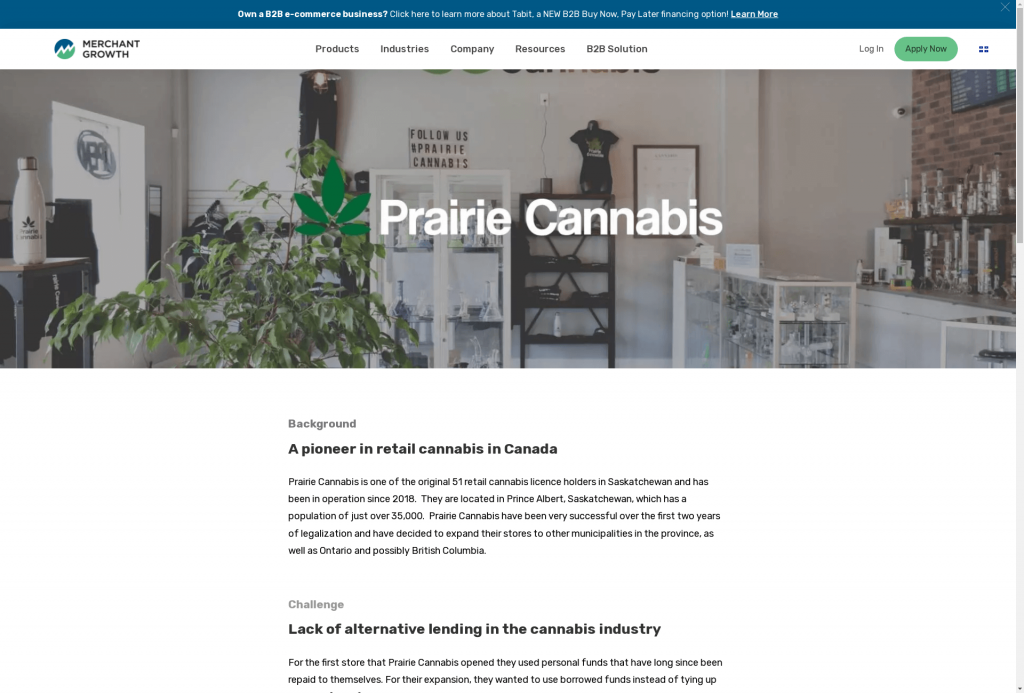
Merchant Growth Case Study with Prairie Cannabis
An Exemplary Customer
Beyond collaborating with other businesses in their industry in order to foster growth, Prairie Cannabis has been a great customer for Merchant Growth as well. In addition to a perfect payment record, as a company that fosters collaboration and community, they've helped us out by providing both reviews and sharing their story with our other prospective Merchant Growth customers by participating in a case study where they also shared about their positive experience working with us.
Furthermore we always take it as the greatest compliment when any business is a repeat customer. They understand that reputation and customer service are key to running a successful business and have gone out of their way to help us out.
Hearing how their Merchant Growth financing allowed them to continue with their business expansion and overcome obstacles, in addition to their collaborative nature, makes them the ideal recipient of this year’s award.
What’s Next for Prairie Cannabis
When it comes to their hopes for the future of their business as well as the cannabis industry at large in Canada, Prairie Cannabis is happy with how their business has grown and will continue to advocate for their industry:
“We have an interest in 9 stores now—and that is enough to keep us pleasantly busy. We are enjoying being able to participate in this industry and plan to continue for many years to come. We do hope that the barriers start to come down and that more services are eventually offered to industry participants. We also hope that the stigma that still surrounds this plant starts to dissipate as more research is done and people become more comfortable with the notion of cannabis and actually try it.”
As for their business motto as well as the advice that they would offer to other small business owners, it all comes down to hard work, passion, and perseverance:
“Never give up. There is always more than one way to do something. If you give up easily, this is not the industry for you. Perseverance, dedication, commitment are just a few of the adjectives that describe people in this industry. It is a lot of work, but it is very rewarding. Small wins are really important and can make your day. Doing what you love with people you care about is worth it.”

Jim Southam of Prairie Cannabis