


Your business has money coming in. Sales are being made, customers are being invoiced, and, on paper, the business may even be profitable. Then payroll is due on Friday, a large supplier invoice needs to be paid and several customer payments you expected this week still haven't arrived.
This is where managing a business's finances becomes about more than simply looking at revenue, profit or the balance in your bank account. Money rarely enters and leaves a business on a perfectly matched schedule. A customer might have 30 days to pay an invoice, inventory might need to be purchased months before it's sold, or a piece of equipment may need to be replaced before the revenue it supports has been earned.
Cash management is the process of monitoring, collecting, using and planning your business's cash so you have enough available to meet your obligations while making effective use of the money you have. At its core, it comes down to one question:
Do you know where your business's cash is today, where it's going next and whether you'll have enough when you need it?
Answering that question doesn't require predicting every dollar perfectly. It requires a process for understanding what's happening now and looking far enough ahead to make informed decisions. A useful way to approach it is to know where you stand, forecast what's coming, collect what you're owed, control when cash leaves, and prepare for what you can't perfectly predict.
What Is Cash Management?
Cash management is how a business monitors and makes decisions about the money it has available, expects to receive and needs to spend. It includes collecting customer payments, planning upcoming expenses, managing outgoing payments and preparing for future cash requirements. The objective is to maintain enough liquidity to operate the business while using available cash effectively.
Liquidity simply refers to having enough accessible cash, or assets that can quickly be converted into cash, to meet short-term financial obligations. A business might own valuable equipment, inventory or property and still have limited liquidity because those assets can't necessarily be turned into cash in time to cover payroll next week. Cash management keeps the focus on what is available when the business needs it.
This makes cash visibility particularly important. Your current bank balance is useful information, but it is only one part of the picture. Effective cash management considers that balance alongside the money expected to arrive and the obligations already waiting to be paid.
Cash Management, Cash Flow and Profit Aren't the Same Thing
Cash management, cash flow and profit are closely connected, but they describe different parts of a business's financial position. Understanding the difference makes it easier to recognize what is actually causing financial pressure. It also helps owners avoid assuming that a profitable business will automatically have enough cash available at any given moment.
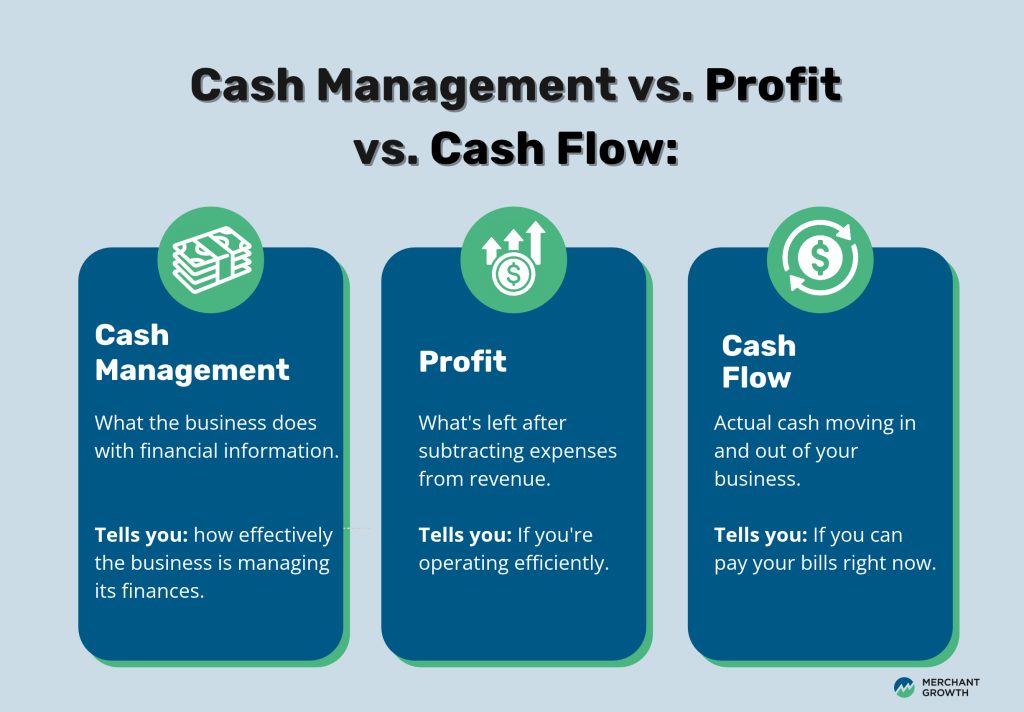
Profit is what remains when revenue exceeds expenses over a particular period. It tells you whether the business is earning more than it costs to operate, but it doesn't necessarily tell you when that money will be available. Revenue can be recorded before a customer actually pays.
Cash flow is the actual movement of money into and out of the business. Customer payments create cash inflows, while payroll, rent, inventory, supplier payments, taxes and other expenses create cash outflows. The timing of those movements determines how much cash is available at different points throughout the month or year.
Cash management is what the business does with that information. It includes the processes and decisions used to monitor those inflows and outflows, anticipate future needs and respond when the timing doesn't line up. Rather than simply observing cash flow, cash management is about actively planning around it.
Imagine a contractor completes a $30,000 project and sends the customer an invoice with 30-day payment terms. The project may contribute to the business's profit immediately from an accounting perspective, but the customer hasn't transferred the $30,000 yet. If payroll and supplier invoices are due next week, the contractor still needs enough accessible cash to cover them while waiting for that invoice to be paid.
Why Is Cash Management Important for a Small Business?
Businesses rarely receive money on the same schedule that they need to spend it. Employees expect to be paid on payday regardless of when customers settle their invoices, while rent, taxes, loan payments and supplier bills each have their own deadlines. Inventory and growth investments can create even larger timing differences because money may leave the business well before those purchases generate additional revenue.
Good cash management gives you a better view of those timing differences before they become immediate problems. It can help you prepare for payroll and operating expenses, plan supplier and tax payments, anticipate seasonal fluctuations and recognize periods when cash may be tighter than usual. It can also reveal periods when the business is likely to have excess cash available for investments, debt repayment or reserves.
A temporary shortage of cash doesn't automatically indicate an unhealthy business. A growing company may need to hire employees before increased capacity produces additional revenue, while a seasonal retailer may spend heavily on inventory ahead of its busiest months. Understanding why cash is tight and when the pressure is expected to ease gives the owner much better information for deciding what to do next.
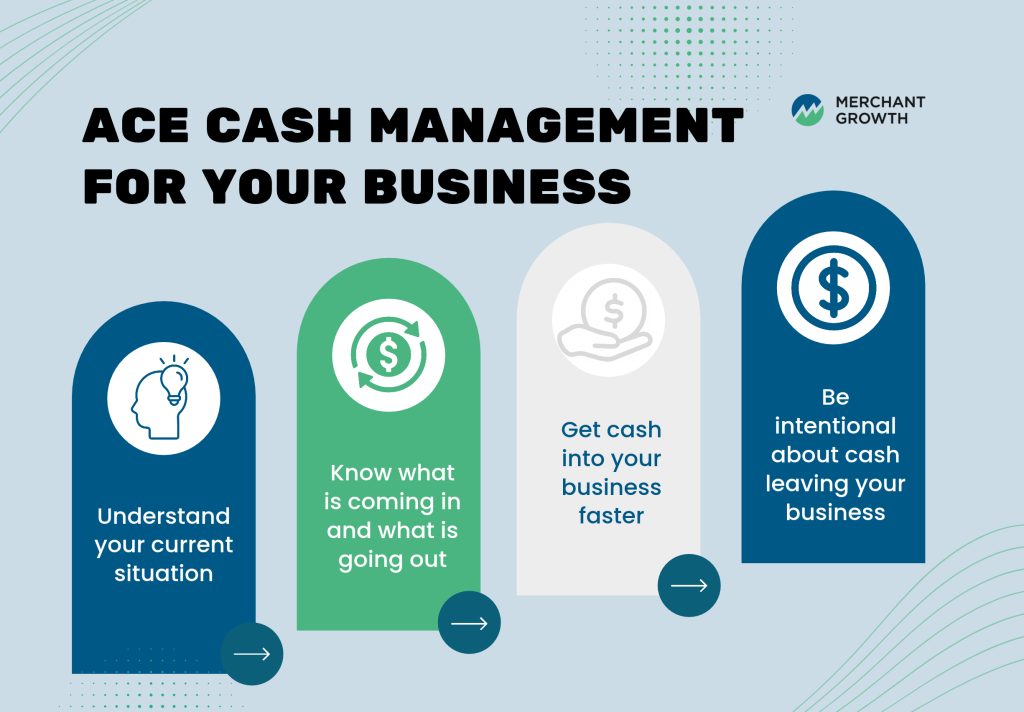
Step 1: Know Where Your Cash Actually Stands
Good cash management starts with visibility. Checking your bank account tells you how much money is there today, but it doesn't tell you how much of that balance is already committed elsewhere. A healthy-looking balance can change quickly when payroll, taxes and several large payments are approaching at the same time.
Start by looking at your current bank balances alongside the financial commitments you already know are coming. That could include payroll, taxes and remittances, rent, supplier invoices, loan or financing payments, recurring operating expenses and planned inventory or equipment purchases. You should also know what outstanding customer invoices are expected to bring additional cash into the business and approximately when those payments are likely to arrive.
For example, seeing $60,000 in the bank feels very different when you know that $25,000 of payroll, a $12,000 supplier payment and $8,000 in tax remittances are due within the next two weeks. Those obligations don't necessarily mean the business is in trouble. They simply provide the context needed to understand how much flexibility that $60,000 actually represents.
The goal at this stage isn't to decide whether you should spend, save or borrow. It's to establish an accurate starting point so the decisions that come next are based on the full picture rather than a single number on a banking dashboard.
Step 2: Forecast What's Coming In and Going Out
Once you know where your cash stands today, the next step is looking forward. A cash flow forecast estimates when money is expected to enter and leave the business over a future period. It turns cash management from a reaction to today's balance into a way of anticipating what could happen next.
On the incoming side, consider expected customer payments, recurring revenue, confirmed sales and predictable seasonal patterns. On the outgoing side, account for payroll, supplier payments, rent, taxes, inventory purchases, loan payments, overhead and any significant investments already planned. The timing matters just as much as the totals because $50,000 arriving next month can't pay an expense that's due next week.
Consider a retailer preparing for the holiday season. The business may reasonably expect November and December to generate its strongest sales of the year, but much of the inventory required for those sales might need to be purchased in August or September. A forecast makes that period of heavier spending visible while there is still time to plan for it.
Forecasts don't need to predict the future perfectly to be useful. A major customer might pay later than expected, sales may come in above or below projections and an unexpected expense can appear at any time. The value of forecasting is that it provides an early warning, allowing you to adjust the numbers as circumstances change instead of discovering a shortage when the payment is already due.
Step 3: Get the Cash You've Earned Into the Business Faster
For businesses that invoice customers, completing the work and receiving the money can happen weeks or even months apart. That delay matters because the business may already be paying the employees, suppliers and other expenses required to deliver the product or service. The longer an invoice remains unpaid, the longer the business is effectively operating without access to cash it has already earned.
Start by looking at how quickly invoices are sent after work is completed. Waiting several days to prepare an invoice automatically adds those days to the collection cycle, even if the customer pays exactly on time. Clear payment terms also make it easier for customers to understand when payment is expected and what payment methods are available.
Once invoices have been sent, accounts receivable should be monitored rather than left until something looks wrong. Automated reminders can reduce some of the manual follow-up, while a consistent process for overdue accounts helps prevent old invoices from quietly accumulating. Businesses can also review whether certain customers regularly pay late and whether their credit terms remain appropriate.
Making payment convenient can remove another source of unnecessary delay. Depending on the business and its customers, that could mean electronic payments, online payment options or other methods that allow funds to move quickly. Some businesses may also choose to offer an early-payment incentive when the cost of that incentive makes financial sense.
The objective isn't to pressure every customer into paying immediately. It's to identify avoidable delays between making a sale and having the resulting cash available to use. Even modest improvements to that timeline can make a noticeable difference when a business carries a large accounts receivable balance.
Step 4: Be Intentional About When Cash Leaves the Business
Managing incoming cash is only half of the equation. Businesses also have some control over when certain payments are made and how purchases are planned. The goal isn't to delay bills unnecessarily, but to use agreed payment terms and available cash deliberately.
Supplier terms are a good place to start. If a supplier gives your business 30 days to pay, routinely paying every invoice the day it arrives may move cash out of the business earlier than necessary. Using the agreed payment period appropriately can keep cash available longer without making the payment late or damaging the supplier relationship.
Inventory purchasing deserves similar attention. Buying significantly more inventory than the business needs can leave money sitting on shelves, while ordering too early can create a longer gap between paying suppliers and earning that cash back through sales. Reviewing order quantities and purchasing schedules can help align spending more closely with expected demand.
Large purchases also need to be considered in the context of the broader cash forecast. Equipment, vehicles, technology and other investments may be necessary, but paying for them at the wrong time could create pressure elsewhere in the business. Planning those purchases around expected cash availability, or considering whether an appropriate financing structure makes more sense than paying the entire cost upfront, can preserve liquidity for other obligations.
Recurring expenses deserve periodic attention as well. Subscriptions, transaction fees, banking costs and services that were once useful can quietly continue long after their value has changed. Reviewing them isn't simply about cutting costs; it's about making sure cash is leaving the business intentionally and supporting something the company still needs.

How Long Is Your Cash Tied Up in the Business?
One way to understand the timing of cash is to look at your cash conversion cycle. In simple terms, this is the amount of time between putting cash into the business and getting that cash back through a customer payment. For businesses that carry inventory or offer customers payment terms, that process can take much longer than the sale itself suggests.
There are three useful pieces to consider.
- Inventory days represent how long inventory typically sits before it is sold.
- Receivable days represent how long customers take to pay
- Payable days represent how long the business has before it needs to pay its suppliers.
Together, they help show where money spends time tied up during the normal operating cycle.
Imagine a retailer purchases inventory today and pays its supplier. The product sits for 45 days before being sold to a commercial customer, and that customer then has another 30 days to pay the invoice. Even though the retailer made a successful sale, the original cash could be committed to that cycle for roughly 75 days before returning to the business.
You don't need to become an expert in financial ratios to make this concept useful. Look at where the longest delays occur in your own business and whether they can reasonably be shortened. Faster inventory turnover, more efficient collections or better-aligned supplier terms can all change how long cash remains committed before becoming available again.
Prepare for the Cash Needs You Can't Perfectly Predict
Forecasting can help you anticipate many cash requirements, but no forecast can account for everything. Equipment breaks, customers pay late, sales fluctuate, and unexpected expenses appear. A strong cash management plan leaves the business some room to respond when reality doesn't match the spreadsheet.
Maintaining an appropriate cash reserve is one way to create that flexibility. There isn't one reserve amount that is right for every company because businesses have different expenses, revenue patterns and levels of risk. A company with highly predictable recurring revenue may have different needs from a seasonal business that experiences large swings throughout the year.
Preparation can also include maintaining appropriate insurance, building room for unexpected costs into budgets and having contingency plans for major customers paying late. Businesses with expensive equipment may want to anticipate eventual repairs or replacement rather than treating those costs as completely unexpected. Seasonal companies can similarly plan for predictable slow periods before revenue begins to decline.
It can also be useful to understand what credit or financing options are available before the business urgently needs them. Having that information doesn't mean borrowing pre-emptively or treating financing as an emergency fund. It simply gives the owner another potential option to evaluate if a legitimate short-term need or investment arises.
The purpose of preparation isn't to eliminate uncertainty. It's to give the business enough flexibility that one late customer payment, equipment repair or slower-than-expected month doesn't immediately force a rushed financial decision.
Where Can Cash Management Services and Technology Help?
Cash management services are tools and financial services designed to help businesses collect, move, monitor and manage their money more efficiently. They may be offered through banks, financial institutions, accounting platforms, payment providers or other software companies. A cash management system can therefore refer broadly to the combination of technology and processes a business uses to keep track of and manage its cash.
Electronic payment options and payment processing can help shorten the time between a customer deciding to pay and the money reaching the business. Automated invoicing and reminders can reduce administrative work around accounts receivable, while payment scheduling can help businesses plan outgoing payments around their due dates. Account reconciliation tools can make it easier to match transactions with accounting records and identify discrepancies.
Cash flow dashboards, accounting software and forecasting tools can improve visibility by bringing information together in one place. Banking alerts can flag important transactions or balance changes, while receivables tracking can make overdue accounts easier to identify. Automation can be particularly valuable when it removes repetitive administrative work that otherwise makes financial information slower or less reliable.
More technology isn't automatically better cash management, though. Before adding another platform, consider what problem it is supposed to solve. A useful cash management solution should make information clearer, accelerate collections, reduce manual work or help the business make better financial decisions.
How Can You Improve Cash Management?
Improving cash management doesn't necessarily require changing everything at once. A better starting point is identifying where your business currently loses visibility or experiences the greatest cash pressure. Once you know where the problem occurs, you can focus on the changes most likely to make a meaningful difference.
Ask yourself whether you know how much cash is truly available after upcoming obligations and whether your forecasts reflect current information. Look at how quickly invoices are sent and paid, how consistently overdue accounts are followed up and whether inventory is being purchased earlier or in larger quantities than necessary. Review whether supplier payment terms are being used effectively and whether recurring expenses are still providing enough value to justify their cost.
Then consider how often cash shortages genuinely surprise you. If the business repeatedly reaches payroll, tax deadlines or large supplier payments without enough warning, the issue may be visibility rather than the expense itself. Better forecasting and a more regular review process can provide time to respond before those dates arrive.
You don't need to fix every weakness simultaneously. Identify the one or two areas creating the greatest pressure and start there, whether that's slow collections, inventory sitting too long, unpredictable expenses or simply not looking far enough ahead. Cash management becomes much more useful when it is treated as an ongoing business process rather than a financial cleanup exercise.
Create a Simple Cash Management Routine
The best cash management process is one the business will actually use consistently. Rather than waiting until the bank balance becomes concerning, establish a regular schedule for reviewing your cash position and looking ahead. How often that review needs to happen will depend on how quickly money moves through your particular business.
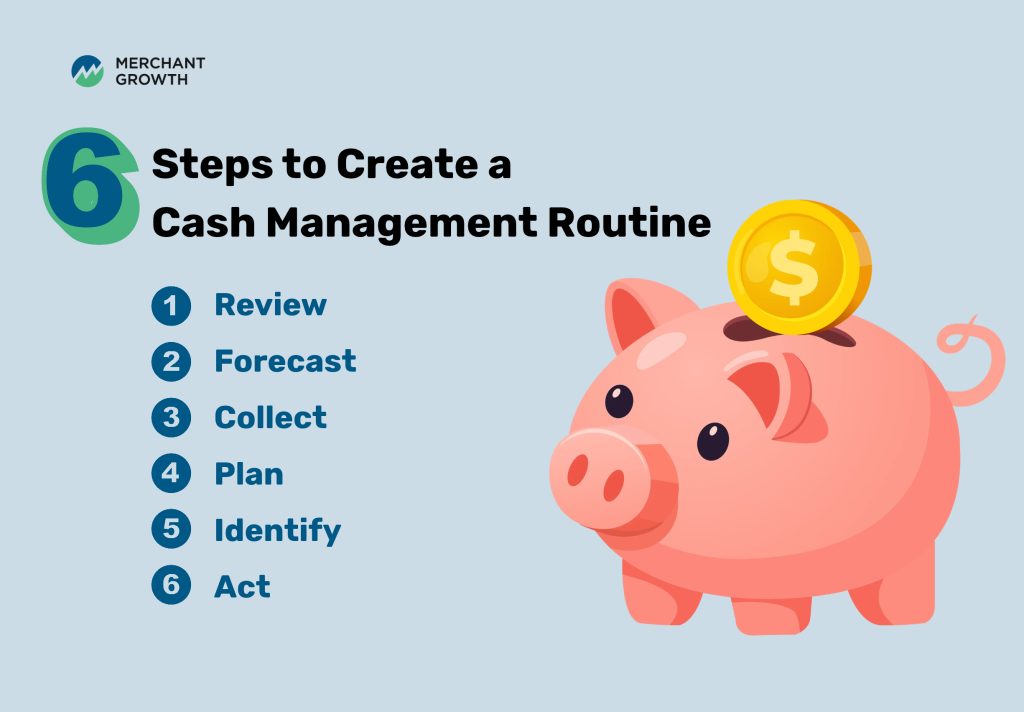
A simple routine can follow six steps:
- Review
- Forecast
- Collect
- Plan
- Identify
- Act
Start by reviewing the cash currently available, then update expected inflows and outflows based on the latest information. Check outstanding customer payments, plan upcoming expenses and identify any periods where the business could have either a shortage or more cash than it requires for immediate obligations.
The final step is deciding whether action is actually necessary. You may need to follow up on overdue invoices, adjust the timing of a purchase, change an inventory order or prepare for a seasonal slowdown. In other cases, the forecast may simply confirm that the business has enough liquidity and no immediate changes are required.
A business with tight margins, rapidly changing sales or significant weekly expenses may need to complete this review frequently. A company with highly predictable recurring revenue and expenses may be comfortable with a different schedule. Consistency matters more than choosing one universal frequency for every business.
Sometimes a Cash Gap Is About Timing, Not a Broken Business
Strong cash management can reveal areas that need to be fixed internally, such as chronically late invoicing, excessive inventory or expenses that consistently exceed what the business can support. It can also reveal something very different: a fundamentally healthy business that needs cash at a different time than revenue naturally arrives. Recognizing which situation you're dealing with matters before deciding how to respond.
A seasonal retailer, for example, may need to purchase inventory several months before its busiest sales period. A contractor may need new equipment before accepting additional projects, while another business may need to hire and train employees before an expansion produces more revenue. A large customer could also be expected to pay a substantial invoice next month even though payroll is due this week.
Growth itself can create similar pressure. Renovations, technology, additional inventory or new employees often require money before the investment has had time to produce a return. If the underlying demand and economics make sense, the resulting cash requirement may be part of executing the opportunity rather than evidence that the business is performing poorly.
This distinction is particularly important when considering business financing. A recurring shortage caused by an underlying operational problem requires a different solution from a temporary requirement created by timing or a planned investment. Financing can provide additional flexibility in the second situation, but it shouldn't replace understanding and addressing the first.

Better Cash Management Gives Your Business More Options
Cash management isn't about keeping as much money as possible sitting in a bank account. It's about understanding what cash is available, anticipating what the business will need and making deliberate decisions about when money comes in and goes out. The more visibility you have, the less likely an upcoming payment or temporary shortage is to catch you completely off guard.
That visibility also gives you more options. With enough notice, you may be able to accelerate collections, adjust purchasing, move a planned expense, use available reserves or determine that additional capital makes sense. The important part is making that decision while there is still time to evaluate the alternatives.
When an established business identifies a temporary cash flow gap or a worthwhile investment that requires capital before the resulting revenue arrives, financing can be one option for bridging that timing difference. Merchant Growth offers flexible business financing for established Canadian businesses that can support investments such as inventory, equipment, technology, marketing, hiring and other growth requirements. Explore Merchant Growth's business financing options to see what may be available for your business.