

Best Ecommerce Platforms for Canadian Businesses: How to Choose the Right One
Selling online in Canada isn’t just growing; it’s become a core part of how businesses succeed. Ecommerce now makes up 14.5% of total retail sales, and Canadians are spending over $3 billion CAD online every month. That kind of demand creates huge opportunity, but it also means more competition and higher expectations from customers.
Choosing the right ecommerce platform is one of the first, and most important, decisions you’ll make when building an online business. It’s not just about launching a website. It’s about choosing the system that will shape how you sell, manage orders, market your products, and grow over time.
With so many options available, it’s easy to get stuck comparing feature lists without thinking about what actually fits your business. Many platforms look similar at a glance, but once you start using them, the differences become much more obvious. Some are easier to manage day to day, some are better for scaling, and some become more expensive than expected once you add the tools you really need.
The truth is, there isn’t one universal “best” ecommerce platform. The right choice depends on what you sell, how you like to work, how much flexibility you need, and where you want your business to be a year from now. In this guide, we’ll break down the best ecommerce platforms by category so you can choose with more confidence and less guesswork.
What Makes a Great Ecommerce Platform?
At its core, an ecommerce platform is the engine behind your online store. It affects everything from your website design and checkout experience to inventory tracking, payment processing, shipping, and customer communication. While most platforms cover the basics, the way they deliver those basics can be very different.
A strong platform should make it easy to build and manage your storefront, accept payments securely, keep inventory organized, and connect with the tools you already use for shipping, accounting, marketing, and customer support. Those are the essentials that keep an online business running smoothly.

Best Ecommerce Platforms for Small Businesses
For small businesses, the priority is usually simplicity, speed, and efficiency. You want a platform that helps you launch quickly, manage your store without a steep learning curve, and grow without needing to rebuild everything later. Below are some of our favourite picks to get your small business online.
| Platform | Monthly Starting Price (CAD) | Best For | Key Strength |
|---|---|---|---|
| Shopify | ~$37 | Scaling SMBs | All-in-one + apps |
| Wix | ~$33 | Beginners | Ease of use |
| Square Space | ~$21 | Creatives | Design |
| Square Online | Free | Retail + POS | Omni channel |
| Woo Commerce | Free | Custom builds | Flexibility |
Shopify
Shopify is one of the most popular ecommerce platforms for small businesses because it brings almost everything into one place. Hosting, security, payment processing, themes, and store management are all wrapped into a streamlined system that is easy to get started with. For many business owners, that simplicity is the biggest advantage. You can spend less time managing the technical side of your site and more time focusing on products, customers, and growth.
It’s also a strong option for businesses that want room to expand. Shopify works well for brands that start small but expect to add more products, more sales channels, or more operational complexity over time. Its app ecosystem gives you access to tools for reviews, subscriptions, email marketing, shipping, and more. The main thing to watch is cost. While Shopify starts at around $37/month CAD, many stores end up paying more once they add apps, premium themes, or advanced functionality.
What makes Shopify especially appealing is how balanced it is. It is user-friendly without feeling too limited, and scalable without being overly technical. That said, some customizations require apps or developer support, so it’s best for businesses that want an all-in-one platform more than complete backend freedom.
Pros:
- Easy to launch and scale
- Strong app ecosystem
- Reliable performance
Cons:
- App costs add up
- Limited customization without apps
Wix
Wix is built for beginners who want to launch quickly and keep the setup process simple. Its drag-and-drop builder is easy to understand, which makes it appealing for business owners creating their first online store. If design flexibility matters to you, Wix gives you a lot of visual control without requiring technical knowledge.
For smaller catalogues and straightforward businesses, Wix can be a very practical choice. It works well for local brands, service-based businesses, side hustles, and smaller product lines that do not need deep operational complexity. The platform also makes it easy to build out content pages, galleries, and basic store functionality in one place. Starting at around $33/month CAD for the functionality to accept payments, it can feel more accessible than some larger ecommerce-focused platforms.
Where Wix tends to be less ideal is long-term scalability. As your store grows, you may find the ecosystem, integrations, and advanced ecommerce tools more limited than what platforms like Shopify or BigCommerce offer. Still, for businesses that want ease of use first, Wix is often one of the smoothest ways to get online.
Pros:
- Very beginner-friendly
- Strong design control
- Quick setup
Cons:
- Limited scalability
- Smaller integration ecosystem
Squarespace
Squarespace is a strong fit for businesses that care deeply about branding, visual presentation, and storytelling. It is especially popular with creative entrepreneurs, boutique brands, photographers, designers, and product-based businesses that rely on polished presentation. If your website needs to feel like an extension of your brand, Squarespace does a very good job of combining content and commerce.
One of its biggest strengths is that it feels cohesive. Instead of patching together multiple tools, you can manage your site, blog, product pages, and checkout experience in one clean environment. That makes it easier to create a consistent customer experience from homepage to purchase. Pricing typically starts around $21/month CAD, which makes it affordable for businesses that want a design-forward platform.
The trade-off is that Squarespace is not usually the best choice for large or operationally complex stores. If you have extensive inventory, complicated product options, or advanced ecommerce workflows, you may eventually outgrow it. But for businesses where strong design and simple selling matter most, it can be an excellent option.
Pros:
- Beautiful templates
- All-in-one simplicity
- Strong content integration
Cons:
- Limited advanced features
- Not ideal for large stores
Square Online
Square Online is a natural choice for businesses already using Square for in-person payments. It connects your online store with your point-of-sale system, helping keep product listings, sales, and inventory in sync. For retailers, restaurants, and service-based businesses selling both online and offline, that connection can make daily operations much easier.
One of the biggest reasons businesses choose Square Online is accessibility. There is a free plan available, and paid plans typically range up to around $99/month CAD, depending on the features you need. That makes it attractive for newer businesses that want a lower-cost way to start selling online without investing heavily up front. It is especially useful if your online store is an extension of an existing brick-and-mortar setup.
The limitation is depth. Square Online works well for straightforward ecommerce, but it does not offer the same flexibility or advanced ecosystem as larger platforms built primarily for online-first growth. Still, for businesses that want omnichannel convenience and a simple learning curve, it is a very practical solution.
Pros:
- Free plan available
- Seamless POS integration
- Easy setup
Cons:
- Limited advanced ecommerce features
- Fewer integrations
WooCommerce
WooCommerce is a very different kind of platform from the all-in-one options above. Because it runs on WordPress, it gives you much more control over how your store looks and functions. For businesses that want custom features, unique design flexibility, or direct control over their website infrastructure, that can be a major advantage.
It is also appealing from a cost perspective because the plugin itself is free, though real-world costs still add up. Hosting, premium plugins, security tools, development support, and maintenance can easily bring the monthly cost into the $20 to $100+ CAD range, depending on how simple or customized your setup is. In other words, WooCommerce can be cost-effective, but it is rarely “free” once your store is fully running.
WooCommerce tends to work best for businesses that are comfortable with WordPress or have access to technical help. It offers impressive flexibility, but that flexibility comes with more responsibility. You are in charge of updates, performance, security, and the overall setup. If you want full control and do not mind a more hands-on approach, WooCommerce can be a powerful option.
Pros:
- Highly customizable
- No platform fees
- Flexible integrations
Cons:
- Requires technical setup
- Ongoing maintenance

Best Ecommerce Platforms for Clothing & Retail Brands
Retail businesses usually need more than a basic storefront. Product variants, inventory tracking, merchandising, and multichannel selling all matter more when you’re dealing with multiple SKUs, seasonal collections, or in-store and online sales at the same time.
| Platform | Starting Price (Monthly CAD) | Best For | Strength |
|---|---|---|---|
| Shopify | $37/Month CAD | Retail brands | Omni channel selling |
| Centra | Price by Quote | Fashion brands | Global scaling |
| Presta Shop | Free | Custom retail | Flexibility |
| AbanteCart | Free | Small retailers | Light weight |
| Big Commerce | Price by Quote | Scaling retail | Built-in features |
Shopify
For clothing and retail brands, Shopify stands out because it handles product variants, inventory, and multichannel selling very well. If you sell items in different sizes, colours, or styles, Shopify makes it relatively easy to organize those options and create a shopping experience that feels smooth for customers.
It is also a strong choice for brands selling across multiple channels. You can connect online sales with marketplaces, social commerce, and in some cases, physical retail operations. That makes Shopify attractive for growing retail businesses that want one central system for products and orders. Pricing still starts around $37/month CAD, but retail brands often budget for additional apps to support reviews, upselling, returns, or advanced merchandising.
The reason Shopify remains so popular in retail is that it balances usability with growth potential. It is approachable enough for smaller brands but capable enough for more established ones. The main drawback is that some advanced functionality depends on paid add-ons, so your monthly cost can rise as your store becomes more sophisticated.
Pros:
- Handles sizes and variants well
- Strong retail integrations
- Easy to scale
Cons:
- App dependency
- Checkout limitations on lower plans
Centra
Centra is built specifically for fashion and apparel brands, which gives it a more focused feel than general-purpose ecommerce platforms. Instead of trying to serve every kind of business, it is designed around the needs of brands managing collections, merchandising, international pricing, and wholesale or multi-market sales.
That specialization is what makes it attractive for established fashion businesses. If you are selling across regions, currencies, or customer segments, Centra offers tools that can help manage that complexity more effectively than many standard small business platforms. It is especially relevant for brands with ambitious growth plans or more advanced operational needs.
The trade-off is accessibility. Centra is not usually positioned for beginners or very small stores, and pricing is generally considered enterprise-level, which means it will be significantly higher than entry-level platforms like Shopify or Wix. For fashion brands that need those built-in capabilities, it can be a strong fit. For everyone else, it may feel too specialized and too expensive.
Pros:
- Apparel-focused features
- Global pricing control
- Strong merchandising
Cons:
- Enterprise pricing
- Not beginner-friendly
PrestaShop
PrestaShop is an open-source platform that appeals to retailers who want flexibility and customization without being tied to a hosted system. It gives merchants more control over the structure and functionality of their store, which can be valuable if your retail setup has unique requirements.
Because the software itself does not come with a traditional licensing fee, it can look cost-effective at first. But in practice, your costs will vary depending on hosting, modules, development work, and maintenance. For many businesses, that means a realistic cost range can shift significantly over time rather than staying fixed like a standard monthly subscription.
PrestaShop makes the most sense for retail businesses that want customization and either have technical resources in-house or are prepared to work with developers. It offers freedom, but it is not the easiest route for teams that want fast, simple store management. If you want control more than convenience, it is worth considering.
Pros:
- Fully customizable
- No licensing cost
Cons:
- Requires technical skills
- Variable costs
AbanteCart
AbanteCart is a lighter-weight option for smaller retail businesses that want a simple, customizable ecommerce setup without the size or complexity of larger platforms. It is often appealing to businesses looking for an alternative to more mainstream solutions.
One of its advantages is cost. The platform itself is free to use, which makes it attractive for budget-conscious retailers. That said, as with other open-source tools, the actual cost depends on hosting, development, and any extensions you choose to add. So while the entry price is low, the total investment depends on how far you want to take it.
AbanteCart can work well for smaller operations with straightforward needs, but its ecosystem and support network are more limited than what you will find with larger platforms. That does not make it a bad option; it just means it is better suited to businesses that value simplicity and cost control over a large marketplace of integrations and services.
Pros:
- Free and customizable
- Simple structure
Cons:
- Limited ecosystem
- Smaller support network
BigCommerce
BigCommerce is a strong platform for retail brands that are scaling and want more built-in functionality from the start. Compared with platforms that rely heavily on add-ons, BigCommerce includes a broader set of native ecommerce features, which can reduce the number of third-party apps you need to manage.
That can be especially appealing for retail businesses with larger catalogues or more complex selling needs. BigCommerce supports growth well, and many merchants like that they can access advanced functionality without piecing together as many separate tools. Pricing generally starts in a similar range to other major ecommerce platforms and increases with plan level and business needs.
The platform can feel a little less intuitive at first than simpler entry-level options, so there may be more of a learning curve during setup. But for businesses that want stronger built-in capabilities and less reliance on extra apps, BigCommerce is often a smart middle ground between usability and depth.
Pros:
- Less reliance on apps
- Scales well
Cons:
- Slight learning curve
Best Ecommerce Platforms for Digital Products
Digital product businesses have different priorities from physical retailers. Instead of inventory and shipping, they care more about secure delivery, subscriptions, checkout simplicity, and creating a smooth customer experience for downloads or memberships.
| Platform | Starting Price (Monthly CAD) | Best For | Strength |
|---|---|---|---|
| Square space | ~$21 | Creators | Content + commerce |
| Payhip | Free | Downloads | Secure delivery |
| Ecwid | ~$7 | Flexibility | Add-on ecommerce |
| SureCart | Free | Subscription | Checkout + billing |
Squarespace
Squarespace is a strong option for creators who want to combine content, branding, and digital sales in one polished experience. If you sell eBooks, templates, courses, guides, or other downloadable products, it gives you a clean way to present your offer without making the site feel overly technical.
What makes it appealing is the balance between simplicity and design. You can create landing pages, blog content, brand-driven product pages, and a checkout flow within the same platform. For creators building an audience and selling directly from their site, that can feel much more natural than using a more operations-heavy ecommerce platform.
Squarespace is best when the business model is relatively straightforward. If you need more advanced digital delivery tools, complex automation, or a highly customized membership setup, you may need something more specialized. But for creators who want a professional storefront without a steep learning curve, it is a very solid choice.
Pros:
- Simple setup
- Strong design
Cons:
- Limited advanced tools
Payhip
Payhip is focused on secure digital delivery, which makes it attractive for businesses that primarily sell downloadable products. Rather than trying to be everything at once, it concentrates on making digital fulfillment simple, organized, and secure.
That specialization can be a real advantage if your biggest priority is making sure customers receive purchased files smoothly and reliably. For a business built around digital downloads, that focus can remove a lot of unnecessary complexity. Pricing will vary by plan and usage, but it is important to account for the total cost of secure delivery features rather than just the base offer.
The trade-off is flexibility. Because it is more specialized, it may not offer the same broad site-building or ecosystem benefits as a full ecommerce platform. That means it works best when digital delivery is the core need, not when you are trying to build a large, multi-layered commerce operation around it.
Pros:
- Built for downloads
- Simple workflow
Cons:
- Limited flexibility
Ecwid
Ecwid is a useful option for businesses that already have a website and want to add ecommerce functionality without rebuilding everything. Instead of starting from scratch, you can plug it into an existing site and begin selling products, including digital products, with relatively little friction.
That makes it especially appealing for smaller brands, creators, and businesses testing online sales. It is lightweight, flexible, and generally affordable compared with more full-scale platforms. Its pricing varies by plan, with entry-level options aimed at keeping costs accessible for businesses that do not need an extensive feature set right away.
Where Ecwid can become limiting is scale. It works well as an add-on commerce solution, but it may not be the best fit for businesses expecting a large or highly customized ecommerce operation over time. For simplicity and lower upfront commitment, though, it is often a practical choice.
Pros:
- Lightweight
- Affordable
Cons:
- Limited scalability
SureCart
SureCart is designed with checkout, subscriptions, and recurring billing in mind, which makes it especially relevant for digital sellers offering memberships, software, services, or subscription-based products. If recurring revenue is central to your business model, that focus can be a major benefit.
One of its biggest strengths is the checkout experience. A faster, cleaner checkout can have a direct impact on conversions, especially for digital products where buyers often expect a quick path from interest to purchase. Pricing depends on the version and setup you choose, so businesses should look beyond the starting cost and consider what they need for billing, integrations, and long-term usage.
Because it has a smaller ecosystem than some major platforms, it may not feel as expansive or established for every use case. Still, for businesses centered on digital sales and subscriptions, SureCart can be a very compelling option.
Pros:
- Strong recurring billing
- Fast checkout
Cons:
- Smaller ecosystem

Best Ecommerce Platforms for B2B Businesses
B2B ecommerce usually requires more than a standard online store. Custom pricing, account-based purchasing, bulk orders, approvals, and workflow automation all become more important when you are selling to other businesses.
| Platform | Price (Monthly CAD) | Best For | Strength |
|---|---|---|---|
| Shopify Plus | $3,400 | Enterprise | Scalability |
| Big Commerce | Price per quote | B2B features | Built-in tools |
| Adobe Commerce | Price per quote | Custom builds | Flexibility |
| Oro Commerce | Price per quote | Wholesale | Workflow automation |
Shopify Plus
Shopify Plus is the enterprise version of Shopify and is built for larger businesses that need more customization, more automation, and more support at scale. It takes the familiar Shopify experience and adds greater flexibility for brands managing higher order volume or more complex operations.
For B2B businesses, Shopify Plus can be useful when you want enterprise reliability without moving into a fully custom platform environment. It supports more advanced workflows and can help create tailored buying experiences for different customer segments. The big consideration, of course, is price. Shopify Plus is significantly more expensive than standard Shopify plans and is typically priced at an enterprise level.
That means it makes the most sense for businesses that have already outgrown entry-level tools and need more robust infrastructure. If your B2B operation is still fairly simple, it may be more platform than you need. But if you need scale and a strong ecosystem, Shopify Plus is a serious contender.
Pros:
- Scalable
- Custom experiences
Cons:
- High cost
BigCommerce
BigCommerce is often a strong B2B option because it includes more built-in functionality than many competing platforms. For businesses that want native support for more advanced selling requirements, this can reduce the need to bolt on multiple apps or custom solutions.
It is particularly appealing for businesses that want to grow without losing operational control. The platform supports more complex product catalogues and can work well for companies serving both B2C and B2B audiences from the same broader ecosystem. Pricing depends on the plan and business needs, but it is generally positioned above entry-level tools while still being more accessible than some enterprise-heavy systems.
The main challenge is usability. Compared with simpler small-business platforms, BigCommerce can feel a bit more involved on the backend. But for B2B merchants that value built-in tools and long-term scalability, that extra complexity may be worthwhile.
Pros:
- Native B2B tools
- Flexible
Cons:
- UI complexity
Adobe Commerce
Adobe Commerce is a powerful option for larger B2B businesses with complex requirements and the resources to support a more advanced platform. It is highly customizable and capable of handling deep integrations, tailored workflows, and sophisticated ecommerce environments.
That level of control is its biggest advantage. If your business needs a platform built around very specific processes, Adobe Commerce can offer the flexibility to create that. Pricing is typically enterprise-level, and the total cost often includes development, implementation, maintenance, and ongoing support, so it is not a low-cost solution.
Because of that, Adobe Commerce is best suited to organizations with larger budgets, technical teams, and long-term ecommerce strategies. It can do a lot, but it also asks a lot in return. For the right business, that trade-off makes sense. For smaller teams, it is often more than necessary.
Pros:
- Full control
- Deep integrations
Cons:
- Complex
- Resource-heavy
OroCommerce
OroCommerce is built specifically for wholesale, distribution, and other B2B-focused operations. That specialization makes it different from platforms that primarily started in the DTC world and later added B2B features.
Its strength is workflow depth. For businesses managing account-based ordering, approvals, customer-specific pricing, and more involved purchasing processes, OroCommerce offers functionality that aligns more directly with how B2B companies actually operate. Pricing is generally positioned for mid-market to enterprise businesses rather than smaller companies, so cost should be evaluated with that in mind.
Because it is so B2B-specific, it is usually not the right fit for small businesses or brands with simple ecommerce needs. But for wholesalers and distributors that need software shaped around their operational reality, it can be a much better fit than a general-purpose platform.
Pros:
- B2B-focused features
- Workflow automation
Cons:
- Not for small businesses
Where Tabit Fits In
Tabit is not an ecommerce platform, but it can play an important supporting role for B2B ecommerce businesses. Rather than replacing your storefront, it complements it by offering buy now, pay later solutions that can make larger purchases more manageable for customers.
That can be especially useful in B2B environments where cash flow, order size, and payment flexibility directly affect buying behaviour. If your platform helps customers place orders but your payment options create friction, a solution like Tabit can help bridge that gap and improve the purchasing experience.
Best Ecommerce Platforms for Dropshipping & Flexible Models
Dropshipping businesses typically care most about automation, supplier integrations, and ease of product management. Since you are often coordinating with third-party suppliers, the platform needs to support smooth order flow and operational flexibility.
| Platform | Price (Monthly CAD) | Best For | Strength |
|---|---|---|---|
| Shopify | ~$37 | Drop shipping | Integrations |
| Woo Commerce | Free | Custom drop shipping | Flexibility |
| Wix | ~$33 | Beginners | Simplicity |
| Ecwid | ~$7 | Add-on | Flexibility |
Shopify
Shopify remains one of the most common choices for dropshipping because of its integration ecosystem. Many dropshipping tools and supplier apps are designed with Shopify in mind, which makes it easier to connect products, import listings, and automate parts of the workflow.
That ecosystem matters because dropshipping businesses often rely on operational speed and simplicity. If you can connect suppliers, manage products, and keep your storefront running without much technical overhead, you can focus more on marketing and customer acquisition.
For dropshipping businesses that want a smoother launch experience, Shopify is often the easiest entry point. It may not be the cheapest once all costs are added in, but the convenience and integrations are often what make it worthwhile.
Pros:
- Strong dropshipping integrations
- Easy to launch
- Beginner-friendly backend
Cons:
- App costs can grow quickly
- Less flexible without third-party tools
WooCommerce
WooCommerce appeals to dropshipping businesses that want more customization and control over the store setup. Because it runs on WordPress, you can create a highly tailored site and connect different tools depending on how you want the business to operate.
That flexibility can be a major advantage for merchants who want more ownership over the storefront and backend. Costs are also more variable than with a fixed subscription platform.
The downside is that WooCommerce requires more hands-on work. If you are comfortable managing plugins, updates, and integrations, it can be a powerful solution. If you want plug-and-play simplicity, it may feel like more effort than necessary.
Pros:
- Flexible setup
- Strong customization potential
- No platform fee
Cons:
- More technical upkeep
- Can become complex over time
Wix
Wix can work for beginner dropshippers who want to get a simple store online without a technical learning curve. Its visual editor and guided setup make it accessible, especially for first-time ecommerce business owners.
For straightforward dropshipping operations, that simplicity can be helpful. You can create a polished storefront and start testing products without committing to a highly technical platform.
Still, dropshipping businesses that scale aggressively may eventually outgrow Wix. It is best suited to smaller operations or early-stage testing rather than highly complex systems with lots of supplier and automation requirements.
Pros:
- Easy to use
- Good for beginners
- Fast store setup
Cons:
- Limited scalability
- Smaller app ecosystem
Ecwid
Ecwid is useful for flexible ecommerce models because it can be added to an existing website instead of forcing you to build a new one from scratch. For entrepreneurs experimenting with dropshipping or hybrid models, that can be a convenient way to test online sales with lower friction.
Its pricing is generally affordable, and it works well for businesses that want something lightweight rather than a full standalone ecommerce system. If you already have an audience, website, or content hub, Ecwid can help you add commerce without a major rebuild.
The challenge is that it is not always the best long-term solution for large-scale dropshipping growth. It shines as a flexible add-on, but not necessarily as the central engine for a highly complex ecommerce operation.
Pros:
- Easy to add to an existing site
- Affordable entry point
- Flexible setup
Cons:
- Less ideal for advanced scaling
- Fewer deep operational tools
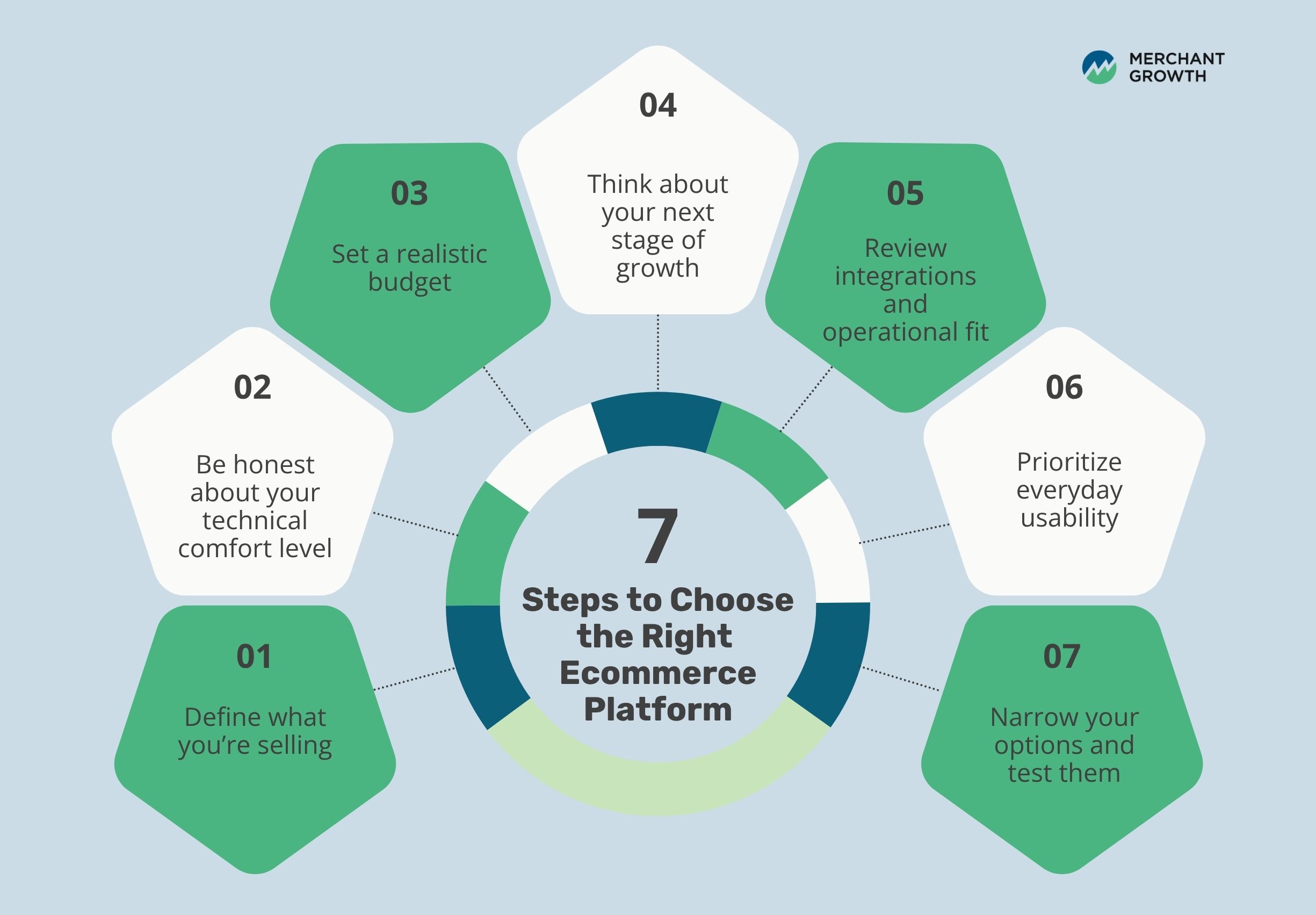
How to Choose the Right Ecommerce Platform
Choosing the right ecommerce platform gets easier when you break the decision into steps instead of trying to compare everything at once. The best platform is usually the one that matches your current needs, supports your next stage of growth, and does not create unnecessary complexity along the way.
Step 1: Define what you’re selling
Start with the basics: are you selling physical products, digital products, subscriptions, B2B services, or a mix of different models? A fashion brand with hundreds of SKUs needs something very different from a consultant selling digital downloads or a wholesaler managing custom account pricing.
When you’re clear on your business model first, it becomes much easier to filter out platforms that are not built for your kind of selling.
Step 2: Be honest about your technical comfort level
Some platforms are designed to be easy from day one, while others give you more control but require more setup and maintenance. If you do not want to deal with hosting, plugins, or troubleshooting, an all-in-one option will likely be a better fit.
On the other hand, if customization matters more than convenience and you have technical support available, a more flexible platform may be worth it.
Step 3: Set a realistic budget
Do not just compare headline pricing. Think about the total working cost of the platform, including apps, themes, payment processing, development help, and any tools you may need for marketing, subscriptions, or shipping.
A platform that looks cheaper upfront can become more expensive later, while a slightly higher monthly fee may actually save money if it includes more built-in functionality.
Step 4: Think about your next stage of growth
A platform should work for the business you have today, but it should also support where you want to go next. Consider whether you plan to expand your product line, sell internationally, add wholesale, connect to a retail store, or increase automation over time.
Choosing a platform that is too limited can create migration headaches later. Choosing one that is far too advanced can create unnecessary cost and complexity now.
Step 5: Review integrations and operational fit
Your ecommerce platform does not operate in isolation. It needs to work with payment processors, shipping providers, accounting tools, email marketing systems, POS software, and other key parts of your business.
Before deciding, make a list of the tools you already use, or know you will need soon, and check how well each platform connects with them.
Step 6: Prioritize everyday usability
It is easy to get distracted by advanced features, but the day-to-day experience matters just as much. Ask yourself how easy it is to add products, update inventory, process orders, and manage customer issues.
A platform that saves you time every day will often deliver more value than one with a long feature list that feels clunky to use.
Step 7: Narrow your options and test them
Once you’ve identified your priorities, narrow the list to two or three serious options. Explore demos, free trials, or backend previews where possible. Looking at the admin experience firsthand often tells you more than reading another feature comparison.
At that point, the decision usually becomes much clearer. You are not choosing the “perfect” platform. You are choosing the one that best fits your business right now, while still giving you room to grow.
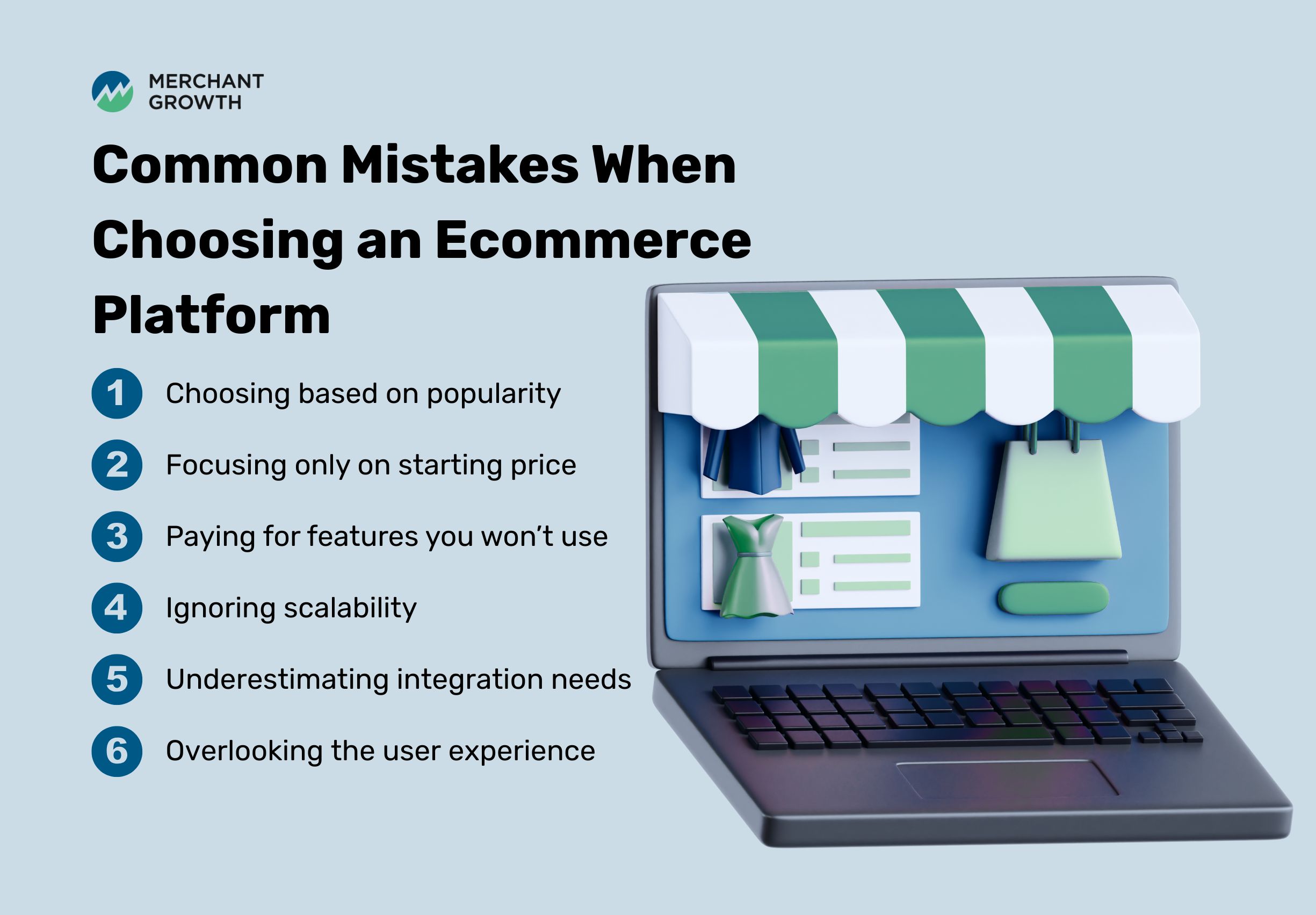
Common Mistakes When Choosing an Ecommerce Platform
Choosing an ecommerce platform can feel exciting at first, but it is also where many businesses make avoidable mistakes. It’s easy to get pulled toward the most popular option, the cheapest monthly plan, or the platform with the longest feature list. The problem is that those factors do not always reflect what your business needs.
Here are some of the most common mistakes to watch for:
- Choosing based on popularity instead of fit: A platform can be widely used and still be the wrong choice for your business model, team, or growth plans.
- Focusing only on starting price: Monthly subscription fees are only part of the picture. Apps, payment processing, themes, and development support can change the real cost significantly.
- Paying for features you won’t use: More features are not always better. If they add cost or complexity without solving a real problem, they can become a distraction.
- Ignoring scalability: A platform that works today may not work six or twelve months from now if your catalog, order volume, or sales channels expand.
- Underestimating integration needs: Your store needs to connect with the rest of your business. If key tools do not integrate properly, operations can become messy very quickly.
- Overlooking the day-to-day user experience: A platform might sound powerful on paper but still be frustrating to manage. Ease of use matters more than many businesses realize.
The good news is that these mistakes are avoidable. A little clarity upfront, about your business model, budget, workflows, and growth plans, can save you a lot of time, money, and frustration later. The goal is not to choose the platform with the most hype. It is to choose the one that will actually help your business run better.
How Merchant Growth Can Support Your Ecommerce Business
Choosing the right platform is an important first step, but it is only one part of building a successful ecommerce business. As your store grows, access to capital can become just as important as the technology behind it.
Merchant Growth provides flexible financing for Canadian businesses, which can help support inventory purchases, marketing campaigns, hiring, expansion, or other investments that help move the business forward.
The right ecommerce platform gives you the foundation to sell effectively. The right financial support gives you the ability to act on growth opportunities when they appear. Put those two pieces together, and you are in a much stronger position to build momentum, serve customers well, and grow with confidence.
The best ecommerce platform is the one that helps your business feel easier to run today, and more ready for tomorrow. If you choose with your real needs in mind, you will not just end up with a better website. You’ll build a stronger path for growth.
Expense Management Software: Best Tools to Track and Control Business Spending
Managing expenses is one of those areas that tends to get more complicated as a business grows. What starts as a few receipts and a simple spreadsheet can quickly turn into a mix of approvals, reimbursements, and unclear spending patterns. Without a clear system in place, it becomes difficult to understand where money is going or how efficiently it’s being used.
This is where expense management software comes into play. These tools are designed to bring structure, automation, and visibility to business spending, helping owners and teams stay organized without adding more manual work. In this guide, we’ll break down how expense management software can support your business and walk through the best tools available based on your business needs.
Where Is Your Business Money Going? Understanding Expense Management
At its core, expense management is the process of tracking, reviewing, and controlling how money is spent within a business. This includes everything from employee reimbursements and travel expenses to subscriptions, software, and operational costs. While the concept is straightforward, the execution can become complex without the right systems in place.
Many businesses struggle with delayed reporting, inconsistent tracking, and a lack of visibility into spending. When expenses are handled manually, it’s easy for things to slip through the cracks or for insights to come too late to be useful. This is why having a structured approach to expense management is essential, not just for organization, but for making better financial decisions overall.
From Spreadsheets to Smart Tools: What Expense Management Software Actually Does
Expense management software replaces manual processes with a centralized platform that automates how expenses are captured, reviewed, and recorded. Instead of collecting receipts and entering data by hand, employees can submit expenses digitally, often in real time. This creates a more streamlined and consistent process across the entire organization.
These platforms typically combine multiple functions into one system, including expense tracking, approval workflows, reporting, and integrations with accounting tools. The result is a more connected and efficient way to manage business spending. Rather than reacting to expenses after the fact, businesses can monitor and manage them as they happen.
What sets these tools apart is their ability to reduce friction while improving accuracy. By automating repetitive tasks and standardizing workflows, expense management software allows teams to spend less time on administrative work and more time focusing on higher-value activities.
Best Expense Management Software by Business Category
There’s no single “best” expense management software for every business. The right solution depends on the size of your business, how your team spends, and how much visibility or control you need. Some tools focus on simplicity and ease of use, while others are built to support more complex workflows and larger teams. Below is a breakdown of some of the most widely used expense management tools, grouped by what they do best.
Best for Small Businesses: Expensify, QuickBooks, Xero & FreshBooks
For small businesses, the priority is usually ease of use, affordability, and quick setup. Many businesses in this stage are deciding between using their accounting software for expense tracking or adopting a dedicated tool that offers more automation and control. The right choice often depends on how complex your expenses are and whether you need structured approval workflows or just basic tracking.
Expensify
Expensify is one of the most widely used expense management tools for small businesses, largely because it simplifies one of the most frustrating parts of the process: receipt tracking. Its mobile-first design allows employees to scan receipts on the spot, while SmartScan automatically extracts and categorizes the data. This removes the need for manual entry and speeds up the entire expense submission process.
The platform offers a free plan that includes basic functionality like receipt scanning, sending and receiving money, and team chat. For businesses that need more structure, the Collect plan (~$7 CAD per user/month) introduces reimbursements, corporate card management, expense approvals, travel booking, and integrations with QuickBooks and Xero. The Control plan (~$12 CAD per user/month, custom pricing) builds on this with more advanced features like multi-level approvals, custom expense rules, ERP integrations, and enhanced reporting.
Expensify strikes a balance between simplicity and capability, making it a strong choice for businesses that want more structure than spreadsheets but don’t need a full enterprise system.
Top Features
- SmartScan receipt capture
- Expense approvals and reimbursements
- Corporate card support
- Travel booking & policy controls
- QuickBooks/Xero integrations
Best For
- Small to mid-sized businesses
- Teams with frequent employee expenses
- Businesses transitioning from manual processes
QuickBooks Online
QuickBooks Online is primarily an accounting platform, but it includes expense tracking features that make it a practical option for many small businesses. Expenses can be automatically pulled in from bank feeds, categorized, and tied directly to financial reports. This creates a centralized system where business owners can manage both accounting and expenses in one place.
Pricing typically ranges from ~$30 to $220 CAD per month, depending on the plan and features required. While QuickBooks is strong when it comes to financial reporting and bookkeeping, it is not designed as a dedicated expense management platform. It lacks more advanced features like layered approval workflows, policy enforcement, and real-time spend controls that are standard in newer expense tools.
That said, QuickBooks is a strong option if you are already using it for accounting and want to avoid adding another system.
Top Features
- Automated expense tracking via bank feeds
- Expense categorization and reporting
- Invoicing and accounting in one system
- Wide integration ecosystem
Best For
- Businesses already using QuickBooks
- Owners wanting an all-in-one solution
- Teams with simpler expense workflows
Xero
Xero is another accounting-first platform that includes expense tracking as part of its broader offering. It allows businesses to manage expense claims, track spending, and integrate financial data within a single system. This makes it especially useful for businesses that want to consolidate their tools rather than introduce a separate expense platform.
Pricing typically falls between ~$25 and $80 CAD per month, depending on the plan. While Xero does support expense tracking, it does not offer built-in corporate card functionality or the same level of automation found in dedicated expense tools. It works best when used as part of a full accounting setup rather than as a standalone expense solution.
For businesses already using Xero, adding expense tracking can be a convenient way to simplify workflows.
Top Features
- Expense claim tracking
- Accounting and reporting integration
- Multi-user access
Best For
- Businesses already using Xero
- Teams looking to consolidate tools
- Simple expense tracking needs
FreshBooks
FreshBooks is a Toronto-based accounting platform that is particularly well-suited for freelancers and small service-based businesses. It combines invoicing, time tracking, accounting, and expense tracking into a single, easy-to-use system. This makes it a strong option for businesses that prioritize simplicity and client billing over complex financial workflows.
Pricing typically ranges from ~$26 to $72 CAD per month, depending on the plan. While FreshBooks offers expense tracking, it is not designed for advanced spend management. It does not include features like corporate cards, layered approvals, or complex policy controls, which limits its use for larger teams or more structured operations.
For freelancers and small teams, however, it offers a clean and efficient way to manage finances without unnecessary complexity.
Top Features
- Expense tracking
- Invoicing and time tracking
- Simple financial reporting
- User-friendly interface
Best For
- Freelancers and consultants
- Small service-based businesses
- Teams prioritizing simplicity
Key Takeaway: Accounting Tools vs Dedicated Expense Platforms
Accounting tools like QuickBooks, Xero, and FreshBooks can handle expense tracking, especially for smaller businesses with straightforward needs. However, they are not purpose-built expense management systems. They focus on recording and reporting expenses rather than actively controlling and managing spending in real time.
If your business requires structured approvals, corporate card controls, or deeper automation, dedicated expense platforms like Expensify, Ramp, or Float will offer significantly more functionality. The choice ultimately comes down to whether you need basic tracking or a more proactive approach to managing spend.
Best for Corporate Cards & Spend Control: Brex, Ramp, Float, Keep
As businesses grow, many move beyond tracking expenses after they happen and instead focus on controlling spending in real time. This is where corporate card and spend management platforms stand out. These tools allow businesses to set rules, monitor transactions instantly, and reduce the need for reimbursements altogether.
Brex
Brex is built around corporate cards and real-time spend management, giving businesses control over expenses before they happen. Instead of reviewing expenses after submission, finance teams can set policies, track transactions instantly, and automate approvals. This proactive approach helps reduce overspending and improve financial visibility.
Brex offers multiple pricing tiers, including a free entry-level option and more advanced plans with additional features. Its strength lies in combining card issuance, expense tracking, and financial controls into a single platform. This makes it particularly valuable for growing businesses that need more structure without adding complexity.
Top Features
- Corporate cards with spend controls
- Real-time transaction tracking
- Automated approvals
- ERP integrations
Best For
- Scaling businesses
- Finance teams needing control
- Multi-entity organizations
Ramp
Ramp positions itself as an automation-first spend management platform, with a strong focus on helping businesses reduce costs. It goes beyond tracking expenses by identifying inefficiencies and offering insights into where money can be saved. This makes it both an expense tool and a financial optimization platform.
Ramp offers a free plan, which makes it accessible for many businesses, along with more advanced features for larger teams. Its automation capabilities, including receipt matching and policy enforcement, reduce the need for manual oversight. This allows finance teams to focus more on strategy rather than administration.
Top Features
- Expense automation
- Spend insights and savings recommendations
- Receipt matching
- Free pricing option
Best For
- Businesses focused on cost control
- Teams wanting automation-first tools
- Growing companies
Float
Float is a Canadian-built spend management platform designed specifically for small and mid-sized businesses. It combines corporate cards, expense tracking, and approval workflows into a single system, making it easier to manage team spending in real time. Its focus on the Canadian market gives it an edge for businesses looking for localized solutions.
Float offers both free and paid pricing tiers, making it accessible while still scalable. Its integration with tools like QuickBooks and Xero ensures that financial data flows smoothly between systems.
Top Features
- Corporate cards
- Real-time spend tracking
- Approval workflows
- Accounting integrations
Best For
- Canadian businesses
- Teams needing spend control
- Growing SMBs
Keep
Keep is a Canadian platform that focuses on simplifying expense automation through corporate cards and lightweight spend tracking tools. While it does not offer the same depth as full expense management platforms, it provides a streamlined way for businesses to control spending and reduce manual processes.
Its strength lies in its simplicity and accessibility, making it a strong option for smaller businesses or startups that are not ready for more complex systems.
Top Features
- Corporate cards
- Expense tracking
- Simple automation
Best For
- Small businesses
- Startups
- Teams needing lightweight solutions
Best for Enterprise: SAP Concur & Workday
Enterprise-level expense management is less about simple tracking and more about control, compliance, and integration across multiple systems. Larger organizations often need tools that can handle complex approval structures, global operations, and strict financial policies. These platforms are designed to support that level of scale, often connecting expense management with broader financial, HR, and operational systems.
SAP Concur
SAP Concur is one of the most established platforms in enterprise expense management, particularly for organizations that need to manage both travel and expenses in a single system. It allows businesses to automate expense reporting, enforce policies, and gain detailed visibility into spending across departments and regions. This makes it especially valuable for companies with frequent travel or complex reimbursement structures.
One of Concur’s key strengths is its ability to standardize processes across large teams while maintaining compliance. It includes advanced reporting tools, audit capabilities, and integrations with ERP systems, which help ensure that financial data remains consistent and accurate. Pricing is provided on a custom, quote-based model, allowing the platform to be tailored to each organization’s size and needs.
Top Features
- Travel and expense management in one platform
- Advanced reporting and analytics
- Policy enforcement and compliance tools
- ERP integrations
Best For
- Large organizations
- Companies with frequent travel expenses
- Businesses requiring strict compliance and reporting
Workday
Workday takes a broader approach to expense management by embedding it within a full enterprise resource planning (ERP) system. Rather than functioning as a standalone tool, it connects expense management with finance, HR, and procurement processes. This creates a more unified system where data flows seamlessly across different parts of the organization.
Because of its scope, Workday is best suited for organizations that are already operating at scale or planning to unify their internal systems. It offers advanced insights, automation, and reporting, but it also requires a higher level of implementation and customization. Pricing is quote-based and tailored to each business, reflecting the complexity of the platform.
Top Features
- End-to-end spend management
- Integration with HR and finance systems
- Advanced analytics and reporting
- Scalable enterprise infrastructure
Best For
- Large enterprises
- Businesses needing system-wide integration
- Organizations managing complex operations

Best for Global & Multi-Currency: Airwallex & OFX
For businesses operating internationally, expense management goes beyond tracking receipts. It involves handling multiple currencies, managing cross-border payments, and maintaining visibility across different regions. These tools are designed to simplify global financial operations while keeping everything connected.
Airwallex
Airwallex is built for businesses that operate across borders and need to manage both spending and payments in multiple currencies. It combines expense management with global financial infrastructure, allowing businesses to issue cards, track expenses, and manage international transactions from a single platform. This makes it particularly useful for companies scaling internationally.
Pricing includes a free “Explore” plan, with additional tiers such as Grow and Accelerate that offer more advanced features. Its ability to integrate global payments with expense tracking sets it apart from more traditional expense tools.
Top Features
- Multi-currency accounts
- Global corporate cards
- Expense tracking and approvals
- International payment capabilities
Best For
- International businesses
- Companies expanding globally
- Teams managing multi-currency expenses
OFX
OFX focuses on international payments and currency management, making it a strong option for businesses that deal with global suppliers or clients. While it includes tools for tracking spending, its primary strength lies in simplifying foreign exchange and cross-border transactions. This gives businesses better visibility into international financial activity.
Pricing is typically transaction-based or customized depending on business needs. Unlike dedicated expense platforms, OFX is not centered around employee expense reporting but instead provides a broader view of global financial operations. This makes it a complementary tool rather than a direct replacement for traditional expense management software.
Top Features
- Foreign exchange management
- Global payments
- Expense visibility across currencies
- Integration with financial systems
Best For
- Businesses with international payments
- Companies managing foreign exchange
- Teams needing global financial visibility
Best for Automation: Zoho Expense
Automation is one of the biggest drivers behind adopting expense management software, and Zoho Expense is built specifically around this idea. It focuses on simplifying the entire expense lifecycle, from receipt capture to approvals and reporting, using automated workflows. This makes it particularly useful for businesses that want to reduce manual processes without moving into enterprise-level systems.
Zoho Expense offers a free plan along with tiered pricing options, making it accessible for small and growing businesses. It integrates seamlessly with the broader Zoho ecosystem, as well as other accounting tools, which allows businesses to build a connected financial workflow. While it may not offer the same card-based controls as platforms like Ramp or Float, it excels in process automation and ease of use.
Top Features
- Automated expense workflows
- Receipt scanning and categorization
- Approval management
- Reporting and analytics
Best For
- Businesses prioritizing automation
- Teams using Zoho products
- Small to mid-sized companies
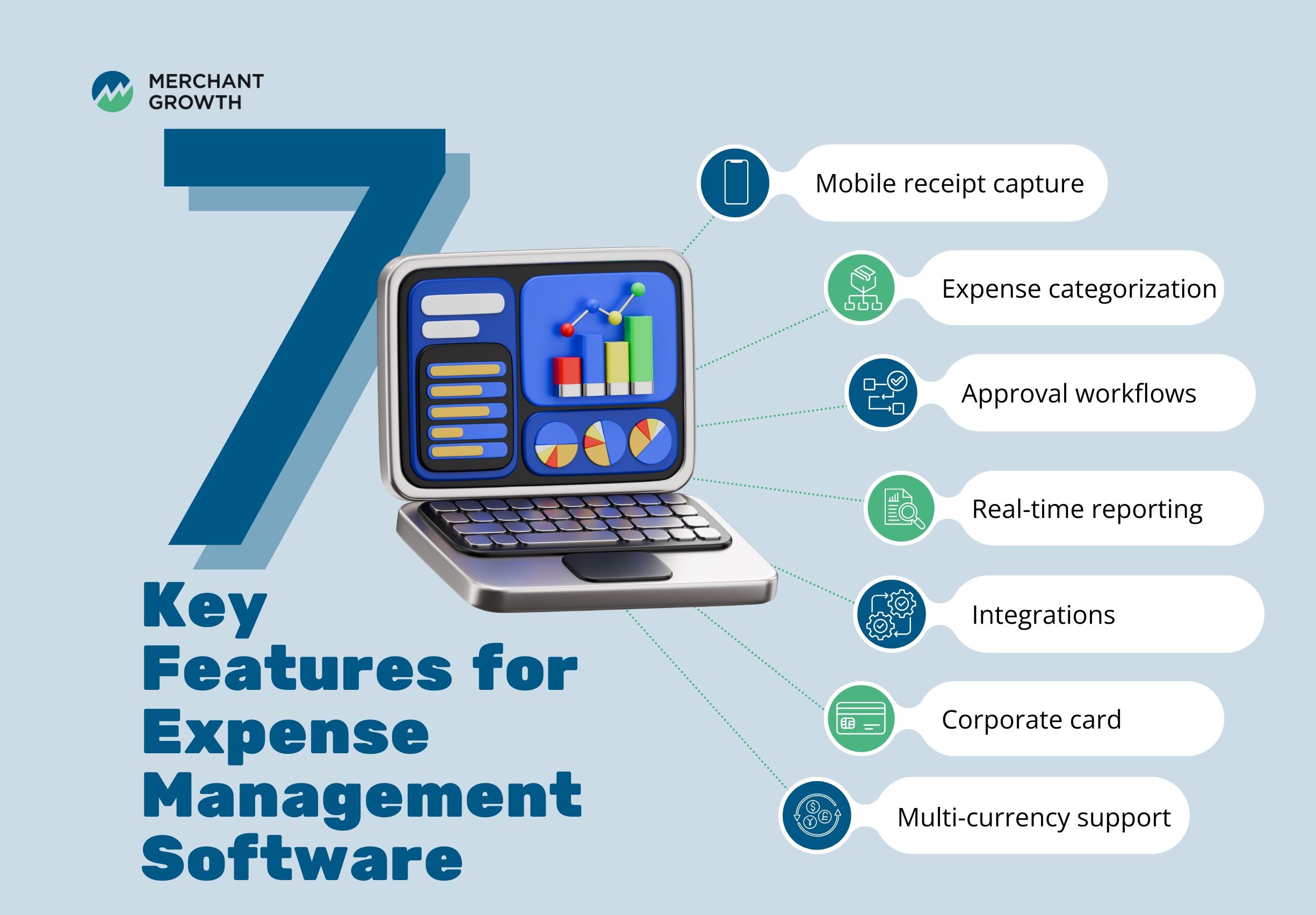
Key Features to Look for in Expense Management Software
While each platform offers its own strengths, there are several core features that consistently matter when evaluating expense management software. These features directly impact how efficient and useful the tool will be in day-to-day operations.
Some of the most important features to consider include:
- Mobile receipt capture, allowing employees to submit expenses quickly
- Automated expense categorization to reduce manual input
- Approval workflows to maintain oversight and control
- Real-time reporting for better visibility into spending
- Integrations with accounting and ERP systems
- Corporate card integration for seamless tracking
- Multi-currency support for global operations
Choosing a tool with the right combination of these features ensures that it aligns with how your business operates, rather than forcing you to adapt your processes to the software.
Benefits of Expense Management Software
Implementing expense management software goes beyond simply organizing receipts. It creates a more structured and transparent way to manage how money moves through your business. Instead of relying on delayed reports or manual tracking, businesses gain immediate visibility and control over spending.
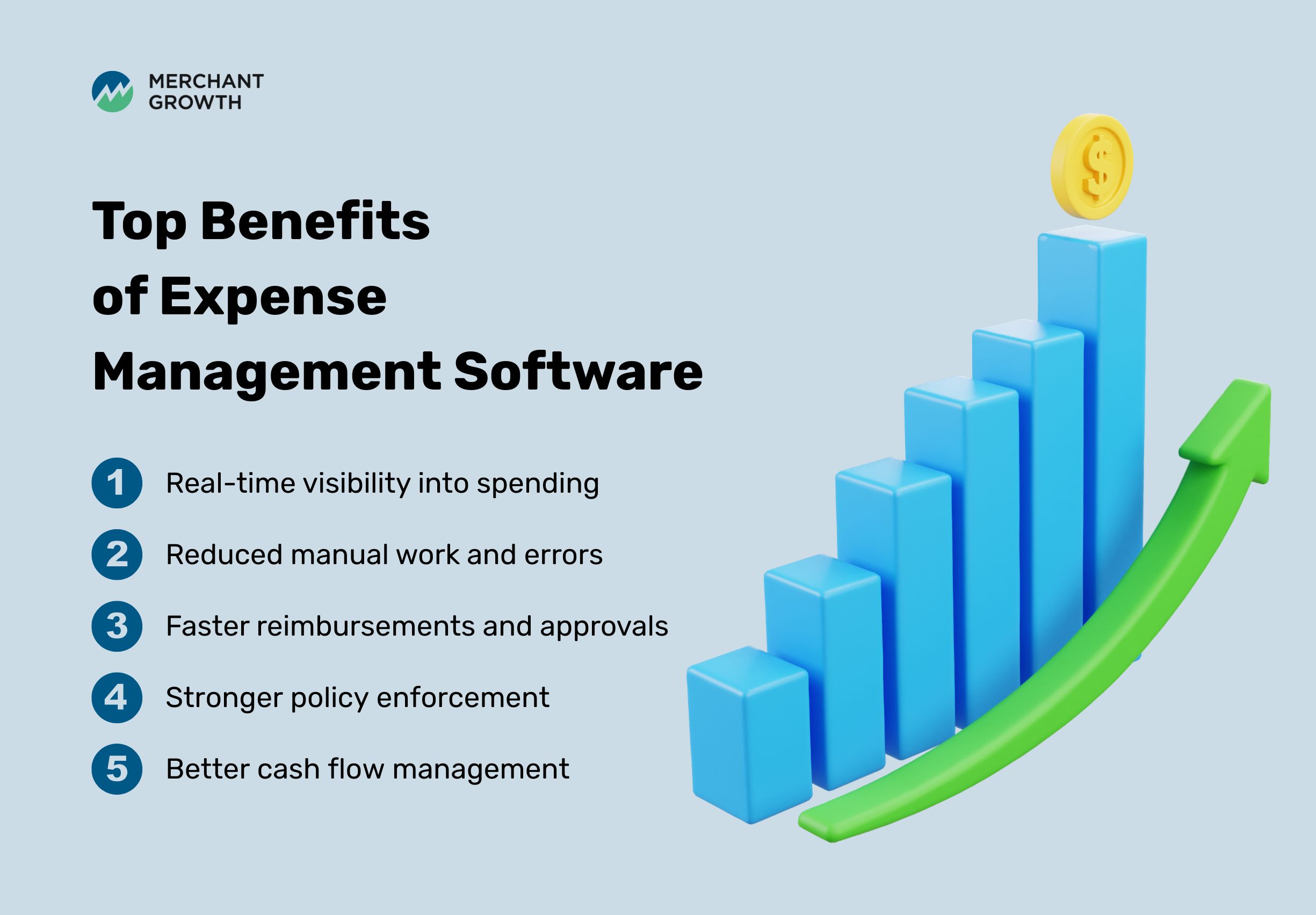
Key benefits include:
- Real-time visibility into spending: See exactly where money is going as expenses happen, making it easier to identify trends and catch issues early.
- Reduced manual work and errors: Automation removes repetitive tasks like data entry and approval routing, improving accuracy and saving time.
- Faster reimbursements and approvals: Streamlined workflows ensure expenses are processed quickly, improving the experience for employees and finance teams.
- Stronger policy enforcement: Set rules and automatically flag out-of-policy expenses, reducing the need for manual oversight.
- Better cash flow management: Clear insights into spending help businesses plan ahead and avoid unexpected shortfalls.
Over time, these improvements lead to stronger financial control and a more proactive approach to managing business finances.
How Expense Management Software Works
Expense management software follows a structured workflow that simplifies how expenses are captured, reviewed, and recorded. While each platform may vary slightly, most systems follow a similar process designed to reduce friction and improve consistency.
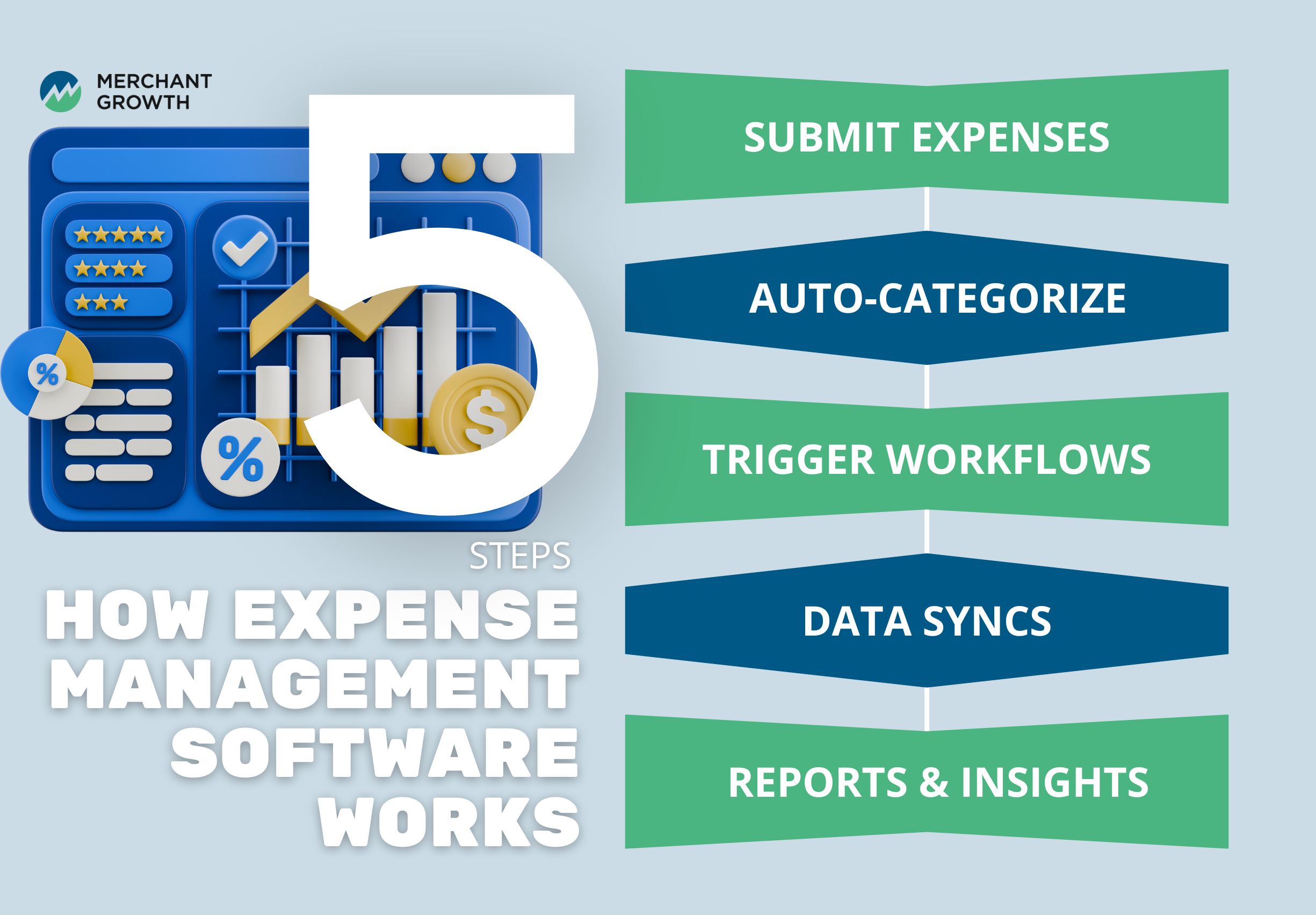
Here’s how it typically works:
- Employees submit expenses: Expenses are submitted through a mobile app or web platform, often by uploading a receipt or linking a transaction directly from a corporate card or bank feed.
- Expenses are automatically categorized: The system uses predefined rules to categorize expenses, reducing the need for manual input and ensuring consistency across records.
- Approval workflows are triggered: Managers review submitted expenses and either approve or flag them based on company policies.
- Data syncs with accounting systems: Once approved, expenses are automatically recorded in accounting software, keeping financial records accurate and up to date.
- Reporting and insights are generated: Businesses can then access dashboards and reports to analyze spending patterns and make informed decisions.
This structured workflow replaces fragmented, manual processes with a centralized system, making expense management more reliable and scalable as a business grows.
How to Choose the Right Expense Management Software
Choosing the right expense management software starts with understanding your business needs. A small team with simple expenses may prioritize ease of use, while a larger organization may need more advanced features and controls. Matching the tool to your level of complexity is key.
It’s also important to consider how the software integrates with your existing systems. A platform that connects seamlessly with your accounting tools will save time and reduce the risk of errors. Ease of adoption is another critical factor, as even the best software won’t deliver value if it’s not used consistently.
Finally, consider how the tool will scale with your business. As your operations grow, your expense management needs will likely become more complex. Choosing a solution that can evolve with you helps avoid the need for frequent changes down the line.
Why Expense Management Software Matters for Small Businesses
For small businesses, managing expenses efficiently can have a direct impact on cash flow and overall financial health. Without clear visibility, it’s easy for costs to add up or for inefficiencies to go unnoticed. Expense management software provides a structured way to stay on top of spending without adding extra workload.
It also creates a foundation for growth. As a business expands, having consistent processes in place makes it easier to scale operations without losing control. This allows owners to focus more on growth opportunities and less on day-to-day financial administration.
Choosing the Right Tool for Your Business
Expense management software is not just about tracking spending, it’s about creating a system that supports better financial decisions. The right tool can help you stay organized, reduce manual work, and gain clearer insight into how your business operates.
Ultimately, the best solution is the one that fits your current needs while allowing room for growth. By focusing on usability, integration, and scalability, you can choose a platform that supports both your day-to-day operations and your long-term goals.
How Merchant Growth Supports Your Financial Operations
Managing expenses is one part of building a strong financial foundation, but having access to capital is just as important. Merchant Growth provides flexible funding solutions that help Canadian businesses manage cash flow and invest in growth opportunities. By combining better expense management with the right financial support, businesses can make more confident decisions and operate with greater stability.
Additionally, Merchant Growth customers have access to additional business tools through Merchant's Market, our exclusive customer marketplace. Some of the expense management and spend control platforms discussed in this guide are available through Merchant's Market, making it easier for existing customers to discover solutions that support their day-to-day operations. Explore exclusive partner discounts in Merchant’s Marketplace by logging into your Client Portal today.
How Inflation Is Impacting Small Businesses in Canada (and What It Means for Survival)
Inflation has become more than just an economic headline for Canadian small business owners. It is showing up in day-to-day decisions, from how much inventory to order to whether it makes sense to take on new expenses or delay investments. While inflation is a normal part of the economic cycle, the pace and persistence of recent increases have created a level of pressure that many businesses are still adjusting to.
For many owners, the challenge isn’t just that costs are rising; it’s that multiple pressures are happening at once. Expenses are increasing, customers are becoming more price-sensitive, and borrowing is getting more expensive. This combination can make it harder to plan ahead with confidence.
In fact, in the third quarter of 2024, 50.2% of Canadian businesses reported inflation as their top expected obstacle, making it the most common concern across the country. Understanding how inflation affects your business is the first step toward responding to it in a way that protects both stability and long-term growth.
What Inflation Really Means for Small Businesses
In a business context, inflation is best understood as a steady increase in the cost of running your operations. This includes everything from the price of goods and materials to wages, rent, utilities, and financing. While inflation is often discussed in broad economic terms, businesses feel it in very specific and practical ways.
Unlike consumers, who may adjust spending habits gradually, businesses have to react more directly. If supplier costs rise, those increases often need to be absorbed or passed on quickly. If borrowing becomes more expensive, it affects decisions around growth, hiring, and inventory. Inflation, in this sense, is not a single issue but a collection of pressures that impact multiple areas at once.
This is why inflation can feel particularly challenging. It requires businesses to constantly reassess decisions that were previously stable, from pricing to purchasing to cash flow planning.
Why Inflation Can Increase the Risk of Small Business Closures
Inflation on its own does not automatically lead to business closures, but it can increase risk when multiple pressures build over time. When costs rise faster than revenue and margins begin to shrink, businesses have less flexibility to absorb unexpected changes or setbacks. Over time, this can create financial strain that becomes difficult to reverse.
Small businesses are often more vulnerable in this environment because they tend to have fewer financial buffers. They may have less negotiating power with suppliers, less access to low-cost financing, and a greater reliance on consistent cash flow to operate. This makes it harder to absorb rising costs without making difficult trade-offs.
Rising borrowing costs add another layer of pressure. More than one-third of Canadian businesses (34.1%) reported that interest rates and debt costs were expected to be a major obstacle. When debt becomes more expensive, it reduces flexibility and increases the importance of managing cash flow carefully.
Closures, when they do occur, are rarely caused by a single issue. More often, they are the result of ongoing pressure across costs, revenue, and financing that gradually becomes unsustainable.
The Key Ways Inflation Affects Small Businesses
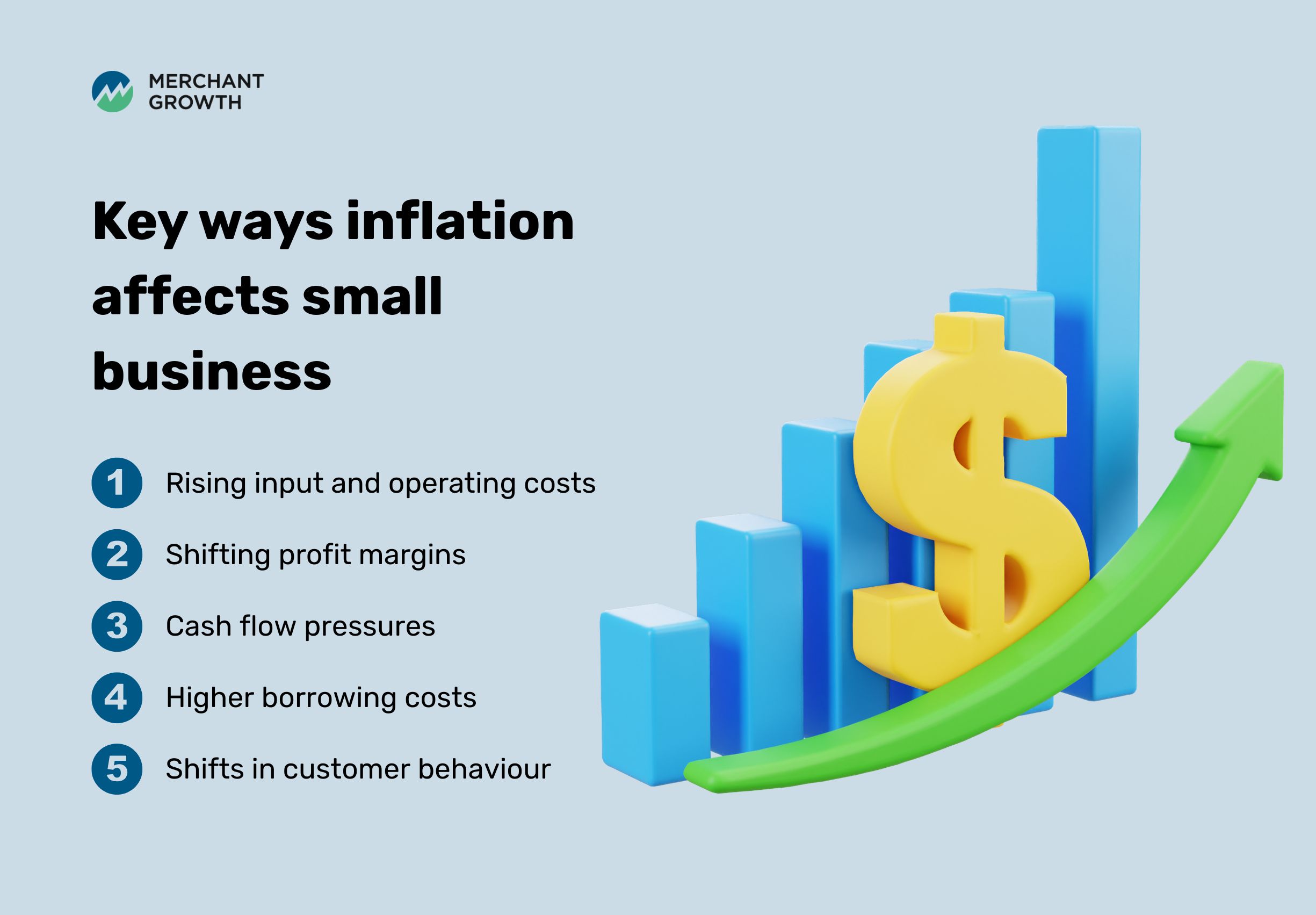
Inflation rarely impacts just one part of a business. Instead, it tends to affect several areas at the same time, creating a cumulative effect that can be difficult to manage without a clear strategy. Costs may be rising across suppliers, labour, and operations, while at the same time, customer demand may be shifting and access to financing becomes more expensive. When these pressures happen together, they don’t just add up; they compound, making it more challenging for businesses to maintain stability without adjusting how they operate.
Rising Input and Operating Costs
One of the most immediate effects of inflation is the increase in input costs. Businesses often see higher prices from suppliers, increased transportation costs, and rising expenses for essentials like utilities and rent. These increases can happen quickly and may not always be predictable, making it harder to plan ahead with confidence.
Because these costs are tied to day-to-day operations, they are difficult to avoid. For example, a restaurant may see higher food costs week over week, while a retail business may face increased shipping and inventory expenses. In response, many businesses start by reviewing supplier relationships, negotiating terms where possible, or identifying areas where small efficiencies can offset rising costs. Even minor adjustments, like optimizing ordering schedules or reducing waste, can help ease pressure over time.
Shrinking Profit Margins
As costs rise, profit margins often come under pressure. While increasing prices can help offset these costs, it is not always a straightforward solution. Customers may become more price-sensitive during inflationary periods, which can limit how much businesses can increase prices without affecting demand.
This creates a balancing act between maintaining profitability and remaining competitive. For instance, a service-based business might choose to gradually increase rates while adding more value to its offerings, rather than implementing a sharp price increase all at once. In many cases, businesses may accept lower margins in the short term to retain customers and maintain stability, while looking for longer-term ways to rebuild profitability.
Cash Flow Pressure
Inflation can also tighten cash flow, even for businesses that remain profitable on paper. Higher costs mean more cash is required to maintain operations, while customer payment timelines may remain unchanged. This gap can create short-term liquidity challenges that are not always immediately visible.
In practice, this might look like needing to pay suppliers sooner while waiting weeks for customer payments to come in. To manage this, businesses often focus on improving invoicing processes, following up on outstanding payments more consistently, or adjusting payment terms where possible. Keeping a closer eye on cash flow timing, not just totals, can make a meaningful difference in maintaining stability.
Higher Borrowing Costs
Interest rate increases often accompany inflation, making borrowing more expensive. This affects everything from lines of credit to long-term financing. For businesses that rely on financing to manage cash flow or invest in growth, higher interest costs can limit options or change the timing of key decisions.
For example, a business that planned to expand or purchase new equipment may choose to delay those investments or explore alternative financing structures. In some cases, reviewing existing debt and understanding how rising rates impact repayments can help businesses make more informed decisions. The goal is not necessarily to avoid financing altogether, but to ensure it aligns with current cash flow realities.
Shifts in Customer Behaviour
Inflation doesn’t just affect businesses; it also changes how customers spend. As consumers face higher costs in their own lives, they may reduce discretionary spending, delay purchases, or become more selective in how they choose products and services.
For businesses, this can lead to noticeable shifts in demand. A retailer, for example, may see customers opting for lower-priced items, while a service provider may experience longer decision cycles. Understanding these patterns allows businesses to adjust their approach, whether that means offering more flexible options, highlighting value more clearly, or refining their product mix to better match customer priorities.
How Canadian Small Businesses Are Responding to Inflation
While inflation creates challenges, it has also led many businesses to adapt and adjust their operations. Rather than reacting passively, many small business owners are taking deliberate steps to manage costs and maintain stability.
Recent data from Merchant Growth highlights how businesses are responding to the tightening of costs in response to the international economic climate:
- 55% are cutting discretionary spending
- 45% plan to take on additional financing
- 29% are negotiating supplier terms
- 25% are reducing inventory levels
- 53% report headcount has remained steady
These actions reflect a mix of cost control and cautious planning. Reducing discretionary spending allows businesses to protect essential operations, while negotiating with suppliers can help offset rising costs. Adjusting inventory levels helps manage cash flow more effectively, particularly when demand becomes less predictable.
At the same time, the fact that more than half of businesses are maintaining headcount suggests a level of cautious resilience. Rather than making drastic cuts, many are choosing to stabilize operations and wait for clearer signals before making larger changes.
Pricing Decisions in an Inflationary Environment
Pricing becomes one of the most important and most challenging decisions during periods of inflation. While increasing prices can help protect margins, it also introduces risk, particularly if customers are already feeling financial pressure themselves. Businesses need to balance the need to remain profitable with the importance of maintaining customer trust and demand.
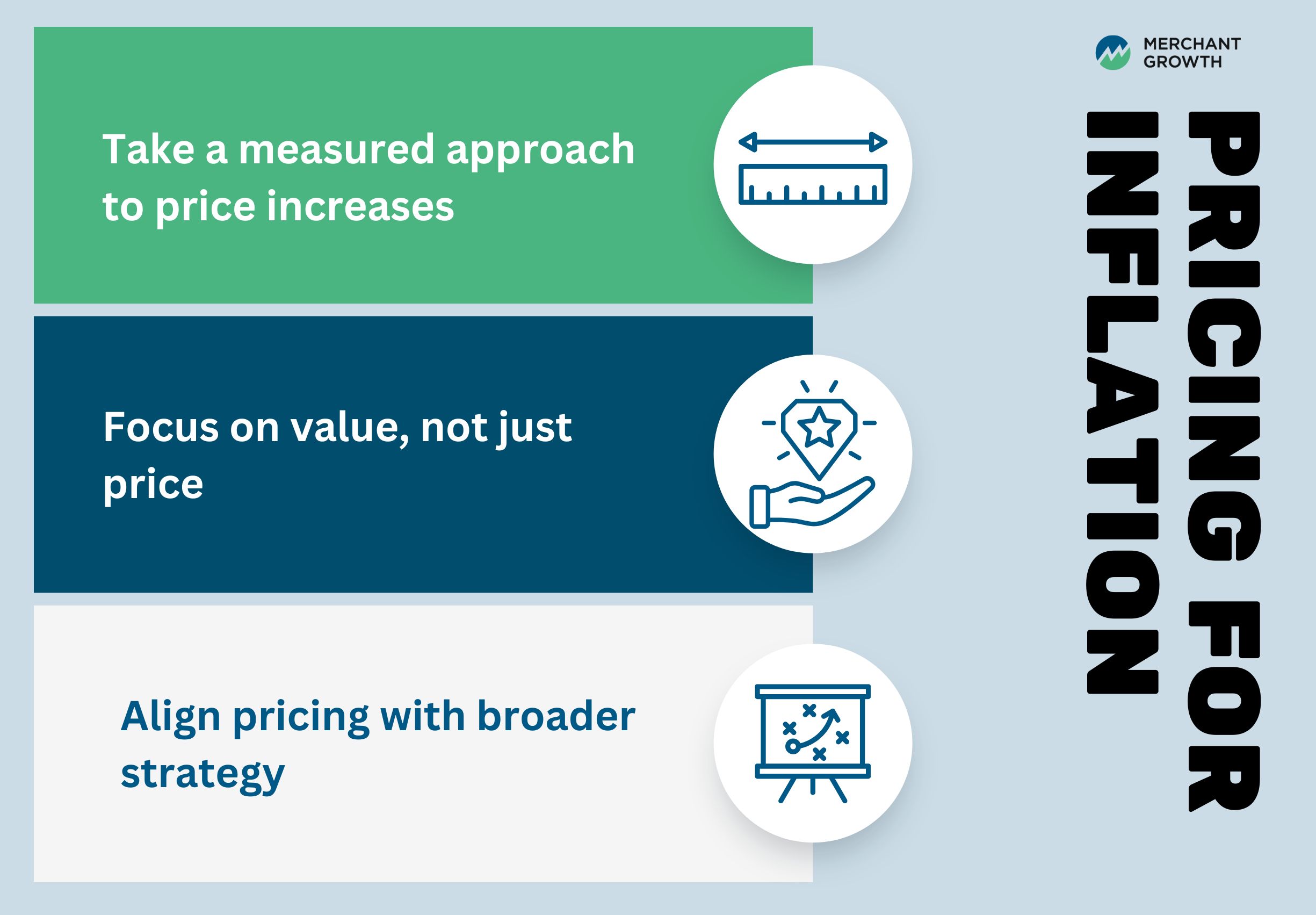
Taking a Measured Approach to Price Increases
Rather than making large, sudden adjustments, many businesses benefit from gradual price increases that are easier for customers to absorb. This approach allows you to monitor how customers respond and adjust accordingly. It also reduces the likelihood of disrupting long-standing relationships or losing repeat business.
Clear communication plays a key role here. When customers understand why prices are increasing, whether due to supplier costs, labour, or broader economic conditions, they are often more receptive. Transparency can help maintain trust even when pricing changes are necessary.
Focusing on Value, Not Just Price
In inflationary periods, competing solely on price becomes more difficult and often less sustainable. Businesses that clearly communicate the value they provide, whether through quality, service, or reliability, are often better positioned to retain customers even as prices increase.
This might involve reinforcing what differentiates your business, improving customer experience, or bundling offerings to create perceived value. Shifting the conversation away from price alone can help protect both margins and customer relationships.
Aligning Pricing with Broader Strategy
Pricing decisions rarely exist in isolation. They are closely tied to cost management, customer retention strategies, and long-term positioning. For example, a business may choose to absorb certain cost increases in the short term to maintain market share, while adjusting pricing more gradually over time.
The goal is not to find a perfect price point, but to create a pricing strategy that supports both short-term stability and long-term sustainability. Businesses that take a more strategic approach to pricing are better equipped to navigate ongoing uncertainty.
Managing Cash Flow and Debt During Inflation
As inflation increases financial pressure, cash flow management becomes even more critical. Even profitable businesses can experience strain if cash outflows begin to outpace inflows, particularly when costs are rising, and payment cycles remain unchanged. Maintaining visibility into cash flow is essential for making informed decisions.
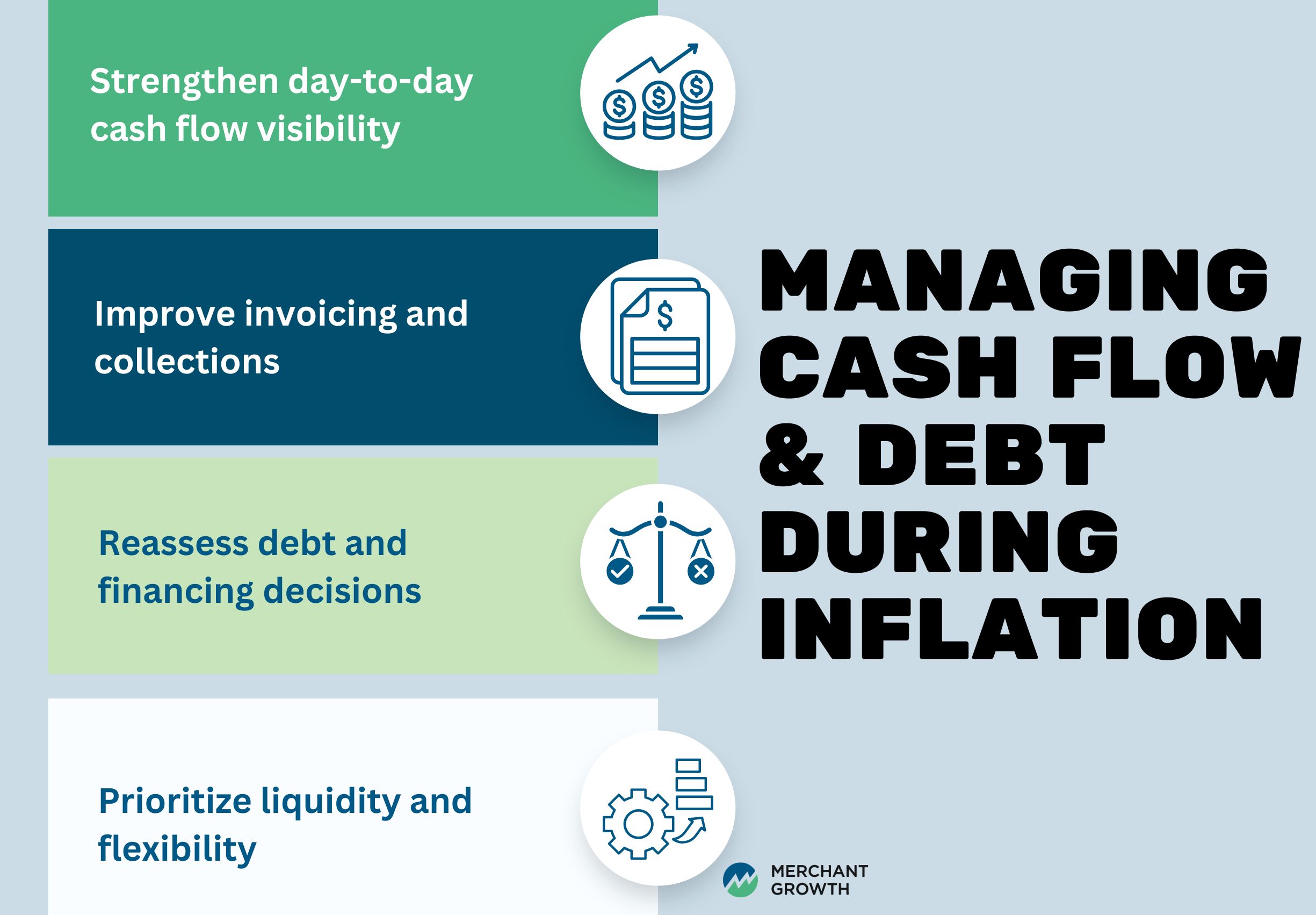
Strengthening Day-to-Day Cash Flow Visibility
The first step in managing cash flow effectively is understanding exactly where money is coming from and where it is going. This includes monitoring incoming payments, tracking expenses closely, and identifying any timing gaps that could create short-term pressure.
Regular cash flow reviews can help businesses spot issues early and adjust before they become larger problems. This level of visibility also makes it easier to plan for upcoming expenses and avoid unnecessary financial strain.
Improving Invoicing and Collections
In an inflationary environment, delays in receiving payments can have a greater impact than usual. Improving invoicing processes, shortening payment terms where possible, and following up consistently on outstanding invoices can help maintain steady cash flow.
Even small improvements in how quickly payments are collected can make a meaningful difference. This reduces reliance on external financing and gives businesses more control over their financial position.
Reassessing Debt and Financing Decisions
With borrowing costs rising, it becomes increasingly important to evaluate existing debt and any new financing decisions carefully. Businesses may need to review repayment terms, interest rates, and overall debt levels to ensure they remain manageable.
At the same time, financing can still play a valuable role when used strategically. For many businesses, access to capital helps bridge gaps, maintain operations, or invest in opportunities. The key is ensuring that any financing aligns with realistic cash flow expectations.
Prioritizing Liquidity and Flexibility
Cash flow management is not just about covering current expenses; it’s about maintaining flexibility. Businesses with stronger liquidity are better positioned to respond to unexpected changes, whether that’s a sudden cost increase or a shift in demand.
By prioritizing liquidity, businesses can reduce risk and create more room to make thoughtful decisions rather than reactive ones.
Planning for Uncertainty: Why Flexibility Matters
Inflation introduces a level of unpredictability that can make even the most well-thought-out plans feel outdated. Costs may rise faster than expected, customer demand can shift, and timelines that once felt reliable may start to move. In this kind of environment, it’s less about having a perfect plan and more about having one that can adapt as things change.
For many business owners, this shows up in small but important decisions. It might mean holding off on a large purchase, adjusting hiring plans, or revisiting pricing more often than usual. Building flexibility into how you plan gives you more room to respond without feeling like you’re constantly starting from scratch.
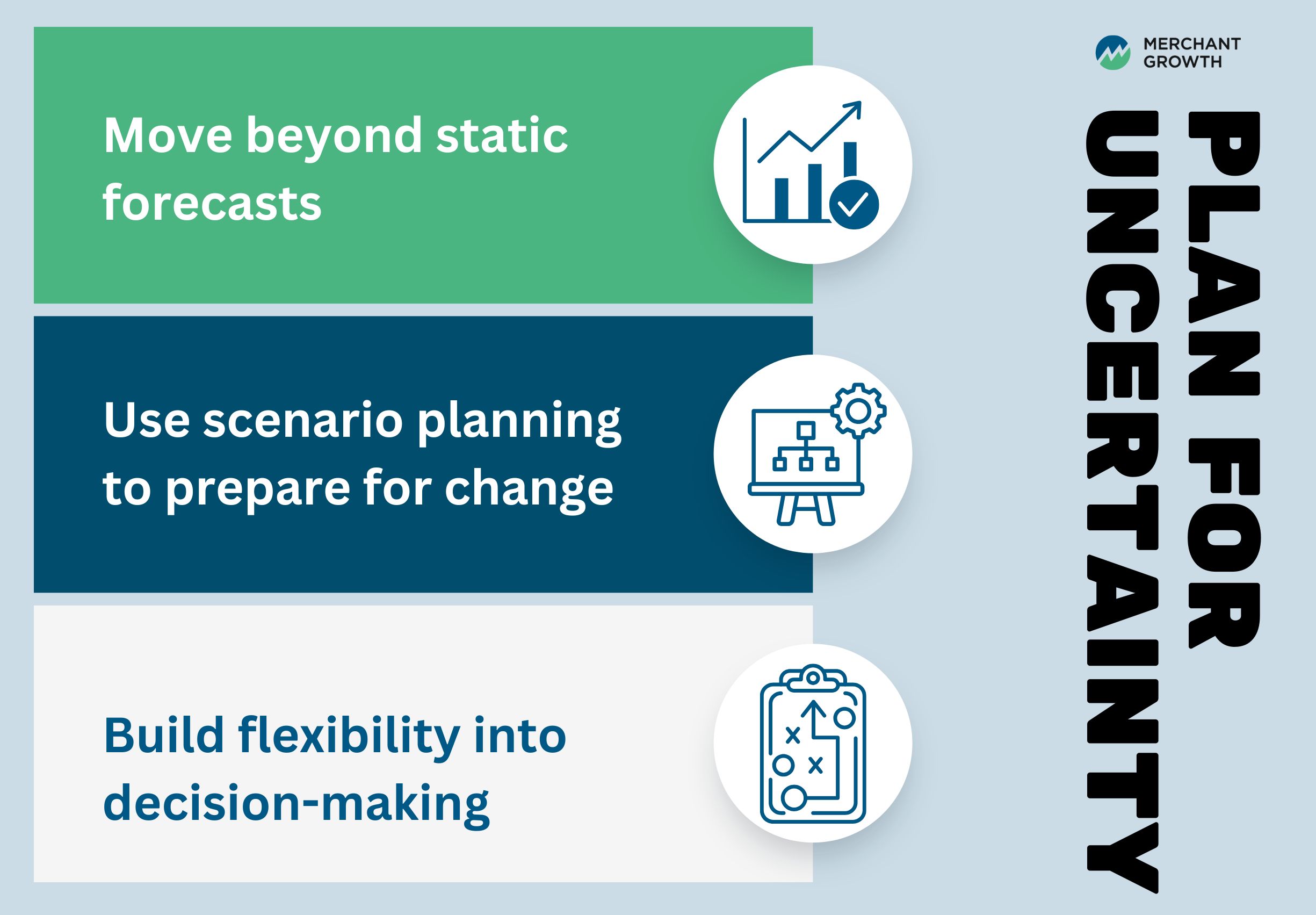
Moving Beyond Static Forecasts
Traditional planning often relies on fixed assumptions about costs, revenue, and growth. During inflationary periods, those assumptions can change quickly, making static forecasts less reliable over time. A budget that felt accurate a few months ago may no longer reflect current conditions.
Instead of treating your plan as something you set once and revisit at the end of the year, it can be helpful to check in more regularly. For example, some businesses are reviewing their numbers monthly instead of quarterly, adjusting projections as new information comes in. This doesn’t require a complete overhaul each time, just small updates that keep your plan aligned with reality.
Using Scenario Planning to Prepare for Change
Scenario planning is a practical way to reduce uncertainty by thinking through a few different “what if” situations in advance. Rather than relying on one expected outcome, you explore how your business would respond under different conditions.
For example, you might ask:
- What happens if supplier costs increase by another 10%?
- How would we adjust if sales slow down for a quarter?
- What changes would we make if borrowing costs continue to rise?
By mapping out these scenarios, even at a high level, you can identify potential risks and outline simple responses ahead of time. This makes it easier to act quickly and confidently if those situations arise, rather than making decisions under pressure.
Building Flexibility into Decision-Making
Flexibility becomes one of the most valuable assets during uncertain periods. In practice, this often means avoiding decisions that limit your options too early. For example, a business might choose to lease equipment instead of purchasing it outright, or stagger hiring rather than committing to multiple roles at once.
It can also mean maintaining a financial buffer where possible, even if it feels conservative in the short term. Having that extra room allows you to respond to unexpected costs or opportunities without disrupting your operations.
Businesses that build flexibility into their decision-making are often better positioned to adapt as conditions evolve. Instead of reacting to every change, they have the space to pause, evaluate, and choose the next step more strategically.
The Balance Between Cost Control and Growth
When costs are rising, it’s natural to focus on tightening spending wherever possible. But while cost control is important, it’s just as important not to lose sight of what helps your business move forward. Cutting too deeply or too quickly can make it harder to compete, serve your customers well, or take advantage of opportunities when they arise.
Finding the right balance often comes down to being intentional about where you reduce and where you continue to invest. For example, a business might delay a non-essential purchase or scale back certain expenses, while still investing in areas that directly support revenue or customer experience. The goal isn’t to stop spending altogether, but to make sure every dollar is working toward something meaningful.
Businesses that take this more balanced approach are often better positioned over time. They’re not just protecting themselves from short-term pressure, they’re also making sure they don’t lose momentum in the process.
Supporting Your Business Through Inflation
Inflation can feel overwhelming at times, especially when multiple challenges are happening at once. But it can also be a moment to step back and strengthen how your business operates. Small improvements in how you manage finances, track performance, and make decisions can add up quickly.
For many business owners, this starts with gaining clearer visibility into their numbers. Understanding where money is going, how cash is flowing, and where adjustments can be made gives you more control over your situation. From there, it becomes easier to make thoughtful decisions rather than reacting to pressure as it comes.
The goal isn’t to have all the answers at once. It’s to stay consistent, review your position regularly, and make adjustments as needed. Over time, that approach builds resilience and confidence, even in uncertain conditions.
How Merchant Growth Supports Canadian Businesses
Navigating inflation often requires a combination of strong financial habits and access to the right support. For many businesses, cash flow can become tight even when the business itself is performing well. Having access to flexible funding can help bridge that gap and provide breathing room when it’s needed most.
Merchant Growth works with Canadian small businesses to provide financing solutions designed to support day-to-day operations and longer-term growth. Whether it’s managing rising costs, smoothing out cash flow, or taking advantage of an opportunity, access to capital can help businesses stay steady without putting unnecessary strain on their operations.
With 45% of businesses considering additional financing, it’s clear that many are looking for ways to stay flexible and prepared. When paired with clear financial visibility and thoughtful planning, the right support can make it easier to navigate uncertainty and continue moving forward with confidence.
Can Your Business Afford a Loan? Understanding Debt Service Coverage Ratio (DSCR)
When you’re thinking about taking on a loan, the first question usually isn’t about interest rates or repayment terms, it’s whether your business can realistically afford the debt in the first place. You might be generating steady revenue and managing day-to-day expenses, but that doesn’t always mean there’s enough room to comfortably take on additional financial obligations. This is where many business owners find themselves unsure of what their numbers are really telling them. Debt Service Coverage Ratio, or DSCR, helps bring clarity to that uncertainty.
DSCR is one of the most important financial metrics lenders use to evaluate whether a business can handle debt, but it’s just as valuable for business owners trying to make smarter financial decisions. Understanding DSCR gives you a clearer picture of your financial capacity, helping you move from guesswork to informed planning when it comes to borrowing.
What Is Debt Service Coverage Ratio (DSCR)?
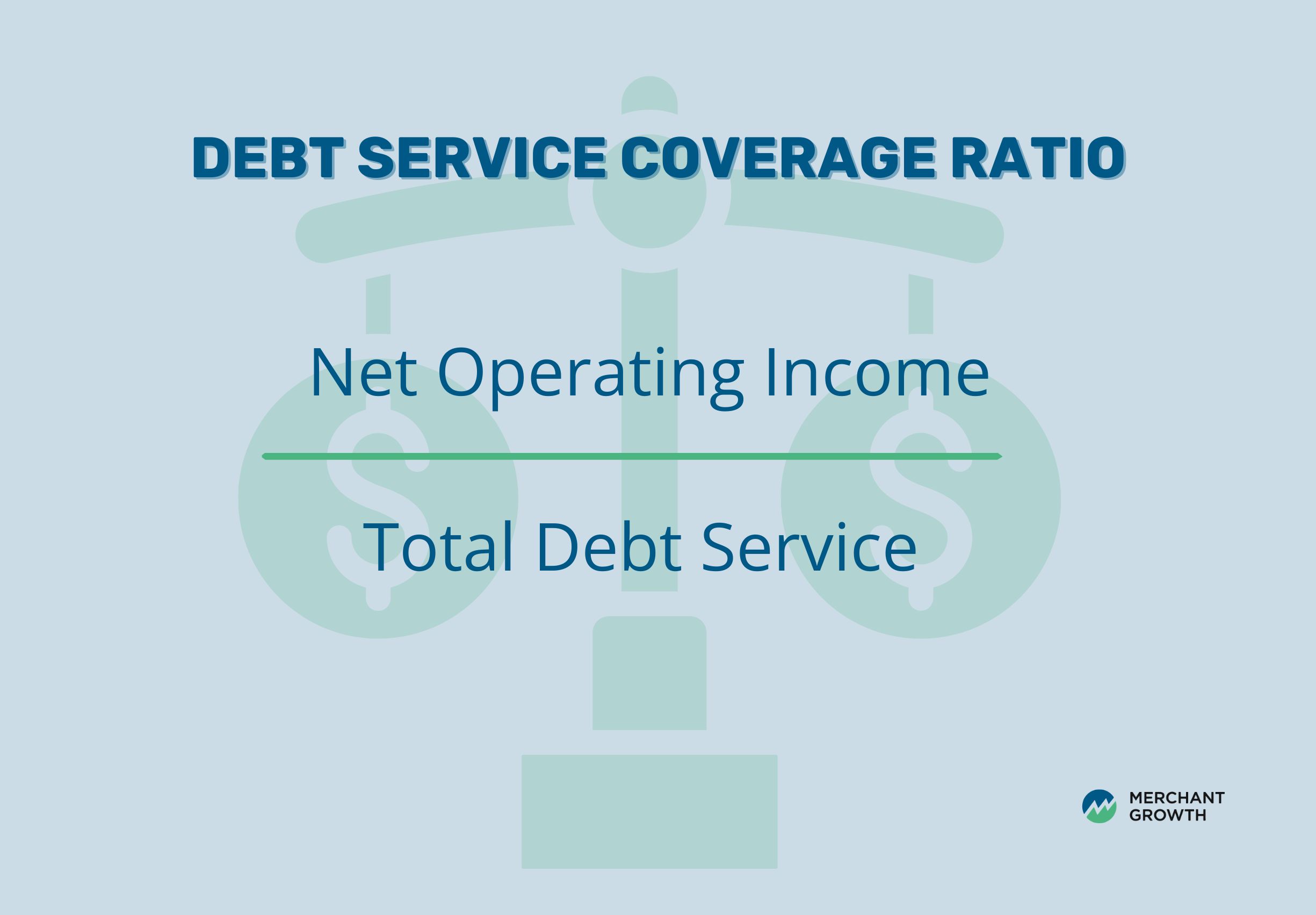
At its core, the Debt Service Coverage Ratio measures how much income your business generates compared to the amount of debt it needs to repay. It’s a simple ratio that answers a very practical question: Do you have enough income to cover your loan payments?
The calculation compares your available income, typically referred to as net operating income, to your total debt obligations, which include both principal and interest payments. The result is a number that shows whether your business is covering its debt, just breaking even, or falling short.
For example, a DSCR of 1.0 means your income exactly matches your debt payments. Anything above that indicates a buffer, while anything below suggests your business may struggle to meet its obligations. With that foundation in place, it becomes easier to understand how this ratio is used in real-world decision-making.
What Does DSCR Tell You?
While the formula itself is straightforward, the insight it provides is much more meaningful. DSCR offers a quick way to assess financial health and risk without needing to analyze every detail of your financial statements.
From a lender’s perspective, DSCR helps determine whether a borrower is likely to repay a loan reliably. A higher ratio suggests a stronger ability to absorb unexpected changes, while a lower ratio signals potential risk. For business owners, it provides a practical way to evaluate whether taking on new debt aligns with current income.
More importantly, DSCR highlights how much flexibility your business has. It shows not just whether you can cover your debt today, but how much room you have if conditions change, which makes it a useful tool for both short-term decisions and long-term planning.
Debt Service Coverage Ratio Formula
The formula for DSCR is relatively simple, but understanding what goes into each part is key to using it effectively.
DSCR = Net Operating Income ÷ Total Debt Service
Net Operating Income
Net operating income represents the income your business generates after operating expenses but before debt payments. This is the portion of your cash flow that’s available to cover your financial obligations.
Total Debt Service
Total debt service includes all required loan payments over a given period, typically combining both principal and interest. This may include multiple loans if your business has more than one outstanding obligation.
By comparing these two figures, DSCR shows how comfortably your business can meet its debt commitments. Once you understand the formula, applying it becomes much more straightforward.
How to Calculate DSCR (Step-by-Step)
Calculating DSCR does not require complicated tools, but it does require accurate numbers and a clear process. Breaking it into steps makes it easier to understand and helps ensure your calculation reflects your business’s actual financial position.
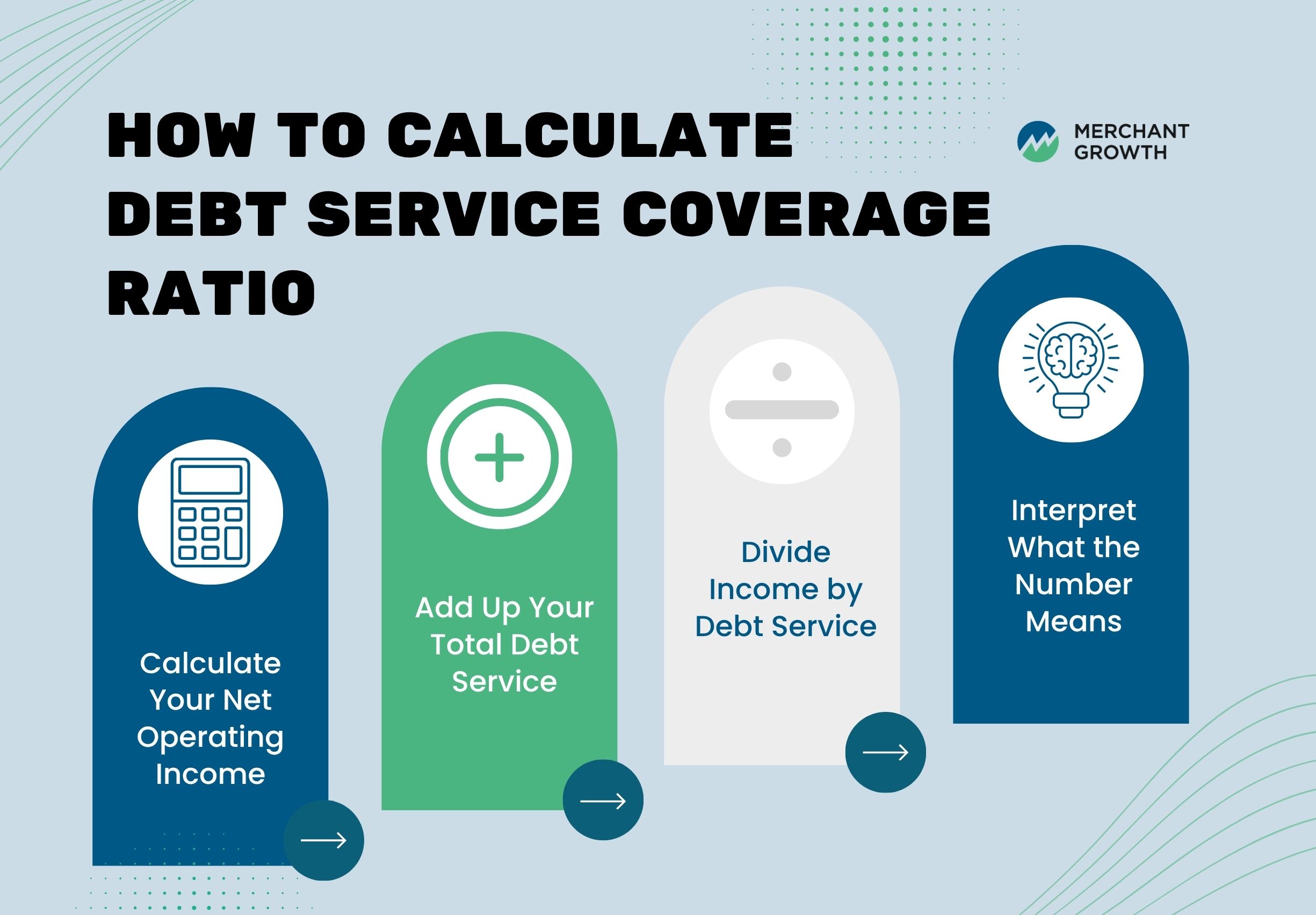
Step 1: Calculate Your Net Operating Income
Start by determining how much income your business generates after operating expenses. This usually means taking your total revenue and subtracting costs such as rent, payroll, utilities, software, etc. The goal is to isolate the income that is available to cover debt payments, rather than the total amount your business brings in before expenses.
This step matters because DSCR is meant to reflect repayment capacity, not just top-line revenue. A business may generate strong sales, but if operating expenses are high, the amount left over to service debt may be much smaller than expected. Using a realistic operating income figure makes the rest of the calculation much more meaningful.
Step 2: Add Up Your Total Debt Service
Next, calculate the total amount your business is required to pay toward debt over the same period. This includes both principal and interest payments and should capture all existing loan obligations, not just the most obvious or largest one. If you are calculating DSCR annually, make sure your debt service total also reflects annual payments.
This part of the formula is just as important as the income side because missing a debt payment can distort the ratio. For example, leaving out a smaller equipment loan or line of credit payment may make your DSCR appear healthier than it actually is. A complete view of your obligations gives you a more accurate picture of your borrowing capacity.
Step 3: Divide Income by Debt Service
Once you have both numbers, divide your net operating income by your total debt service. The result is your DSCR. This tells you how much income your business generates for every dollar of debt it must repay.
Step 4: Interpret What the Number Means
The final step is understanding what your DSCR is telling you in the context of your business. Rather than focusing only on whether the number is “good” or “bad,” it’s more useful to look at what it reveals about your financial flexibility and risk.
Start by asking how much room your business has to handle change. If your income were to drop or expenses were to increase, would your current DSCR still support your debt payments? Looking at your ratio this way helps you understand how resilient your business is, not just whether it works on paper.
It’s also important to consider how stable your DSCR is over time. A consistent ratio suggests predictable performance, while large fluctuations may indicate underlying cash flow challenges. When you view DSCR as part of a broader pattern rather than a single number, it becomes a much more practical tool for decision-making.
DSCR Example
Understanding the formula is one thing, but seeing how DSCR plays out in a real scenario makes it easier to apply. Instead of just calculating the ratio, it’s helpful to look at how small changes in your numbers can affect the outcome.
Consider a business with a net operating income of $120,000 and total annual debt payments of $100,000. In this case, the DSCR is 1.2, meaning the business generates 20% more income than required to cover its debt. On the surface, this looks stable, but it’s important to understand how sensitive that margin can be.
For example, if expenses increase slightly and reduce income to $110,000, the DSCR drops to 1.1. If revenue dips further, the ratio can quickly approach 1.0, leaving very little room for error. This is why DSCR is not just about hitting a number; it’s about understanding how stable your finances are under different conditions.

What Is a Good Debt Service Coverage Ratio?
There’s no single “perfect” DSCR, but there is a practical way to think about what makes a ratio strong or risky. Instead of focusing only on benchmarks, it’s more useful to understand what different ranges mean for your business in real terms.
- A DSCR below 1.0 means your business is not generating enough income to cover its debt, which often signals immediate financial pressure.
- A DSCR around 1.0 means you are covering your obligations, but with no flexibility if anything changes.
- A DSCR between 1.2 and 1.5 generally indicates a reasonable buffer, which is why many lenders use this range as a minimum requirement.
- A DSCR above 1.5 suggests a stronger financial position, with more room to handle fluctuations or take on additional opportunities.
What matters most is not just where your DSCR falls, but how stable it is over time. A business with a consistent DSCR of 1.3 may be in a better position than one that fluctuates between 1.0 and 1.6. Lenders and business owners alike look for consistency because it signals reliability.

Why DSCR Matters for Loans and Financing
When applying for financing, DSCR is one of the primary metrics lenders use to evaluate your application. It helps determine whether your business qualifies for a loan and influences the terms you may be offered.
A stronger DSCR can improve your chances of approval, increase your borrowing limit, and lead to more favourable interest rates. Conversely, a lower DSCR may result in stricter conditions or reduced access to capital.
For Canadian small businesses, this is particularly important, as lenders often prioritize stable cash flow. Understanding how DSCR impacts these decisions allows you to approach financing with greater confidence and preparation.
How Business Owners Can Use DSCR
Once you understand your DSCR, it becomes easier to pressure-test your decisions before committing to them. Instead of relying on assumptions, you can use your numbers to see how new debt might impact your business in real terms.
For example, before committing to a loan, you can calculate how it will affect your DSCR and determine whether your business can comfortably support the additional payments. This helps reduce the risk of overextending your finances.
It can also be used to assess growth opportunities, such as hiring, expanding operations, or investing in equipment. By understanding how these decisions impact your ratio, you can move forward with greater clarity and confidence.
How to Improve Your Debt Service Coverage Ratio
If your DSCR isn’t where you’d like it to be, there are several ways to strengthen it over time. Because the ratio is influenced by both income and debt obligations, improvements can come from either side of the equation.
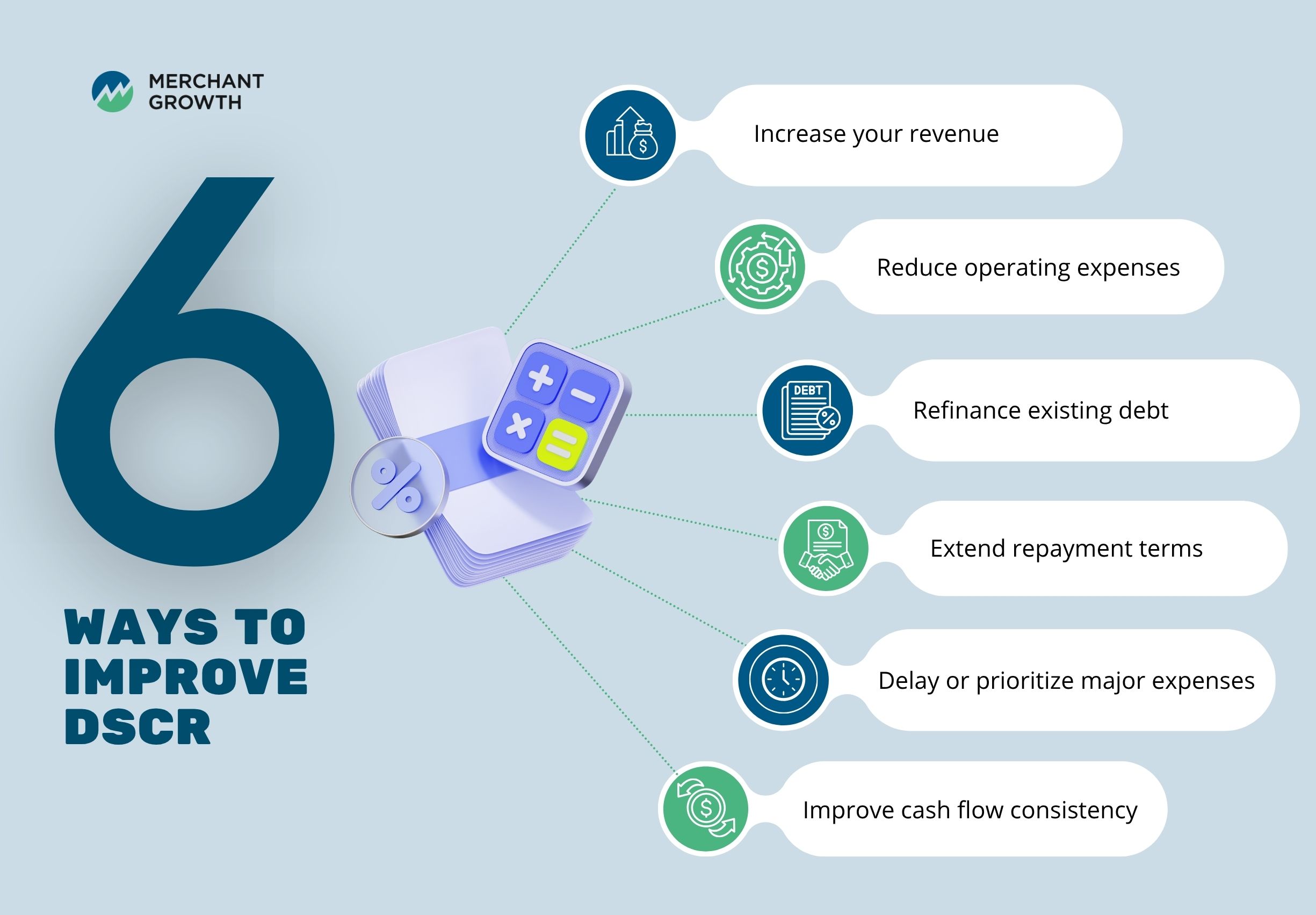
Here are some of the most effective strategies:
Increase your revenue
Growing your revenue directly improves your DSCR by increasing the income available to cover debt payments. This might involve expanding your customer base, adjusting pricing, or introducing new offerings. Even gradual increases can make a noticeable difference over time.
Reduce operating expenses
Lowering your expenses improves your net operating income, which strengthens your ratio. This could include cutting unnecessary costs or improving efficiency in your operations. Small savings can add up and have a meaningful impact on your financial position.
Refinance or restructure existing debt
Adjusting your loan terms can reduce your total debt service. Refinancing at a lower rate or consolidating payments can make your obligations more manageable. This approach can improve your DSCR without requiring changes to your revenue.
Extend repayment terms
Lengthening repayment periods reduces your regular payment amounts, improving your short-term cash flow. While it may increase total interest paid, it can help stabilize your finances and improve your DSCR in the near term.
Delay or prioritize major expenses
Timing large purchases carefully can help preserve your cash flow. Delaying non-essential expenses or prioritizing those that generate revenue can strengthen your financial position. This helps maintain a healthier balance between income and obligations.
Improve cash flow consistency
More predictable cash flow makes it easier to manage debt payments. This can involve improving invoicing processes, tightening payment terms, or encouraging faster customer payments. Stability in your income helps support a stronger DSCR over time.
Improving your DSCR is less about one major change and more about consistently strengthening your financial position. As these improvements take effect, your ratio becomes a more reliable indicator of your ability to manage debt.
Common Mistakes When Using DSCR
Even though DSCR is straightforward to calculate, small mistakes can lead to inaccurate conclusions. Being aware of these pitfalls helps ensure your ratio reflects your true financial situation.
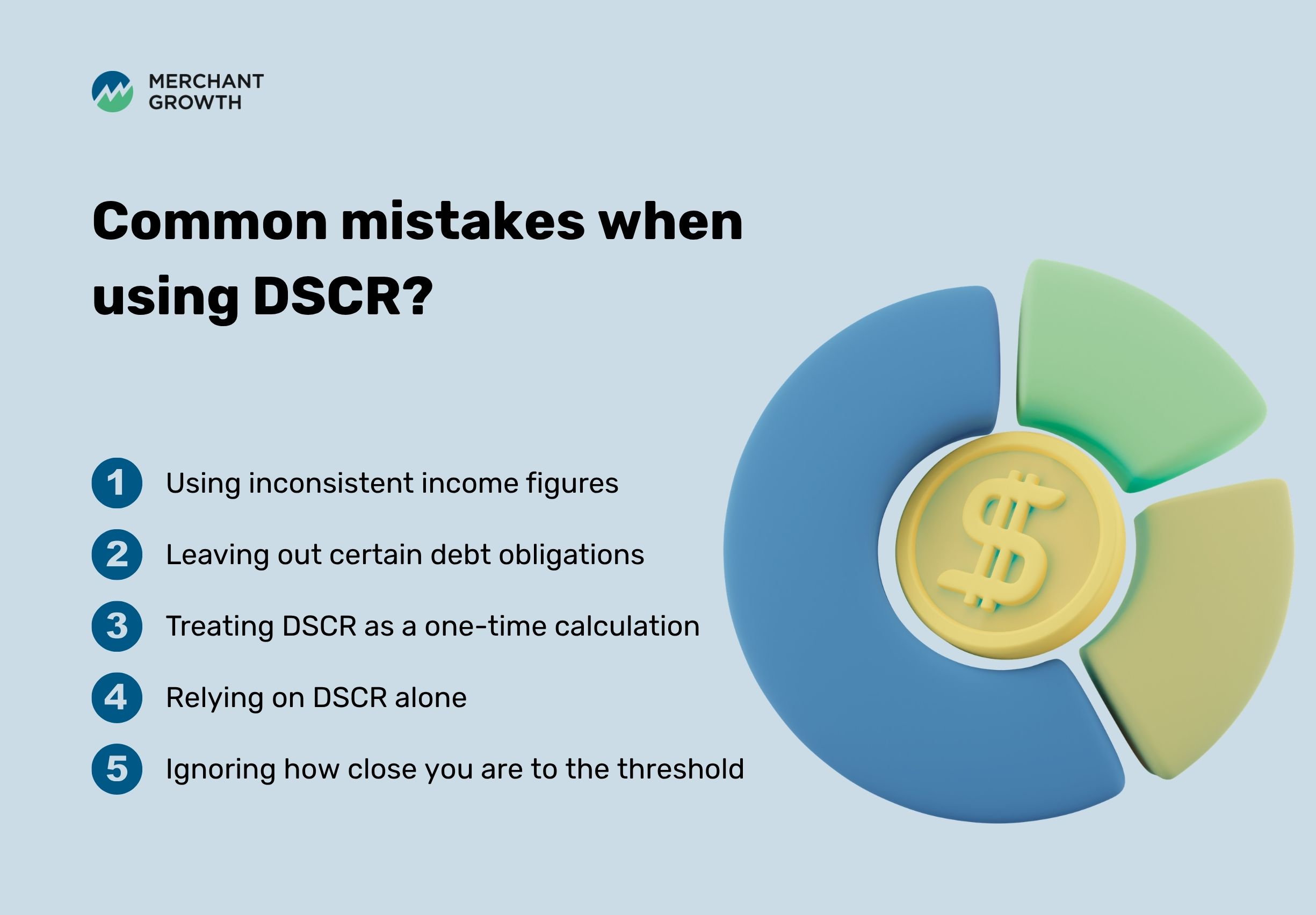
Here are some common mistakes to avoid:
Using inconsistent or inaccurate income figures
If your income is based on rough estimates or inconsistent reporting periods, your DSCR may not reflect reality. For example, mixing monthly and annual figures or relying on unusually strong months can distort your results. Using consistent, up-to-date financial data ensures your ratio is both accurate and comparable, giving you a clearer picture of your actual repayment capacity.
Leaving out certain debt obligations
All loan payments should be included in your calculation, not just your primary or most visible debt. Smaller obligations like equipment financing, lines of credit, or secondary loans can still impact your ability to manage payments. Missing even one of these can make your DSCR appear stronger than it actually is, which may lead to overestimating how much debt your business can realistically handle.
Treating DSCR as a one-time calculation
Your business is constantly changing, which means your DSCR should be updated regularly to reflect those changes. Revenue can fluctuate, expenses can shift, and new obligations may arise, all of which affect your ratio. Relying on a single calculation over time can create a false sense of stability and lead to decisions based on outdated information.
Relying on DSCR alone
DSCR is a useful metric, but it doesn’t capture every aspect of your financial health. It doesn’t reflect factors like market conditions, customer concentration, or operational risks that can also impact your ability to repay debt. Using DSCR alongside other tools, such as cash flow forecasts or budgeting, gives you a more complete and reliable understanding of your financial position.
Ignoring how close you are to the threshold
A DSCR just above 1.0 may technically indicate that you can cover your debt, but it leaves very little room for error. Even small changes in revenue or unexpected expenses can push your ratio below that level. Understanding how much buffer you have, and how quickly it could change, helps you better manage risk and make more cautious financial decisions.
Recognizing these challenges helps you use DSCR more effectively. With that awareness, it becomes easier to understand where the metric is most useful and where it has limitations.
Limitations of Debt Service Coverage Ratio
While DSCR is a valuable tool, it does not provide a complete view of your financial health. Understanding its limitations helps you use it more effectively as part of a broader strategy.
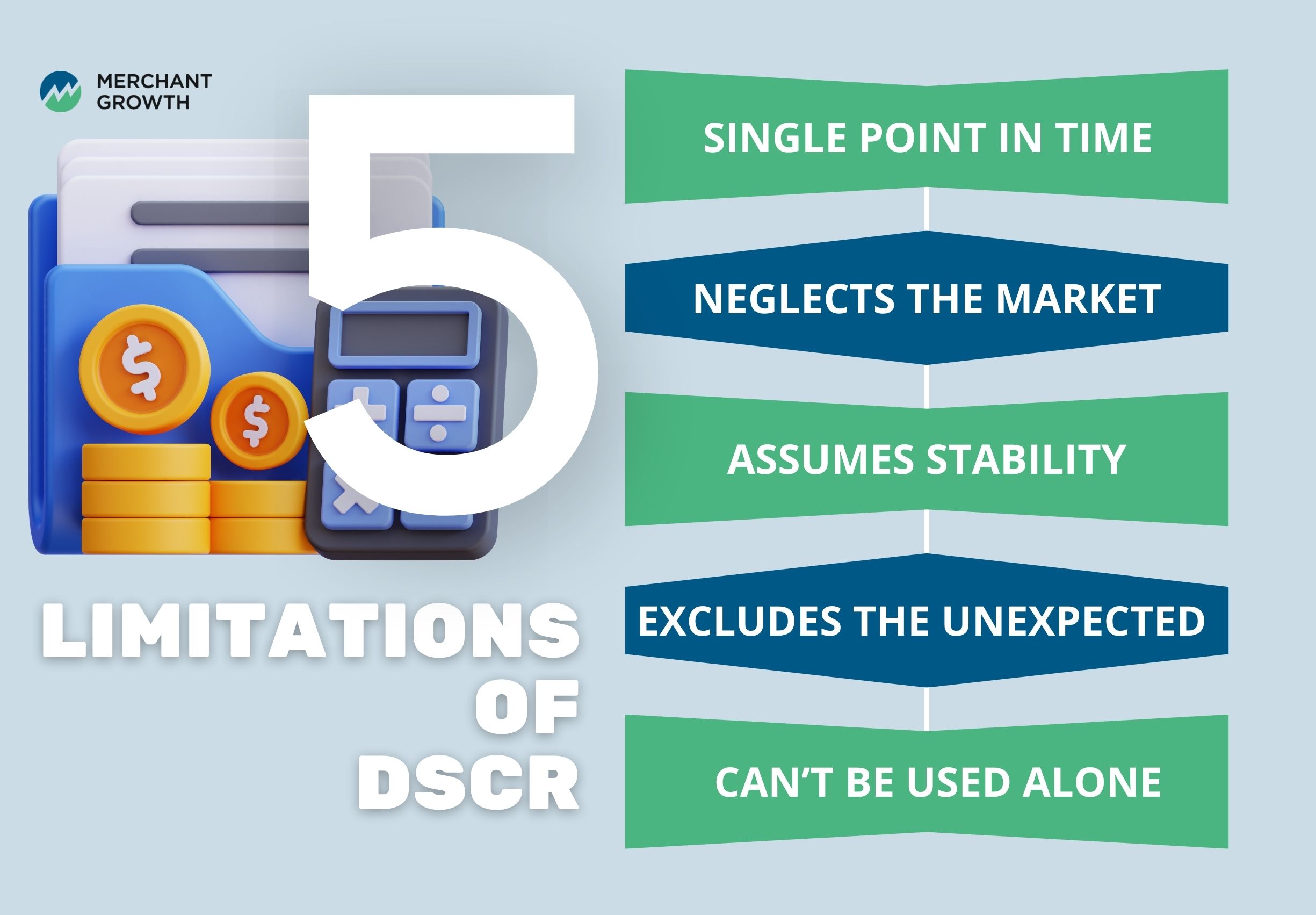
Here are some key limitations:
It reflects a single point in time
DSCR is based on current or projected numbers, which means it captures a snapshot of your finances rather than a long-term view. While this can be useful for assessing your position today, it doesn’t automatically account for future changes in revenue or expenses. Regularly recalculating your DSCR helps ensure it stays relevant as your business evolves.
It doesn’t account for market conditions
External factors like economic shifts, industry trends, or changes in customer demand are not reflected in the ratio. Even if your DSCR looks strong, these outside influences can still impact your ability to generate income and repay debt. This is why it’s important to consider the broader business environment alongside your financial metrics.
It assumes stable cash flow
DSCR works best when income is relatively consistent, but many businesses experience fluctuations throughout the year. Seasonal trends, project-based work, or delayed payments can all affect cash flow in ways the ratio doesn’t fully capture. Looking at your cash flow patterns alongside your DSCR provides a more realistic view of your financial stability
It excludes unexpected expenses
Unplanned costs, such as equipment repairs, supplier changes, or sudden increases in operating expenses, are not included in DSCR calculations. These events can reduce the cash available for debt payments, even if your ratio appears healthy. Building a contingency buffer into your finances can help offset this limitation and reduce risk.
It should not be used in isolation
DSCR is a helpful indicator, but it is only one part of your overall financial picture. It doesn’t replace tools like budgeting, cash flow forecasting, or profitability analysis, all of which provide additional insight into your business. Using multiple metrics together allows you to make more informed and balanced financial decisions.
Understanding these limitations strengthens how you use DSCR. When combined with other insights, it becomes a more reliable tool for planning your next steps.

Using DSCR to Plan Your Next Financial Move
Once you understand your DSCR, it becomes a practical tool for planning ahead. It allows you to evaluate different scenarios and understand how changes in your finances could impact your ability to manage debt.
This forward-looking approach helps you make more confident decisions about borrowing, investing, or scaling your business. Instead of relying on assumptions, you’re working with a clearer understanding of your financial capacity.
How Merchant Growth Can Support Your Financing Goals
Understanding your DSCR is an important step in preparing for financing, but it’s not the only factor that determines your options. Many traditional lenders rely on strict requirements, which can limit access for some businesses.
Merchant Growth offers flexible funding solutions designed to help Canadian small businesses manage cash flow and invest in growth. With faster access to capital and fewer barriers than traditional lending, it provides an alternative path for businesses looking to move forward.
By combining a clear understanding of your financial metrics with the right funding partner, you can make more confident decisions and position your business for long-term success.
Understanding Personal Guarantees in Business Loans
Signing a business loan can feel like a major milestone. It often represents growth, expansion, or the next phase of your company’s journey. But that confidence can shift quickly when you’re asked to personally guarantee the loan. For many business owners, the reaction is immediate: “I incorporated to protect myself, why am I personally liable?”
A personal guarantee changes the equation. It connects your personal finances to your business debt, even if your company is structured as a corporation. And while this is common in Canadian small business financing, it’s not always fully understood before documents are signed.
This guide explains what a personal guarantee is, why lenders require one, how it works in practice, and what risks and protections you should consider before agreeing to it. The goal isn’t to create fear; it’s to provide clarity.
Key Takeaways
- A personal guarantee makes you personally liable if your business defaults on its debt.
- Incorporation does not protect you once a personal guarantee is signed.
- Guarantees can be limited, unlimited, joint, or continuing.
- They may survive corporate bankruptcy.
- Not all business loans require one, but many do.
- Understanding the scope and terms before signing is critical.
What Is a Personal Guarantee?
A personal guarantee is a legally binding promise that makes an individual responsible for repaying a business debt if the company cannot. In simple terms, it means that if your business fails to meet its financial obligations, the lender can pursue you personally for repayment.
This is not symbolic language or a procedural formality. A personal guarantee is an enforceable contract. When you sign it, you are stepping outside the corporate shield and accepting individual responsibility.
It’s important to understand the distinction between the borrower and the guarantor. The corporation is the borrower; it receives the funds and operates the business. The individual who signs the personal guarantee becomes the guarantor, the party legally responsible if the borrower defaults. That distinction is what creates the risk exposure.

Why Lenders Ask for Personal Guarantees
From a lender’s perspective, small businesses can present a higher risk than large, established corporations. Many early-stage or growing businesses have limited assets, shorter operating histories, or inconsistent revenue patterns. A personal guarantee helps offset that risk.
By requiring the business owner to personally guarantee repayment, the lender aligns accountability with borrowing. It signals commitment and reduces the likelihood of strategic default. In many cases, it is a standard condition for approving small business loans, leases, equipment financing, and credit facilities.
Business owners often ask, “Do all business loans require a personal guarantee?” The answer is no, but many do, especially for smaller companies without substantial collateral. Requirements vary depending on the lender, loan size, structure, and overall risk profile.

How a Personal Guarantee Overrides Limited Liability
One of the primary benefits of incorporation is limited liability. A corporation is a separate legal entity, meaning its debts are generally distinct from the personal finances of its shareholders or directors.
However, when you sign a personal guarantee, you voluntarily override that protection. You are effectively reconnecting personal assets to corporate obligations. Incorporation does not shield you from liabilities you have personally agreed to assume.
This is where many business owners are caught off guard. The protection of incorporation remains intact for other business liabilities, but the specific debt covered by the guarantee becomes personally enforceable. Understanding that distinction before signing is critical.
Types of Personal Guarantees
Not all personal guarantees are structured the same way, and the differences can significantly affect your level of personal risk. Many business owners assume a guarantee is a standard, one-size-fits-all clause. In reality, the scope of liability depends entirely on how the agreement is written. The financial exposure, duration, and enforcement rights can vary meaningfully from one contract to another.
Before signing any personal guarantee on a business loan, it’s important to understand exactly what you are agreeing to. The wording in the agreement determines whether your liability is capped, shared, ongoing, or unlimited. A careful review of structure is just as important as reviewing the loan amount itself.
Here are the most common types of personal guarantees.
Unlimited Personal Guarantee
An unlimited personal guarantee means the guarantor is responsible for the full outstanding balance of the debt, plus potential interest, fees, and legal costs. There is no financial cap limiting liability. If the business defaults, the lender may pursue repayment for the entire amount owed.
This structure provides the lender with maximum protection and is common in smaller or higher-risk loans. For the guarantor, however, it represents the broadest potential exposure. Understanding the full scope of liability under an unlimited guarantee is essential before signing.
Limited Personal Guarantee
A limited personal guarantee places a cap on liability, either as a fixed dollar amount or a percentage of the debt. This structure creates clearer financial boundaries and can reduce personal exposure.
Limited guarantees are sometimes negotiated when multiple partners are involved or when the business has a stronger financial footing. While they still create personal liability, they offer more predictability around maximum risk.
Joint and Several Guarantees
When multiple individuals sign a guarantee, they may be jointly and severally liable. This means each guarantor can be held responsible for the entire debt, not just their share. The lender has the right to pursue any one of the guarantors for full repayment, regardless of internal ownership splits.
This structure is common when multiple shareholders or directors are involved. It’s important for each guarantor to understand that their personal exposure may extend beyond what they consider their “portion” of the business.
Continuing Guarantee
A continuing guarantee extends beyond a single loan and may apply to future credit advances until formally revoked. This means the guarantee can remain active even as new borrowing occurs under the same credit facility.
Without careful review, business owners may not realize that their obligation remains in effect across multiple transactions. Continuing guarantees are particularly important to examine when dealing with revolving credit lines or long-term financing relationships.
What Happens If the Business Defaults?
If a business misses payments and enters default, lenders typically begin by pursuing the company itself. They may attempt to recover funds through corporate assets, secured collateral, or negotiated repayment plans.
If those efforts are insufficient, the lender may then pursue the guarantor personally. This can include seeking legal judgments, enforcing collection actions, or pursuing personal assets, depending on the agreement.
Business bankruptcy and personal guarantees are often misunderstood. Filing for corporate bankruptcy does not automatically eliminate personal liability under a signed guarantee. The corporation may discharge its obligations, but the guarantor’s personal responsibility can remain enforceable.
This is why a bankruptcy personal guarantee scenario can become particularly complex. The guarantee exists independently of the corporate structure once it has been executed.
Credit Impact: What Business Owners Should Know
Many business owners ask whether a personal guarantee affects their credit score or appears on their credit report. In most cases, the guarantee itself does not immediately show up as a reported debt. It represents contingent liability, meaning it only becomes actionable if the business defaults.
However, if default occurs and the lender initiates collection or legal action, that activity can affect your personal credit. Court judgments, delinquent accounts, or settlements may appear in credit reporting systems.
Understanding this distinction helps clarify risk. A guarantee does not automatically damage your credit, but default and enforcement actions can.
How Personal Guarantees Apply to Common Canadian Financing
Personal guarantees appear across many financing products in Canada, but the way they are structured can vary significantly depending on the lender, the purpose of the funding, and the specific program rules. Some products rely heavily on personal guarantees as part of their risk management process, while others may have alternative structures or government backing that change how liability is handled.
Understanding how guarantees apply across different financing types helps business owners avoid assumptions. Just because one loan required a personal guarantee does not mean every product will be structured the same way.
Government-Backed Emergency Loans (e.g., CEBA)
Programs such as CEBA were created under specific federal guidelines and delivered through participating financial institutions. Because these loans were government-backed and designed as emergency support, their structure differed from conventional business loans. In many cases, they did not rely on personal guarantees in the traditional sense.
However, the exact terms depended on program rules and how the lending institution administered the funds. Business owners should always review the original agreement rather than assuming government support eliminates all personal exposure.
BDC Financing
BDC offers a range of financing products, and whether a personal guarantee is required depends on the structure of the loan, the borrower’s financial profile, and the available security. For early-stage or higher-risk financing, personal guarantees may be part of the approval framework. For more established businesses with strong assets or performance history, structures may differ.
The key takeaway is that BDC financing is not automatically personally guaranteed in every case. Requirements are assessed individually, and terms vary by product and risk level.
Business Credit Cards
Many small business credit cards require the primary applicant to personally guarantee repayment. Even though the account is issued in the name of the business, the individual cardholder is often ultimately responsible for outstanding balances if the company cannot pay.
This structure is common because credit cards are typically unsecured forms of financing. Without pledged collateral, lenders use personal guarantees to reduce risk. Business owners sometimes overlook this detail when applying, assuming the corporate name alone limits liability.
These examples illustrate that personal guarantees are common across Canadian financing products, but they are not universal or identical in structure. The specific agreement, not the product category, determines your personal exposure. Careful review of each financing contract ensures there are no surprises later.

Can You Get Out of a Personal Guarantee?
Once signed, a personal guarantee cannot simply be revoked at will. It is a binding contractual obligation. However, there are circumstances where liability may change.
In some cases, guarantees can be limited before signing through negotiation. After repayment of the loan, the guarantee is typically released. Refinancing with a different lender may also alter or replace the original obligation.
If you are unsure about your exposure, reviewing the agreement with legal counsel can provide clarity. It is far easier to negotiate terms before signing than to unwind them afterward.

The Real Risks to Personal Wealth
A personal guarantee may expose savings, real estate equity, investments, and in some cases, future income to enforcement actions if default occurs. The actual risk depends on the structure of the guarantee, the amount outstanding, and the lender’s enforcement approach.
This does not mean default is inevitable or that guarantees are inherently reckless. It means business owners should understand the scope of potential exposure. Risk awareness supports responsible decision-making.

A Responsible Approach to Personal Guarantees in Small Business Financing
Personal guarantees are common in small business lending, but how they are structured matters. Transparent communication, realistic repayment expectations, and disciplined underwriting reduce the likelihood of default.
Responsible financing should be clear about obligations, scope, and duration. When lenders assess cash flow carefully and structure repayment around sustainable performance, both parties benefit. Strong underwriting protects the lender while also protecting the borrower from overextension.
At Merchant Growth, financing decisions are built around real business performance and practical growth planning. The goal is not to impose unnecessary personal jeopardy, but to structure capital in a way that aligns with your company’s capacity and trajectory.
Before You Sign: A Practical Checklist
Before agreeing to a personal guarantee, it’s worth slowing down and reviewing the details carefully. These agreements are often presented as standard paperwork, but the fine print can meaningfully change your level of personal exposure. Taking a few extra minutes here can save you from confusion later and help you make a decision that fits your risk comfort level.
Here are the key questions to review before you sign:
- Is the guarantee limited or unlimited?
- Is there a financial cap?
- Does it apply to future advances?
- Is it joint and several with other guarantors?
- When does the obligation expire?
- Should legal counsel review the agreement?
Clarity at the outset reduces uncertainty later, especially if your business faces an unexpected slowdown or financing needs change over time. When you understand exactly what you’re signing, you can move forward with confidence, and avoid unpleasant surprises down the road.
From Understanding Personal Guarantees to Financing With Confidence
Most Canadian entrepreneurs will encounter a personal guarantee at some point in their business journey. The key is not avoiding them entirely, but understanding what they mean and how they work.
When you understand your obligations, review terms carefully, and align financing with realistic growth plans, personal guarantees become part of a structured risk-sharing framework rather than a hidden hazard.
Personal guarantees are serious commitments, but they don’t have to be confusing. If you’re considering business financing and want clarity before signing, speak with Merchant Growth about financing solutions designed for Canadian entrepreneurs who value transparency and sustainable growth.
Business Loan Application Denied? Here’s What to Do Next
Finding out your loan application was denied can feel like a punch to the gut. You spent time preparing documents, outlining your plans, and explaining your business, only to hear “no.” It’s frustrating, and for many business owners, it can feel personal. But in reality, a loan denial is rarely about you as an entrepreneur. It’s about how a lender assesses risk, and whether your business fits within their specific lending criteria.
The truth is, many healthy businesses get declined for financing, especially by traditional banks. A loan application denied does not automatically mean your business is struggling or unviable. It often means there’s a mismatch between your business profile and that lender’s requirements. Understanding why business loan applications get denied, and what you can do next, puts you back in control.
This guide walks through the most common reasons for business loan rejection, what happens after a denial, how to strengthen your next application, and what alternatives exist when banks say no.
What Does “Loan Application Denied” Actually Mean?
When a lender denies your application for a business loan, it means their underwriting team determined the level of risk was too high based on their internal standards. Every lender has a different risk model, and those models evaluate several key factors before approving funding.
Typically, lenders look at:
- Your ability to repay the loan
- Your personal and business credit profile
- Your current cash flow
- Your existing debt obligations
- The stability of your industry
- The completeness and clarity of your documentation
A denial does not necessarily mean your business is failing. It may simply mean you don’t meet that lender’s current business loan requirements. In many cases, the same business declined by one lender may be approved by another with a different risk appetite or evaluation process.
The Top Reasons Business Loan Applications Get Denied
When a loan application is denied, it’s rarely for just one vague reason. Lenders rely on structured underwriting criteria to assess risk, and most rejections trace back to a handful of common factors. The challenge is that lenders don’t always provide detailed explanations, which can leave business owners guessing about what went wrong.
Understanding the most common reasons for business loan rejection can help you identify where your application may have fallen short, and more importantly, what you can improve before applying again. While every lender’s standards differ, the underlying themes are surprisingly consistent across banks and financial institutions.
Let’s break down the most common causes.
Weak or Inconsistent Cash Flow
Cash flow is one of the most important factors in the business loan application process. Lenders want to see predictable income that comfortably covers operating expenses and proposed loan payments. Even if your sales are strong on paper, irregular inflows, seasonal dips, or tight margins can raise concerns about repayment reliability.
This is why 41% of loan denials are tied to weak cash flow. Revenue tells lenders about growth potential, but cash flow tells them whether you can repay the loan on time, every time. In lending decisions, repayment capacity carries more weight than sales volume. A business generating steady, reliable cash flow will almost always appear lower risk than one with higher but inconsistent revenue.
Poor Personal or Business Credit
Your credit score still plays an important role in business loan applications. Many lenders review both your personal credit history and your business credit profile when assessing risk. Late payments, high utilization, or previous defaults can signal elevated risk.
Business owners often ask, “Can I get a business loan with bad credit?” The answer depends heavily on the lender. Traditional banks tend to maintain stricter credit thresholds, while alternative lenders may consider credit alongside cash flow performance and overall business strength. A lower credit score doesn’t automatically mean financing is impossible, but it can limit your options or affect pricing.
High Debt Load
If your business already carries significant debt, lenders may hesitate to approve additional financing. Debt-to-income ratios and overall leverage are closely examined to determine whether the business can reasonably take on more obligations.
Even profitable companies can face rejection if their existing debt payments consume too much of their monthly cash flow. From a lender’s perspective, adding more debt increases repayment risk, especially if margins are already tight. Demonstrating that your business has room to absorb new payments is essential in the approval process.
Lack of Collateral
Traditional lenders frequently require collateral to secure a loan. This could include equipment, property, inventory, or other tangible assets. If your business lacks sufficient assets to pledge, approval can become more difficult.
Statistics Canada reports that 32% of loan denials are linked to insufficient collateral. This can be particularly challenging for service-based businesses or newer companies that haven’t accumulated substantial physical assets. In these cases, the structure of the financing and the type of lender can significantly affect approval likelihood.
Incomplete or Weak Documentation
Strong documentation signals professionalism and financial control. Missing financial statements, inconsistent bookkeeping, unclear projections, or vague business plans can all weaken your application.
Even when the numbers are solid, poor presentation can create doubt. Lenders want to see accurate, organized, and transparent reporting. Clean documentation not only speeds up the review process but also builds confidence in your ability to manage capital responsibly.
Limited Time in Business
Startups and early-stage companies are statistically considered higher risk. If your business has been operating for less than two years, approval may be more challenging, particularly with traditional banks that prioritize established operating history.
This doesn’t mean young businesses can’t secure financing. It simply means lenders may evaluate them differently, often placing greater emphasis on projections, personal credit, and management experience.
Understanding these factors helps turn rejection from a mystery into a roadmap. Once you know what lenders are evaluating, you can begin strengthening those areas intentionally.
In the next section, we’ll look at what to do immediately after a loan denial, and how to turn that setback into a smarter, stronger application moving forward.
How Likely Are You to Be Approved for a Business Loan?
One of the most common questions business owners ask after a loan application is denied, or before they even apply, is: What are my actual chances of getting approved? The honest answer is that approval isn’t based on a single number or a quick checklist. Lenders look at a combination of factors to determine how risky it would be to extend financing to your business.
Some factors carry more weight than others depending on the lender’s underwriting model, but most financial institutions evaluate a core set of indicators when reviewing business loan applications.
Typically, lenders look at:
- Stability and predictability of revenue
- Cash flow coverage relative to proposed loan payments
- Personal and business credit history
- Industry risk profile
- Time in operation
Each of these factors helps lenders answer one central question: Can this business repay the loan consistently and on time? Strong revenue growth can help, but predictable cash flow and responsible credit behaviour often carry more influence in the final decision.
Traditional banks generally apply stricter, standardized approval criteria, particularly around credit scores, collateral, and operating history. Alternative lenders may assess risk more dynamically, weighing real-time revenue performance and broader business trends alongside credit metrics. That’s why two lenders reviewing the exact same application can reach completely different conclusions.
If you’re wondering how to get a small business loan, the first step is understanding what lenders are really evaluating, not just what they advertise on their websites. When you know which levers influence approval odds, you can take practical steps to strengthen your position before submitting your next application.
What to Do Immediately After a Loan Denial
A loan rejection can feel discouraging, but it’s important to pause before reacting emotionally. A denial is not a final verdict on your business, it’s feedback. When approached strategically, it can actually strengthen your next application and improve your long-term financing readiness. The key is to treat the experience as diagnostic rather than definitive.
Instead of asking, “Why did this happen to me?” the better question is, “What can I learn from this?” Here’s how to respond productively.
Request Specific Feedback
Your first step should be to ask the lender for detailed feedback about why the application was declined. While not all institutions provide in-depth explanations, many will outline the primary reason for the decision. This could include credit score thresholds, insufficient cash flow coverage, high leverage ratios, or documentation gaps.
Understanding the exact reason matters because it determines your next move. For example, if the issue was cash flow coverage, you may need to focus on improving margins or reducing expenses. If it was credit-related, you’ll know to prioritize score improvement before reapplying. Clear feedback transforms a vague rejection into a concrete action plan.
Review Your Credit Profile
Your personal and business credit reports play a larger role in business loan applications than many owners realize. After a denial, request copies of your credit reports and review them carefully for inaccuracies. Even minor reporting errors, such as outdated balances or misreported late payments, can negatively impact your approval chances.
Beyond correcting errors, it’s important to understand where your score sits relative to typical lending benchmarks. Traditional banks often require stronger credit profiles, while alternative lenders may evaluate credit alongside real-time performance metrics. Knowing your position helps you target the right type of lender and avoid unnecessary rejections in the future.
Assess Cash Flow and Debt Structure
Cash flow is one of the most common reasons business loan applications get denied. Take a detailed look at your monthly revenue trends, recurring expenses, and existing debt obligations. Ask yourself whether your business could comfortably absorb additional loan payments without straining operations.
This is also a good time to evaluate whether discretionary expenses can be reduced or whether supplier payment terms can be renegotiated. Even modest improvements in monthly free cash flow can significantly strengthen financial ratios. Lenders want to see stability and repayment capacity; small operational adjustments can make a meaningful difference.
Strengthen Financial Documentation
Clean, organized documentation builds lender confidence. If your application included incomplete financial statements, unclear projections, or inconsistent bookkeeping, now is the time to address those gaps. Update your profit and loss statements, balance sheets, and cash flow reports so they accurately reflect your current position.
It’s also helpful to prepare realistic projections that clearly explain how the loan will support growth and generate returns. Lenders want to see thoughtful planning, not just optimistic forecasts. Transparency, consistency, and professionalism in your documentation demonstrate that you are managing your business with discipline and foresight.
Taking these steps doesn’t just prepare you for your next application; it strengthens your business overall.
How to Strengthen Your Next Loan Application Strategically
If you’re preparing to apply again, the goal isn’t just to correct past issues; it’s to position your business more effectively. Financing decisions are about risk alignment. The better you understand how lenders evaluate applications, the more strategically you can present your business.
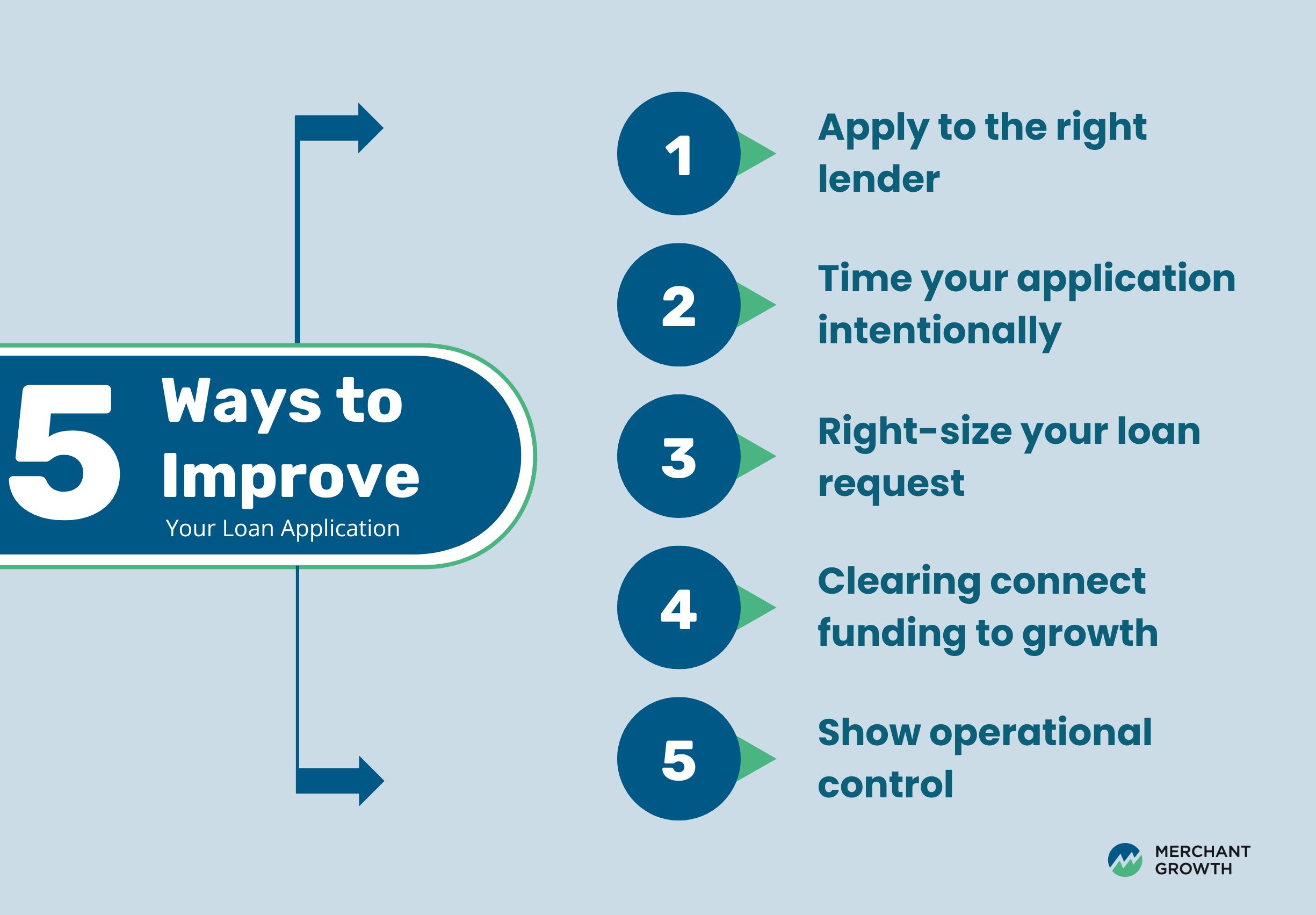
Apply to the Right Type of Lender
Not all lenders assess risk the same way. Traditional banks often emphasize collateral, long operating history, and strong credit benchmarks. Alternative lenders may focus more on current cash flow performance and revenue stability. Understanding this difference is essential when navigating the business loan application process. Matching your business profile to the right lender can dramatically improve approval odds.
Time Your Application Intentionally
Timing plays a larger role than many business owners realize. If your revenue has recently dipped due to seasonality or temporary disruption, waiting until performance stabilizes can improve how your numbers are evaluated. Lenders typically review recent financial activity closely, so applying during a strong revenue cycle can strengthen your case.
Right-Size Your Loan Request
One common reason business loan applications are declined is that the requested amount exceeds what the business can realistically support. When considering how to get a small business loan, it’s important to align your request with your revenue and repayment capacity. A realistic, well-supported funding request signals financial discipline and reduces perceived risk.
Clearly Connect Funding to Growth
Lenders are more comfortable approving loans that are tied to measurable business outcomes. Whether you’re investing in inventory, hiring, marketing, or equipment, clearly explain how the funds will generate return. Demonstrating that you have a plan, not just a need, strengthens your application significantly.
Show Operational Control
Strong financial documentation is important, but so is your ability to explain your numbers. When you can confidently discuss revenue trends, margins, and projections, you demonstrate control and oversight. That credibility can make a meaningful difference in how lenders perceive your business.

When Banks Say No: Exploring Alternative Financing Options
If traditional lenders decline your application, that doesn’t mean financing is off the table. Many Canadian small businesses secure funding through alternative channels every year, especially when banks apply stricter requirements around credit, collateral, or operating history.
The financing landscape today is broader than it was even a decade ago. In addition to traditional banks, business owners can explore a range of funding sources that may better match their stage of growth, revenue structure, or industry type. Some common alternatives include:
- Non-bank lenders
- Online financing platforms
- Revenue-based financing
- Government programs
- Smaller structured loans
Each option comes with its own structure, eligibility criteria, and repayment model. The key is understanding how these lenders evaluate risk and whether their approach aligns with your business’s strengths.
Unlike many traditional banks, alternative lenders often assess businesses more holistically. Instead of focusing exclusively on credit score or physical collateral, they may consider a broader range of performance indicators, such as:
- Real-time revenue performance
- Cash flow trends
- Overall business stability
Technology-driven underwriting has changed how some lenders evaluate applications. By analyzing up-to-date financial data and revenue patterns, they can form a more current picture of business health. This doesn’t mean standards are lower, it simply means the evaluation process may be different.
For many businesses, especially those with steady revenue but limited collateral or shorter operating history, this broader assessment model can open doors that traditional lending frameworks may not.

Why Rejection Isn’t the End of the Road
Traditional banks operate under strict regulatory frameworks and conservative underwriting models. Their criteria are often rigid, and many growing businesses simply don’t fit inside those parameters yet.
The reality is that risk models vary. Some lenders prioritize collateral. Others focus on historical credit. Still others, including Merchant Growth, focus on real business performance and cash flow.
Many businesses that are declined by banks still qualify for structured growth financing. The key is finding a lender whose evaluation process matches your business stage and trajectory. Financing should support growth, not penalize ambition.
Financing Readiness Is Ongoing, Not Just After a Rejection
Loan approval isn’t a one-time event. Financial health is something you build continuously. Maintaining organized books, steady cash flow, manageable debt levels, and clear growth plans improves optionality over time.
When your financial fundamentals are strong, you have more choices. And having choices is one of the most powerful positions a business owner can be in.
From Rejection to Resilience
A loan application denied can feel discouraging, but it can also be a turning point. Many successful businesses have faced initial rejection before finding the right financing partner.
The key isn’t avoiding rejection entirely. It’s understanding why it happened, strengthening your foundation, and exploring options that fit your business reality.
If your loan application was denied, it doesn’t mean your business isn’t viable, it means you need the right financing partner. Merchant Growth works with Canadian small businesses to provide flexible funding solutions designed to support real growth, even when traditional lenders aren’t an option.
Can Canada Survive a Trade War with the U.S.? What It Means for Small Businesses
Over the past year, the Canada–U.S. trade relationship has shifted in ways few businesses expected. What began as tariff disputes has evolved into a more complex and uncertain cross-border environment. February 1st marked one year since tariffs escalated between the two countries, and for many Canadian businesses, that year has required adaptation, recalibration, and resilience.
At a national level, Canada has not “collapsed” under trade pressure. But survival at the macroeconomic level does not automatically translate to stability for small businesses operating on tight margins. The real question isn’t just whether Canada can survive a trade war with the U.S. It’s how Canadian businesses, especially small and mid-sized ones, navigate the operational impact.
To better understand what’s happening on the ground, Merchant Growth surveyed 103 Canadian small businesses in January 2026. The results offer a clear picture: resilience exists, but it comes with cost pressure and cautious decision-making.
In this article, we’ll explain what a trade war means, why Canada is particularly exposed, what the data says about small business resilience, and what business owners can do next.
Key Takeaways
- A trade war increases costs through tariffs and retaliatory measures.
- 41% of surveyed small businesses report margin declines due to tariffs.
- Nearly half absorbed added costs instead of raising prices.
- Trade uncertainty delays investment, hiring, and expansion.
- Survival depends on adaptation, fiscal policy, and business-level cash flow management.
What Is a Trade War? (In Simple Terms)
A tariff is a tax placed on imported goods. When one country imposes tariffs, the affected country may respond with its own tariffs in retaliation. That cycle of escalating trade barriers is what defines a trade war.

The impact goes beyond the tax itself. Tariffs raise the cost of goods crossing borders, which increases input costs for manufacturers, retailers, and distributors. Over time, businesses adjust supply chains, pricing strategies, and sourcing decisions. Consumers may face higher prices, and investment decisions become more cautious.
The economic effect isn’t limited to the tariff percentage. The real cost often lies in uncertainty and unpredictability around policy shifts, negotiations, and future restrictions. That uncertainty influences hiring, capital investment, and long-term planning.

Why Is Canada So Exposed to a U.S. Trade War?
The United States is Canada’s largest trading partner, and the scale of that relationship is significant. In 2024 alone, nearly $3.6 billion (US$2.6 billion) worth of goods and services crossed the Canada–U.S. border every single day. Cross-border trade is deeply integrated across industries, including manufacturing, energy, automotive production, steel, and aluminum. Supply chains often operate seamlessly across provincial and state lines, with products and components moving back and forth multiple times before reaching consumers.
Because these industries are highly interconnected, even modest tariffs can ripple across multiple sectors. For example, an auto part manufactured in Ontario may cross the border several times before final assembly. Each tariff layer compounds cost.
The impact is also regionally uneven. Provinces with stronger exposure to manufacturing and resource exports may feel pressure more acutely than service-driven economies. This interconnected structure makes “Canada vs U.S. trade war” effects highly sector-specific.
How Will a Trade War Affect Canada?
The effects of a trade war don’t show up in just one headline number. They ripple through the economy in layered and sometimes subtle ways. While the national economy may continue functioning, individual industries, regions, and businesses can feel pressure differently depending on their exposure to cross-border trade. Understanding these channels of impact helps clarify why even targeted tariffs can create broader economic consequences.

At a high level, trade conflict affects Canada in several key ways:
- Higher input costs for imported components
- Margin compression for exporters
- Delayed investment decisions
- Consumer price sensitivity
For businesses, higher input costs are often absorbed initially to protect customer relationships and maintain market share. Many companies hesitate to raise prices immediately, especially in competitive sectors. But sustained cost pressure eventually forces difficult decisions around pricing, hiring, and expansion.
Uncertainty acts as an economic tax. Even if tariffs themselves are modest, unpredictability reduces confidence. When business owners hesitate to invest in equipment, inventory, or new hires, growth slows. The effects may not be dramatic in a single quarter, but they accumulate over time, influencing both business momentum and broader economic performance.

What the Data Says: How Canadian Small Businesses Are Responding
National economic indicators tell one story. Small businesses tell another. To understand how the trade war is affecting Canadian companies on the ground, Merchant Growth conducted its own Trade War Survey in January 2026, gathering insights from 103 small businesses across the country. The findings provide direct visibility into how owners are adjusting operations, managing margins, and planning for the months ahead.
The data reveals not panic, but pressure. And that pressure is shaping real business decisions.
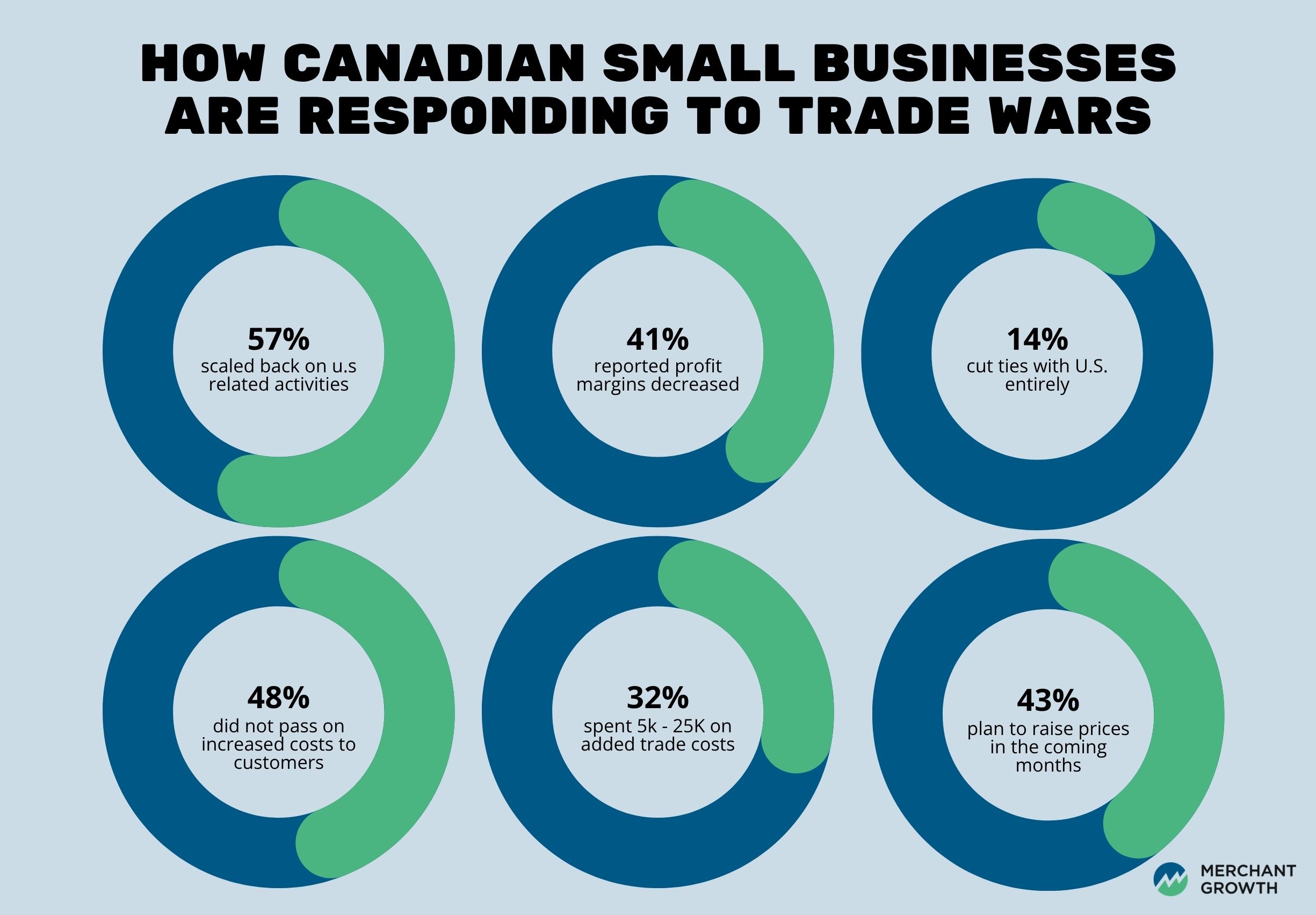
Key findings include:
- 57% scaled back U.S.-related activity
- 14% cut ties with U.S. activity entirely
- 41% reported profit margin decreases
- 32% spent $5,000–$25,000 in added trade costs
- 9% spent $26,000–$100,000
- 48% did not pass on increased costs to customers
- 43% plan to raise prices in the next six months
The pattern is clear: many businesses are absorbing higher costs to protect customer demand. Nearly half chose not to immediately pass tariff-related increases on to buyers. While this strategy preserves relationships and competitiveness in the short term, it places sustained pressure on profitability.

Operational adjustments further illustrate how businesses are adapting:
- 55% are cutting discretionary spending
- 45% plan to take on additional financing
- 29% are negotiating supplier terms
- 25% are reducing inventory
- 53% report headcount has remained steady, reflecting cautious resilience
Taken together, the findings suggest something important. Canada may appear stable at the macro level, but small businesses are making deliberate trade-offs behind the scenes, protecting demand, preserving jobs, and carefully managing cash flow in the face of rising uncertainty.

Why Didn’t 2025 Tariffs “Break” Canada?
Despite the disruption, Canada’s economy has not collapsed under tariff pressure. Several factors contributed to resilience.
CUSMA (formerly USMCA) protections limited full exposure in certain sectors. Businesses adapted supply chains and diversified sourcing. Currency movements partially offset tariff costs for exporters. Consumer “buy local” behaviour provided some support to domestic producers.
Additionally, federal fiscal capacity remains a buffer. Targeted support measures and government programs can help stabilize affected industries.
The outcome is nuanced: Canada didn’t break, but it didn’t escape impact either. The pressure has been uneven, concentrated in trade-dependent sectors rather than across the entire economy.

Can Canadian Federal Finances Withstand a Prolonged Trade War?
Fiscal resilience matters in prolonged trade disputes. In simple terms, fiscal resilience refers to the federal government’s ability to respond to economic stress through spending, tax relief, or targeted support programs without destabilizing public finances. During trade disruptions, that can mean sector-specific aid, temporary tax measures, wage subsidies, or credit programs designed to help affected industries stay afloat.
The federal government’s capacity to deploy targeted stimulus, meaning temporary spending or financial support intended to stabilize the economy, plays an important stabilizing role. If exporters, manufacturers, or regional industries face sudden tariff pressure, timely government support can cushion the immediate impact and prevent broader job losses or business closures.
However, sustained trade conflict would test fiscal limits. Government support is funded through public revenues and borrowing, and those resources are not unlimited. A short-term dispute may be manageable, but a prolonged or escalating trade war could strain budgets, increase deficits, and reduce the government’s flexibility to respond to future shocks.
Fiscal policy acts as a stabilizer, not a shield. It can soften the blow of external disruption, but it cannot eliminate structural exposure to cross-border trade risk. For small businesses, confidence in government stability and policy support influences real decisions around hiring, capital investment, and expansion. When that confidence weakens, businesses often shift into preservation mode rather than growth mode

A Structural Shift, Not Just a Short-Term Dispute
While it’s tempting to frame trade tensions as a temporary flare-up, many analysts suggest something more fundamental may be unfolding. The current environment may represent a structural shift in global trade dynamics rather than a one-off policy dispute. If that’s the case, the implications extend beyond tariffs and into how Canada positions itself economically over the long term.
Canada’s deep reliance on a single trading partner has historically delivered efficiency and scale. However, concentration also creates vulnerability. Diversifying export markets, strengthening domestic supply chains, and reducing dependency on specific cross-border inputs could help mitigate future exposure. These adjustments take time, but they build resilience into the system.
There is also a strategic opportunity embedded in this shift. Canada’s role in critical minerals, energy development, advanced manufacturing, and reshoring initiatives could become more central in a more fragmented global trade environment. If global supply chains become more regionalized, Canada may benefit from its resource base, political stability, and proximity to major markets.
Trade tensions may therefore signal a longer-term recalibration of global commerce. Businesses that recognize this possibility and plan for continued volatility rather than a quick return to stability may be better positioned to adapt, diversify, and compete over time.
How Small Businesses Can Build Resilience During a Trade War
National policy decisions and trade negotiations unfold over months, sometimes years. Small businesses don’t have that luxury. When costs rise or uncertainty increases, owners need to respond in real time. The ability to adapt quickly often determines whether pressure becomes temporary or structural.

While macro policy evolves slowly, small businesses can act immediately. Practical steps include:
- Diversifying suppliers where feasible
- Reviewing pricing strategy and margin buffers
- Negotiating supplier payment terms
- Improving working capital management
- Using financing strategically to smooth volatility
The Merchant Growth survey shows that many businesses are already taking these steps. With 45% turning to financing and 29% renegotiating supplier terms, the focus is clearly on preserving cash flow and maintaining flexibility.
At the small business level, resilience often comes down to liquidity. When margins compress, even profitable companies can feel strain. Strong cash flow management provides breathing room, allowing businesses to make strategic decisions rather than reactive ones.

How Long Will It Take the Canadian Economy to Recover?
There isn’t a fixed timeline for economic recovery in a trade dispute. The pace of improvement depends largely on policy stability, the direction of trade negotiations, and how quickly businesses adapt to shifting conditions.
If negotiations stabilize and tariff uncertainty eases, investment confidence could return relatively quickly. Businesses tend to respond fast when predictability improves. However, if tensions persist or escalate, the adjustment period may stretch longer, requiring continued cost discipline and strategic flexibility.
For small businesses, the priority isn’t predicting exactly when macroeconomic recovery will arrive. It’s building operational resilience, the kind that allows growth and stability even when external conditions remain uncertain.

From Surviving a Trade War to Strengthening Your Business
Uncertainty is increasingly part of doing business. Survival is not just about national GDP resilience, it is about small business stability.
The Merchant Growth survey highlights real operational pressure: margin compression, cautious hiring, and increased financing demand. These are not signs of collapse, but they do signal strain.
Managing cash flow under pressure, absorbing cost shocks, and financing growth strategically are essential during periods of volatility. Financing should create flexibility, not risk.
Trade wars create uncertainty. Resilient businesses create options.
If rising costs or cross-border disruptions are affecting your cash flow, talk to Merchant Growth about financing solutions built to support Canadian small businesses through change.
What Is the Break-Even Point? A Simple Guide to Break-Even Analysis
Every business eventually reaches a moment when its revenue finally covers its costs. Before that point, the company is effectively investing in its own operations, spending money on rent, salaries, materials, and marketing while sales gradually catch up. Once revenue equals expenses, the business has reached what’s known as the break-even point.
For many entrepreneurs, understanding when this moment will happen is one of the most important parts of financial planning. Knowing your break-even point helps answer critical questions:
- How much do you need to sell to cover your costs?
- Is your pricing sustainable?
- How long might it take before a new product or business idea becomes profitable?
This is where break-even analysis becomes useful. By examining the relationship between costs, pricing, and sales volume, break-even analysis helps business owners estimate when their company will begin generating profit. Whether you're launching a startup, introducing a new product, or evaluating the performance of an existing business, understanding this calculation can provide valuable insight into your financial strategy.
Key Takeaways
- The break-even point is when total revenue equals total costs.
- Break-even analysis shows how much a business needs to sell before it becomes profitable.
- The calculation depends on fixed costs, variable costs, and contribution margin.
- Lower costs or higher prices reduce the break-even threshold.
- Break-even analysis helps businesses plan pricing, sales targets, and profitability.
- It works best when combined with broader financial planning tools.
What Is the Break-Even Point?
The break-even point is when a business’s total revenue equals its total costs. At this stage, the company is no longer losing money, but it has not yet begun generating profit either. Every dollar earned beyond this point contributes directly to profit because the initial operating costs have already been covered.

Reaching the break-even point is an important milestone for any business. It represents the moment when operations begin to sustain themselves financially rather than relying on startup capital or borrowed funds. For new businesses, understanding how long it may take to reach this stage can help set realistic expectations for growth.
The break-even point also provides useful insight for established companies. When launching new products, adjusting pricing, or expanding operations, businesses often calculate a new break-even point to understand how much sales volume will be required to support those changes.
Break-Even Point vs Break-Even Analysis
Although the terms are often used together, the break-even point and break-even analysis refer to different concepts.
The break-even point is the specific level of sales where revenue and costs are equal. It is a single figure that represents the threshold between operating at a loss and becoming profitable.

Break-even analysis, on the other hand, is the process used to calculate that threshold. This analysis examines how costs, pricing, and sales volume interact. By adjusting these variables, businesses can explore different scenarios and better understand how changes might affect profitability.
For example, increasing prices or reducing costs will lower the break-even point. On the other hand, higher operating expenses or lower margins will push it further away, requiring greater sales volume before profits begin.
How to Calculate the Break-Even Point in 3 Steps
Calculating the break-even point may sound complicated at first, but the process is actually quite straightforward when you break it down into a few steps. The goal is to figure out how much a business needs to sell before it covers all of its operating costs. Once you know this number, it becomes much easier to set realistic sales targets and understand how close your business is to becoming profitable.
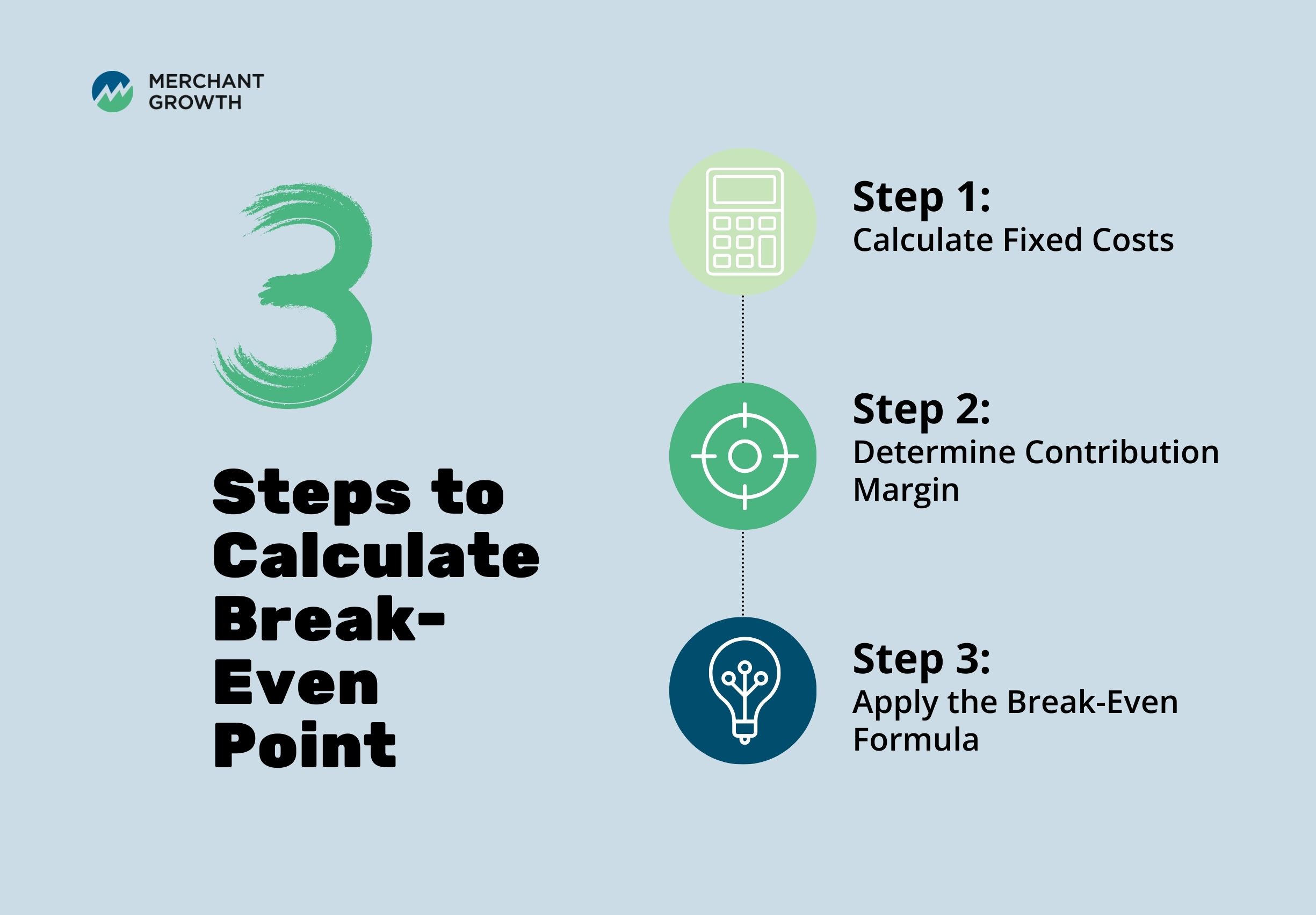
Step 1: Calculate Fixed Costs
The first step is identifying your fixed costs. These are expenses that stay the same regardless of how much your business sells. Whether you sell one product or one thousand, these costs still need to be paid each month.
Typical fixed costs include:
- Rent or mortgage payments
- Salaries and wages
- Insurance
- Software subscriptions
- Utilities
Because fixed costs remain relatively stable, they provide the starting point for calculating your break-even point. Understanding these expenses clearly helps you determine how much revenue your business must generate before it begins making a profit.
Step 2: Determine Contribution Margin
Next, you’ll need to calculate your contribution margin. This number shows how much money each sale contributes toward covering fixed costs after the cost of producing the product has been accounted for.
The formula looks like this:

Contribution Margin = Price per Unit – Variable Cost per Unit
For example, if a product sells for $100 and costs $60 to produce, the contribution margin is $40. That means every sale contributes $40 toward covering fixed expenses such as rent, salaries, and other operating costs.
Step 3: Apply the Break-Even Formula
Once you know your fixed costs and contribution margin, calculating the break-even point becomes simple. You can use the following formula:

Break-Even Point (Units) = Fixed Costs ÷ Contribution Margin
This calculation shows how many units a business needs to sell before it covers all of its costs. Once sales pass that number, the business begins generating profit because the fixed costs have already been paid.
Once these numbers are clear, calculating your break-even point becomes much easier. By understanding how fixed costs, variable costs, and contribution margin work together, business owners can see how pricing decisions, cost changes, or shifts in sales volume will affect profitability. The next step is to take a closer look at these key components and how they influence the break-even calculation.
The Key Components of Break-Even Analysis
Break-even analysis is built on a few core financial variables that determine how quickly a business can move from covering its costs to generating profit. These variables help business owners understand how pricing, production costs, and operating expenses interact with one another. When these components are clearly defined, it becomes much easier to estimate how much revenue is required to sustain the business.
Before applying the break-even formula, it is important to understand the three key elements that drive the calculation: fixed costs, variable costs, and contribution margin. Each plays a different role in determining how much a business must sell to cover its expenses.
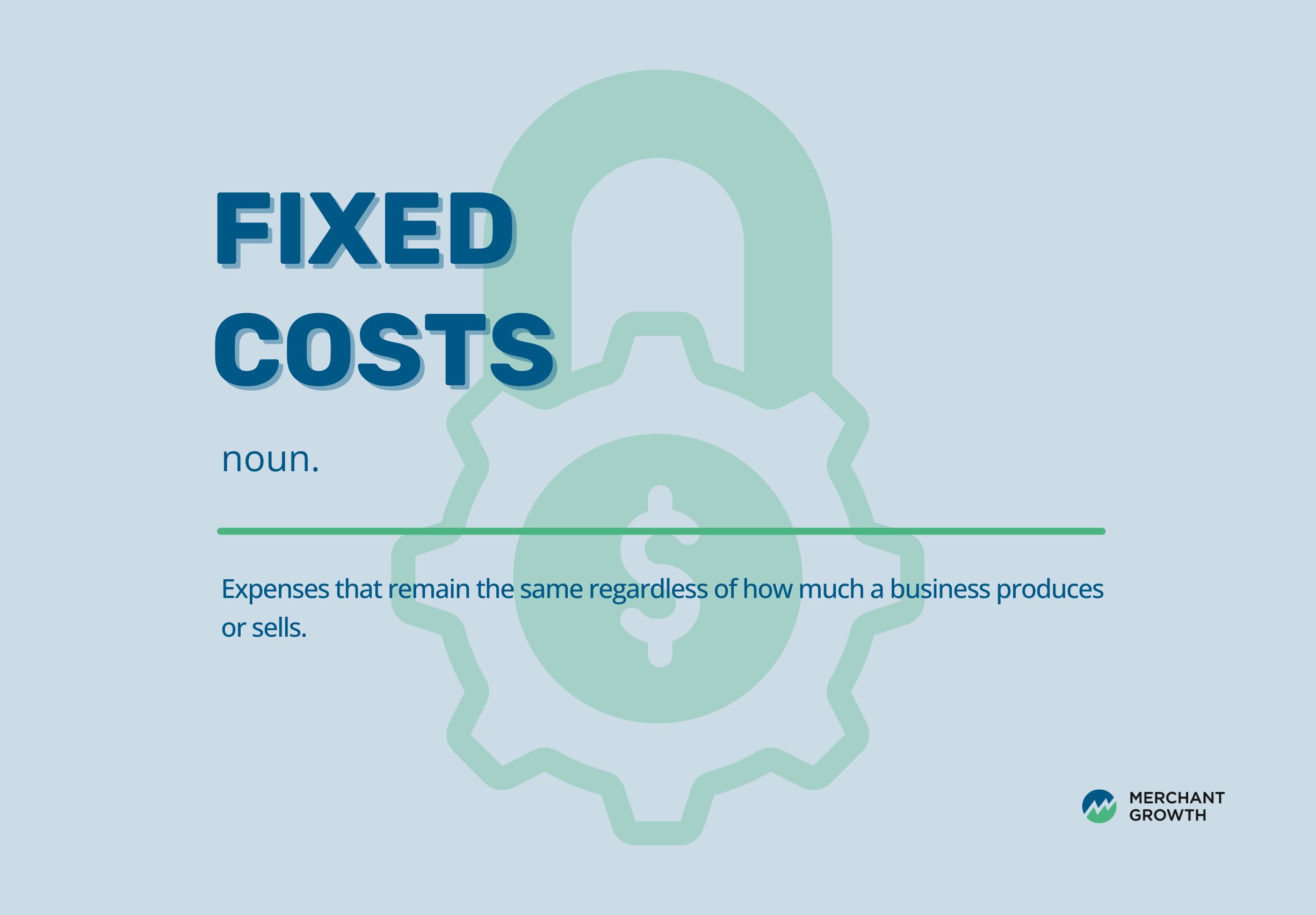
Fixed Costs
Fixed costs are expenses that remain the same regardless of how much a business produces or sells. These costs must be paid regularly, even during periods when sales slow down or fluctuate. Because they do not change with production levels, fixed costs often represent the baseline amount a business must cover before it can begin earning a profit.
Common examples of fixed costs include rent, salaries, insurance, and software subscriptions. These ongoing expenses form the foundation of a break-even calculation because they represent the minimum financial commitment required to keep the business operating.
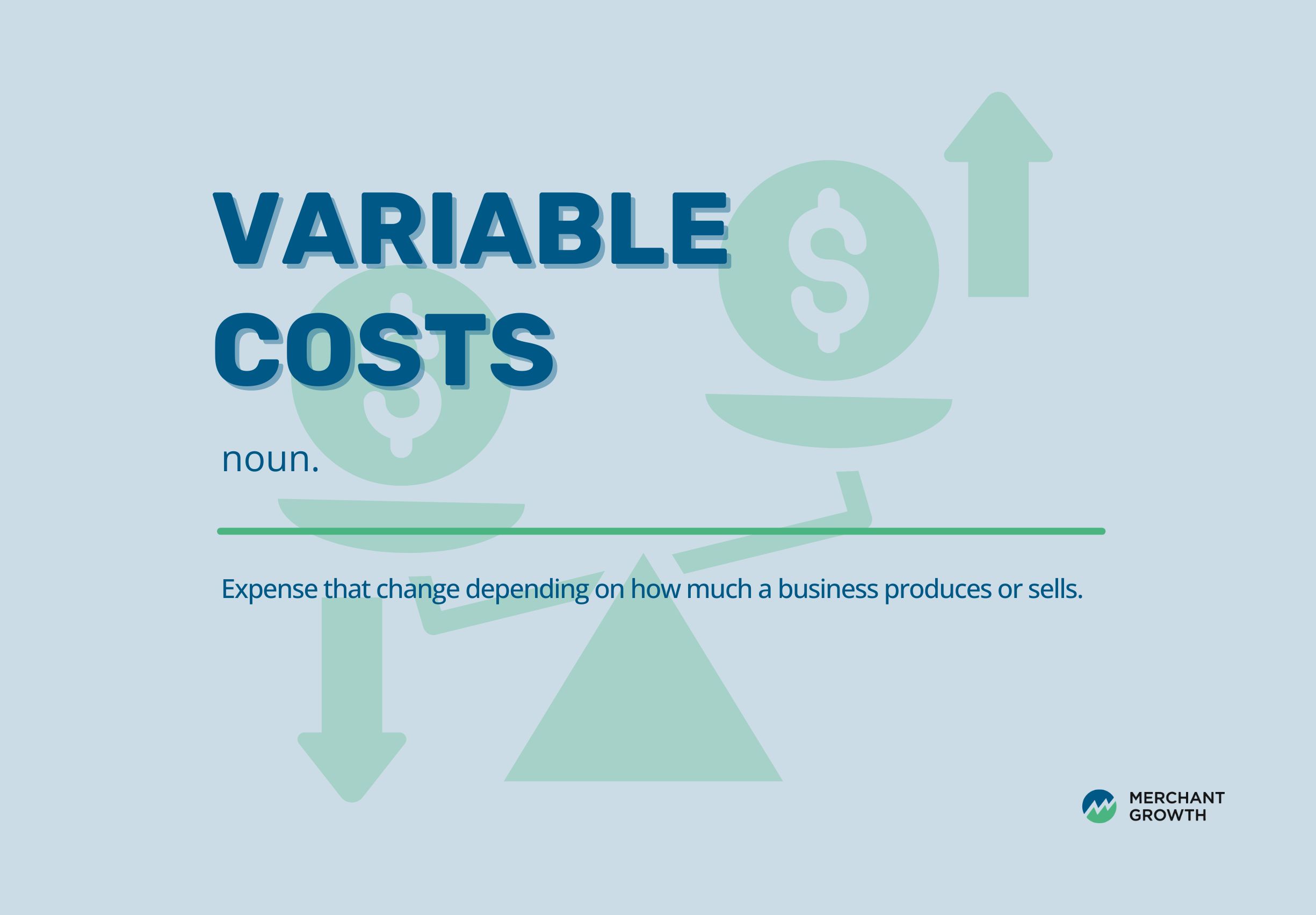
Variable Costs
Variable costs, as the name suggests, change depending on how much a business produces or sells. When production increases, these costs rise accordingly, and when production slows, they decrease. Because they are tied directly to sales activity, variable costs are closely linked to a company’s revenue generation.
Examples of variable costs include raw materials, packaging, shipping, and sales commissions. Understanding these costs is important because they affect how much profit remains from each sale after production expenses are covered.
Contribution Margin
The contribution margin represents the portion of revenue from each sale that helps cover fixed costs. It is calculated by subtracting the variable cost per unit from the selling price of the product or service. Once fixed costs have been fully covered, any remaining contribution margin becomes profit.
By understanding contribution margin, businesses can see how changes in pricing or production costs may influence their path to profitability. Even small adjustments in margins can significantly affect how quickly a company reaches its break-even point.
Break-Even Point Formula (Units)
Once the key components are clear, the break-even point can be calculated using a straightforward formula. Many businesses begin by measuring break-even in terms of units sold, which makes it easier to connect the calculation directly to sales activity.
The formula is:

Break-Even Point (Units) = Fixed Costs ÷ (Price per Unit – Variable Cost per Unit)
This equation highlights the relationship between costs, pricing, and sales volume. If operating costs increase or prices decrease, the number of units required to break even will rise. On the other hand, improving margins through pricing adjustments or cost reductions can lower the break-even threshold and help businesses reach profitability sooner.
Break-Even Point Formula (Sales Dollars)
While calculating break-even in units works well for product-based businesses, some companies prefer to measure break-even in terms of total revenue. This approach is particularly useful for service-based businesses that may not sell standardized products.
The formula for calculating break-even in revenue terms is:

Break-Even Sales = Fixed Costs ÷ Contribution Margin Ratio
Instead of focusing on the number of units sold, this calculation shows how much total revenue must be generated before a business begins producing profit. For service businesses, consultants, and subscription-based companies, this revenue-based perspective can provide a clearer picture of financial performance.

Example of Break-Even Analysis
To better understand how break-even analysis works in practice, it helps to walk through a simple example. Consider a business with the following financial structure:
- Fixed costs: $50,000
- Price per unit: $100
- Variable cost per unit: $60
First, calculate the contribution margin:
$100 – $60 = $40
Next, divide the fixed costs by the contribution margin:
$50,000 ÷ $40 = 1,250 units
This means the business must sell 1,250 units before it begins generating profit. Once that threshold has been reached, each additional sale contributes directly to the company’s bottom line.
Break-Even Chart Explained
Break-even analysis is often easier to understand when visualized using a chart. This chart illustrates how revenue and costs change as sales volume increases.
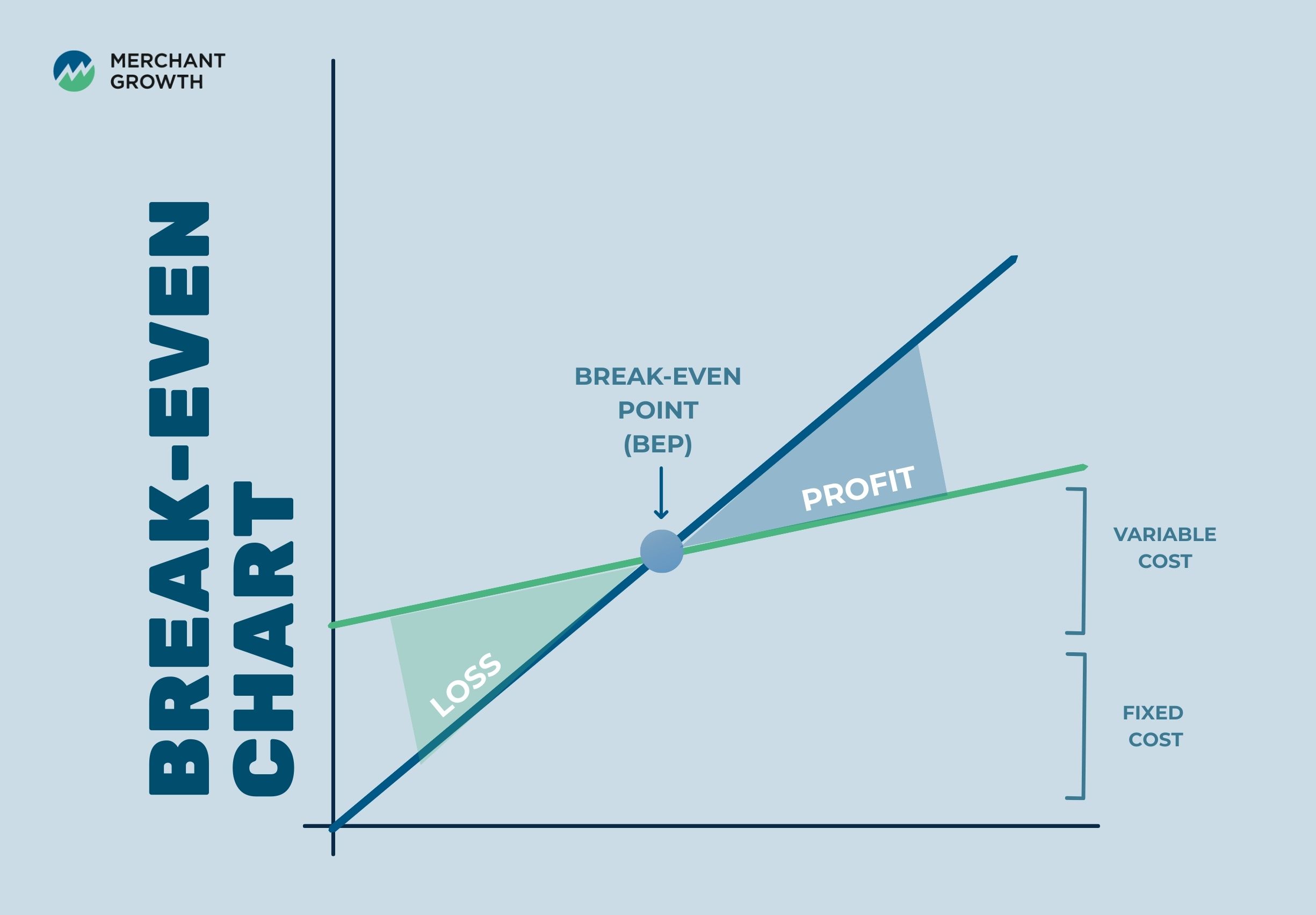
In a typical break-even chart, the horizontal axis represents sales volume, while the vertical axis represents both revenue and costs. Fixed costs appear as a horizontal line because they remain constant regardless of sales activity. Meanwhile, total costs gradually increase as production grows due to rising variable expenses.
The revenue line rises alongside sales volume. The point where the revenue line intersects with the total cost line represents the break-even point. This visual representation makes it easier for business owners to see how adjustments in pricing, cost structure, or production levels can influence profitability.

Why Break-Even Analysis Matters for Business Owners
Break-even analysis is more than just a financial calculation. For many business owners, it becomes a valuable planning tool that helps guide important decisions about pricing, growth, and cost management.
By understanding the break-even point, companies can set realistic sales targets and evaluate whether a business idea is financially viable. It also provides insight into how pricing strategies and operational costs influence profitability.
For established businesses, break-even analysis helps assess the potential impact of new initiatives such as launching products, expanding operations, or entering new markets. Rather than relying on guesswork, business owners can use this analysis to make more informed decisions based on financial data.

Is a High Break-Even Point Good?
A higher break-even point means a business must generate more sales before it begins earning profit. In some cases, this may indicate higher financial risk, especially if revenue fluctuates or market demand is uncertain.
However, a high break-even point is not always a negative sign. Certain industries require substantial upfront investments in equipment, technology, or infrastructure. Businesses operating in these sectors often expect higher break-even thresholds because their fixed costs are larger.
Ultimately, the key question is whether the required sales volume is realistic. If demand is strong and the business model is sustainable, a higher break-even point may simply reflect the scale of the operation.
Common Break-Even Analysis Mistakes
Although break-even analysis is a useful tool, it can produce misleading conclusions if important factors are overlooked. Many mistakes occur when businesses rely on incomplete cost estimates or outdated financial assumptions.

Common errors include:
- Ignoring variable costs, which can lead to overstating profitability.
- Underestimating operating expenses, especially smaller recurring costs that add up over time.
- Assuming demand is guaranteed, even though market conditions can change.
- Failing to update calculations when costs, pricing, or production levels shift.
Regularly reviewing and updating break-even calculations helps ensure they remain accurate as the business grows and evolves.

The Limitations of Break-Even Analysis
While break-even analysis provides valuable insights, it is not a complete financial forecasting tool. The calculation assumes that prices, costs, and sales patterns remain relatively stable, which may not always reflect real-world conditions.
External factors such as changes in customer demand, economic trends, or competitive pressures can influence profitability in ways that break-even analysis alone cannot predict. For this reason, businesses often combine break-even analysis with other financial planning tools.
Budgeting, forecasting, and market analysis can provide additional context that helps business owners understand how their financial strategies may perform under different circumstances.

From Break-Even to Profitability: Planning the Next Stage of Growth
Reaching the break-even point is an important milestone, but it is only the beginning of a company’s financial journey. Once a business has covered its costs, the focus shifts toward sustaining profitability and building long-term growth.
At this stage, many companies begin investing in expansion opportunities such as hiring new staff, increasing marketing efforts, or purchasing additional inventory. These initiatives often require upfront capital before the resulting revenue is realized.
Merchant Growth supports Canadian businesses by providing flexible financing solutions designed to help companies move beyond break-even and continue growing. Access to working capital can help businesses manage cash flow, invest in new opportunities, and scale operations with greater confidence.
Move Beyond Break-Even and Grow Your Business
Understanding your break-even point is an important step toward building a sustainable business. When you know how much revenue is required to cover your costs, it becomes easier to set realistic goals and make informed financial decisions.
Merchant Growth provides flexible funding solutions designed to help Canadian small businesses manage cash flow, invest in growth, and scale with confidence. Whether you are expanding operations, launching new products, or strengthening your financial foundation, the right financing can help support your next stage of growth.
Explore Merchant Growth financing solutions to move beyond break-even and build a stronger future for your business.
How to Solve Cash Flow Problems Without Shutting Down Your Business
Cash flow problems rarely start with a dramatic moment. More often, they creep in quietly, an invoice that takes longer to get paid, an unexpected expense, or a few slow weeks of sales. Suddenly, a business that looks healthy on paper is struggling to cover payroll, pay suppliers, or keep up with everyday expenses. Even profitable companies can run into serious trouble when there simply isn’t enough cash available at the right time.
The good news is that cash flow issues are usually manageable when they are identified early and addressed with the right strategies. By understanding the causes, recognizing the warning signs, and taking practical steps to stabilize finances, businesses can regain control without shutting down operations.
In the sections ahead, we’ll break down what cash flow problems actually look like in a business, why they tend to happen, and what you can do to fix them. We’ll also look at how to identify the type of cash flow challenge you’re facing so you can take practical steps to stabilize your finances and keep your business moving forward.
Key Takeaways
- Cash flow problems occur when a business doesn’t have enough available cash to cover expenses.
- Late payments, high operating costs, and rapid growth are common triggers.
- Identifying the type of cash flow problem helps determine the best solution.
- Accelerating payments and controlling expenses can improve liquidity quickly.
- Long-term cash flow management and forecasting help prevent future issues.

What Are Cash Flow Problems?
Cash flow problems occur when a business does not have enough available cash to meet its immediate financial obligations. This situation can arise even if the company is technically profitable. For example, a business might have strong sales and outstanding invoices, but if customers haven’t paid yet, there may not be enough cash available to cover payroll, rent, or supplier payments.
The root of most cash flow issues is timing. Businesses often incur expenses before they receive payment for their products or services. When that timing gap becomes too large, financial pressure builds quickly. Over time, persistent cash shortages can disrupt operations, strain relationships with suppliers, and limit the company’s ability to invest in growth.
Understanding what cash flow problems look like is the first step toward solving them. Once business owners recognize the patterns that cause these challenges, they can begin implementing strategies to stabilize their finances.
What Causes Cash Flow Problems in a Business?
To understand what’s creating cash flow pressure, it helps to look at two areas of the business. Some problems are operational, meaning they arise from everyday activities like invoicing customers, managing inventory, or paying routine expenses. Others are more strategic and relate to decisions around pricing, growth, or financial planning. Identifying which category a challenge falls into can make it much easier to address the root cause.

Operational Causes
One of the most common causes of cash flow problems is slow-paying customers. When invoices remain unpaid for long periods, businesses may struggle to cover their expenses even if they have strong sales. Weak invoicing processes or inconsistent follow-ups can make this situation worse by allowing overdue payments to accumulate.
Inventory management can also create cash flow pressure. When businesses purchase more inventory than they need, a large portion of their cash becomes tied up in unsold products. At the same time, high fixed expenses, such as payroll, rent, and software subscriptions, can quickly drain available cash during slower periods.
Strategic Causes Businesses Often Miss
Some causes of cash flow problems are less obvious. Pricing strategies, for example, can play a major role. If prices are too low or margins are too thin, a business may struggle to generate enough cash from each sale to cover operating costs.
Rapid growth can also strain working capital. Expanding operations often requires spending money on inventory, hiring, and marketing before new revenue arrives. Similarly, offering long payment terms to customers shifts the financing burden onto the business itself. Without proper forecasting, these decisions can create financial pressure even in otherwise successful companies.
In many cases, more than one of these factors may be affecting a business at the same time. That’s why it’s important not only to understand the possible causes of cash flow problems, but also to determine the type of cash flow challenge you’re dealing with. Identifying whether the issue is temporary, structural, or tied to growth can make it much easier to choose the right solution.
Diagnose the Type of Cash Flow Problem You're Facing
While these causes can affect businesses in different ways, the impact they have on cash flow isn’t always the same. In some cases the pressure is temporary and tied to timing issues, while in others it reflects deeper financial imbalances or rapid growth. Understanding how the problem is showing up in your business can help clarify what kind of solution is needed.
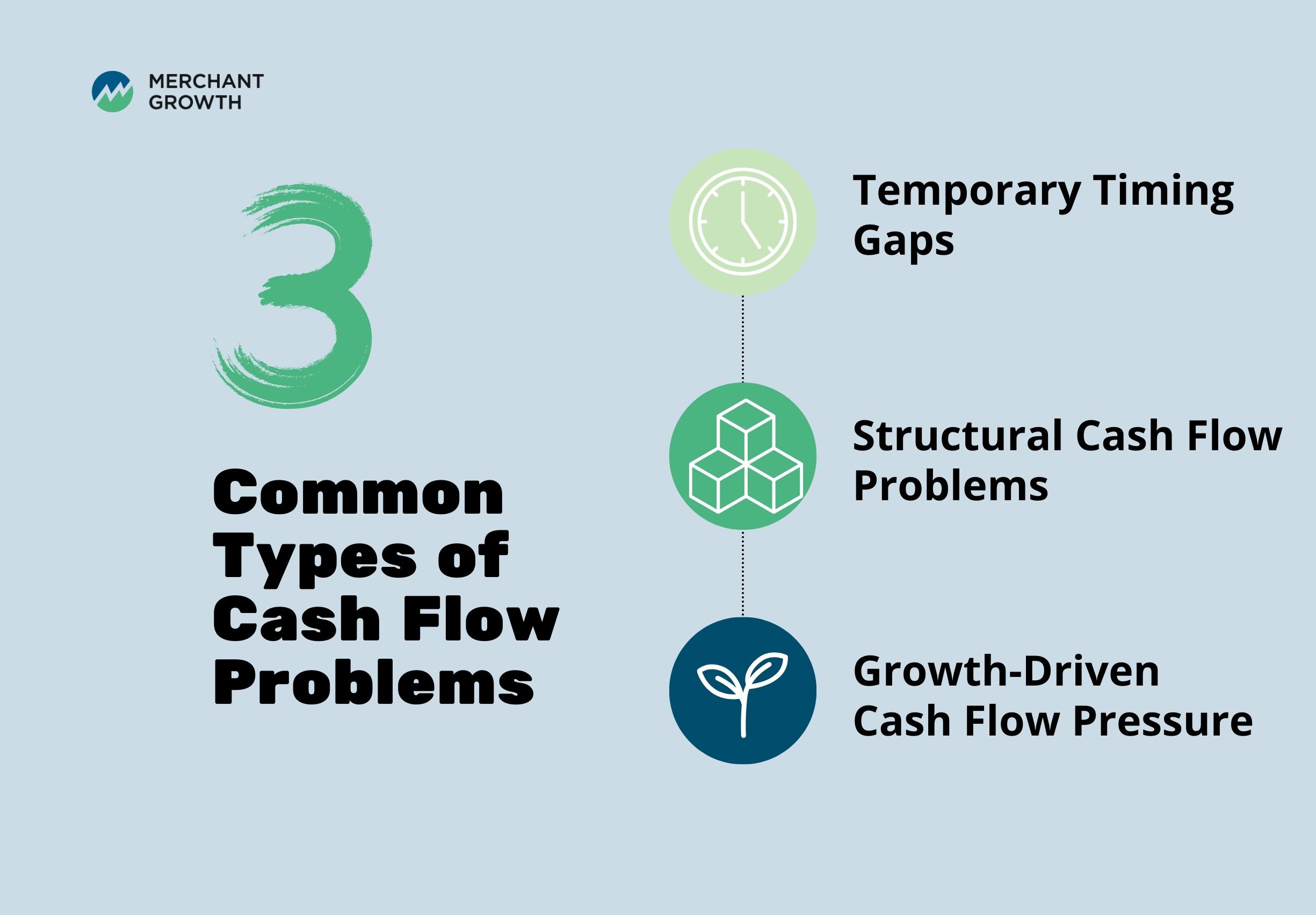
Temporary Timing Gaps
A temporary timing gap occurs when revenue is coming in, but expenses arrive sooner than expected. This is common when customers take longer to pay invoices or when sales fluctuate seasonally. In these situations, the business may simply need better payment terms or improved collections processes.
Structural Cash Flow Problems
A structural cash flow problem is more serious. In this case, operating expenses consistently exceed incoming cash. This may be caused by high overhead costs, poor pricing strategies, or inefficient operations. Solving this type of problem usually requires adjusting the underlying business model.
Growth-Driven Cash Flow Pressure
Some companies experience growth-driven cash flow pressure. Rapid expansion can require significant upfront investment before revenue increases. Purchasing inventory, hiring staff, or launching marketing campaigns all require capital. Without careful planning, even a growing business can experience cash shortages during periods of expansion.
Signs Your Business Has a Cash Flow Problem
Many businesses overlook early warning signs until the situation becomes urgent. Recognizing these signals can help prevent larger financial challenges and give business owners time to take corrective action before the problem escalates.

Common indicators of cash flow problems include:
- Difficulty paying suppliers on time
- Increasing reliance on credit or short-term borrowing to cover routine expenses
- Delaying payroll or other operational payments
- Postponing investments in equipment, marketing, or hiring
- Reducing inventory purchases due to limited cash
- Constantly reacting to short-term financial pressures instead of planning ahead
These warning signs often appear gradually, which is why they are easy to overlook at first. Paying attention to them as they come up can help businesses address cash flow challenges before they begin to disrupt day-to-day operations.
A 30-Day Plan to Stabilize Cash Flow
When a business starts running into cash flow challenges, taking a structured approach can help bring finances back under control. Instead of reacting to problems as they arise, it helps to focus on a short-term plan that prioritizes protecting available cash, bringing in revenue faster, and managing outgoing expenses. The following four-week framework outlines practical steps businesses can take to assess their financial situation, improve liquidity, and begin rebuilding a more stable cash position.

Week 1: Identify Immediate Cash Risks
Start by reviewing all outstanding invoices and identifying which payments are overdue. At the same time, prioritize essential expenses such as payroll, rent, and supplier payments. During this stage, it is also important to pause any non-essential spending so that available cash can be directed toward critical obligations.
Week 2: Accelerate Cash Inflows
Once immediate risks are identified, focus on bringing cash into the business faster. Contact customers with overdue invoices and establish clear payment expectations. Some businesses may offer small discounts for early payment or require deposits for new projects to improve cash flow timing.
Week 3: Reduce Cash Outflows
The next step is to control spending. Negotiating payment terms with suppliers can help align expenses with incoming revenue. Businesses should also review recurring expenses to determine whether any subscriptions, services, or discretionary purchases can be reduced or postponed.
Week 4: Build a Short-Term Cash Buffer
In the final stage, businesses should begin strengthening their financial resilience. Updating cash flow forecasts can help identify upcoming financial risks. Exploring short-term financing options or establishing a minimum cash reserve can also provide stability while longer-term improvements take effect.
Immediate Actions to Improve Cash Coming In
Several operational adjustments can improve cash flow relatively quickly. Many of these changes focus on accelerating incoming payments and improving the way money moves through the business. By tightening invoicing processes and making it easier for customers to pay, businesses can often shorten payment cycles and reduce delays. Small adjustments in how payments are requested and collected can make a noticeable difference in how quickly cash comes in.
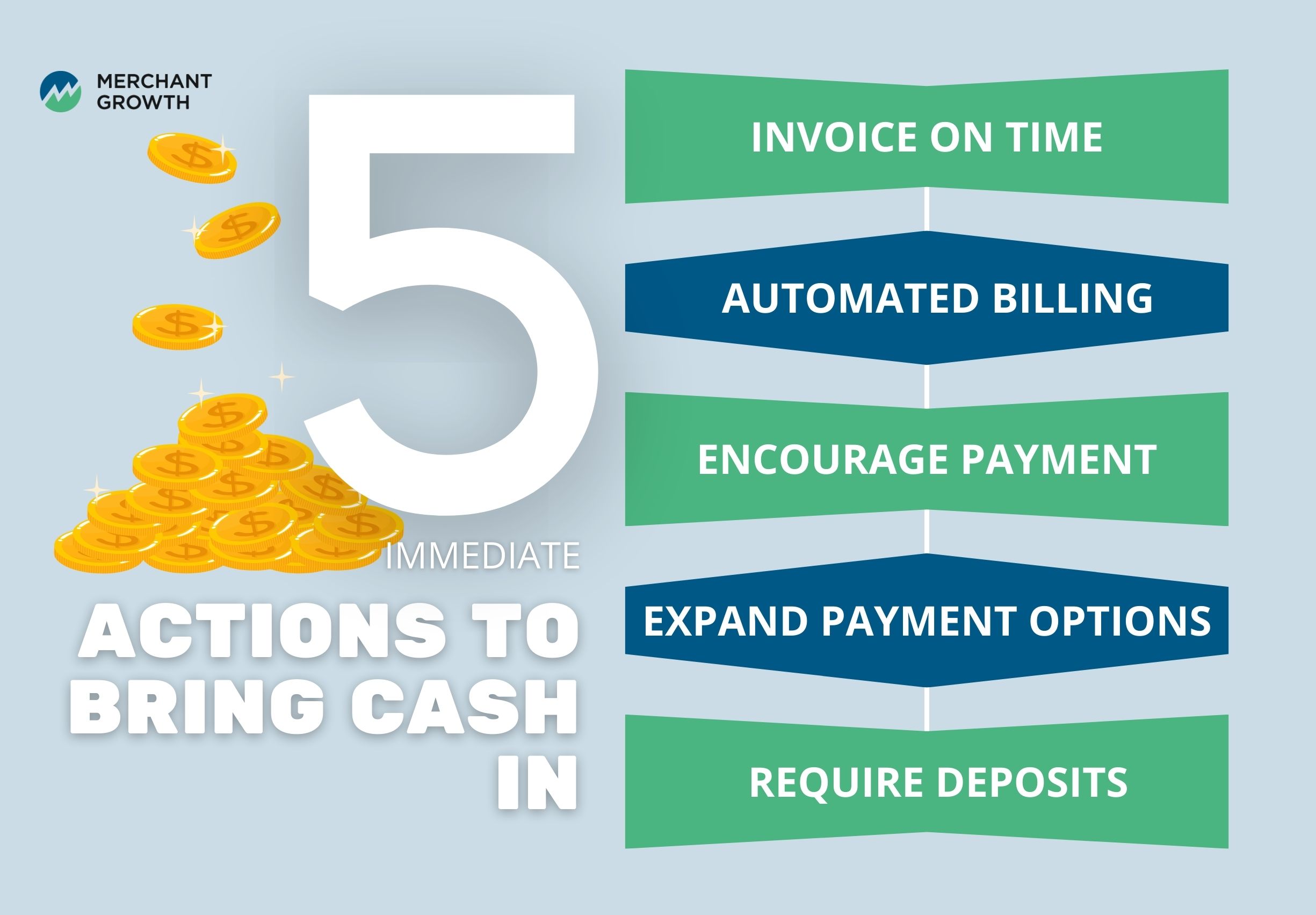
Practical steps that can help improve cash flow include:
- Send invoices immediately after work is completed. Prompt invoicing reduces delays and ensures customers receive payment requests as soon as possible.
- Use automated billing systems. Automation can streamline invoicing and help ensure invoices are sent consistently and on time.
- Encourage faster payments. Offering small discounts for early payment can motivate customers to settle invoices sooner.
- Expand payment options. Accepting credit cards or online payment platforms can make it easier for customers to pay promptly.
- Require deposits or milestone payments for larger projects. Collecting partial payments upfront helps cover initial costs before work is completed.
Strategies to Reduce Cash Outflows
While increasing revenue is important, managing expenses is equally critical for maintaining healthy cash flow. Businesses can improve financial stability by carefully controlling how and when money leaves the company. Reviewing spending patterns and adjusting payment terms can create more flexibility and help align outgoing expenses with incoming revenue. Even small changes in how costs are managed can make a meaningful difference in preserving available cash.

Ways to reduce cash outflows include:
- Negotiate longer payment terms with suppliers. Extended payment terms can help align expenses more closely with incoming revenue.
- Review and reduce non-essential spending. Evaluating discretionary expenses may reveal opportunities to cut costs without affecting core operations.
- Manage inventory levels carefully. Excess inventory ties up valuable working capital that could otherwise support daily operations.
- Delay non-critical purchases or investments. Postponing equipment upgrades or large purchases can help preserve cash during tighter periods.

Manage Your Cash Flow More Effectively
Managing cash flow effectively requires consistent attention rather than a one-time fix. Businesses that regularly monitor their finances are better able to spot potential issues early and take action before they become larger problems. Having a clear view of how money is moving in and out of the business allows owners to make more informed decisions about spending, investments, and future growth.
One of the most useful tools for maintaining control over cash flow is a forecast. By estimating future cash inflows and outflows, businesses can anticipate potential shortfalls and plan for upcoming expenses. Regularly reviewing financial reports can also reveal patterns in revenue and spending, helping business owners identify trends that may affect liquidity over time.
Preparation is another important part of strong cash flow management. Building a cash reserve can provide a financial cushion during slower periods or when unexpected expenses arise. Even a modest buffer can help businesses navigate temporary challenges without disrupting day-to-day operations. Modern accounting software and financial tools can further support this process by providing real-time insights that make it easier to track financial performance and plan ahead.

When to Consider Financing to Solve Cash Flow Problems
Even when businesses take the right steps to improve their cash flow, those changes don’t always produce results immediately. Adjusting payment terms, improving collections, or reducing expenses can take time to fully affect the flow of money through the business. In the meantime, companies still need to cover everyday costs such as payroll, supplier payments, and inventory purchases.
This is where access to additional working capital can play an important role. Financing can help businesses bridge temporary gaps in cash flow while they work on strengthening their financial processes. It may be used to cover short-term operating expenses, purchase inventory ahead of demand, or manage fluctuations in seasonal revenue.
When used thoughtfully, financing gives businesses the flexibility to keep operations running smoothly while longer-term improvements take effect. Instead of constantly reacting to short-term cash shortages, owners can focus on improving their processes, serving customers, and continuing to grow the business.
Preventing Future Cash Flow Problems
Solving cash flow problems is only part of the process. Preventing them from recurring requires consistent financial planning and ongoing monitoring. Businesses that regularly review their financial position are better able to anticipate potential challenges and make adjustments before they become serious disruptions.

Maintain a Reliable Cash Flow Forecast
Maintaining an accurate cash flow forecast allows businesses to anticipate potential shortfalls before they occur. By projecting future inflows and outflows, owners can identify periods where cash may become tight and plan accordingly. Regularly updating these forecasts also helps businesses adjust spending and investment decisions as financial conditions change.
Review Payment Terms and Expenses Regularly
Payment terms and spending patterns can have a significant impact on cash flow stability. Reviewing customer payment policies and tightening credit terms when necessary can help reduce delayed payments. At the same time, regularly monitoring expenses ensures that costs remain aligned with revenue and prevents unnecessary spending from eroding available cash.
Build a Cash Reserve
Building a financial buffer is another important step in preventing future cash flow issues. Maintaining a reserve of available cash allows businesses to absorb unexpected expenses or temporary revenue slowdowns. Even a modest reserve can provide stability and give business owners the flexibility to manage challenges without disrupting operations.

Turning Cash Flow Challenges Into Opportunities for Growth
Cash flow problems can feel overwhelming, but they are also a common part of running a business. Many companies experience periods of financial pressure as they grow, adapt to market conditions, or adjust their operations.
Businesses that take a proactive approach to managing cash flow often emerge stronger. By improving invoicing processes, controlling expenses, and forecasting future financial needs, business owners can build a more resilient financial foundation.
Merchant Growth supports Canadian small businesses by providing flexible financing solutions designed to help stabilize cash flow and support ongoing growth. Whether a business needs working capital to manage short-term expenses or funding to pursue new opportunities, access to the right financial tools can make a meaningful difference.